跳到内容

Choosing the correct spike length for self-leveling floors feels simple until a contractor punctures a fresh pour or a distributor gets a return shipment full of complaints. The wrong length doesn't just look bad — it costs rework hours and damages client trust on high-value commercial jobs. The fix starts with understanding that spike length is a scenario, not a fixed spec.
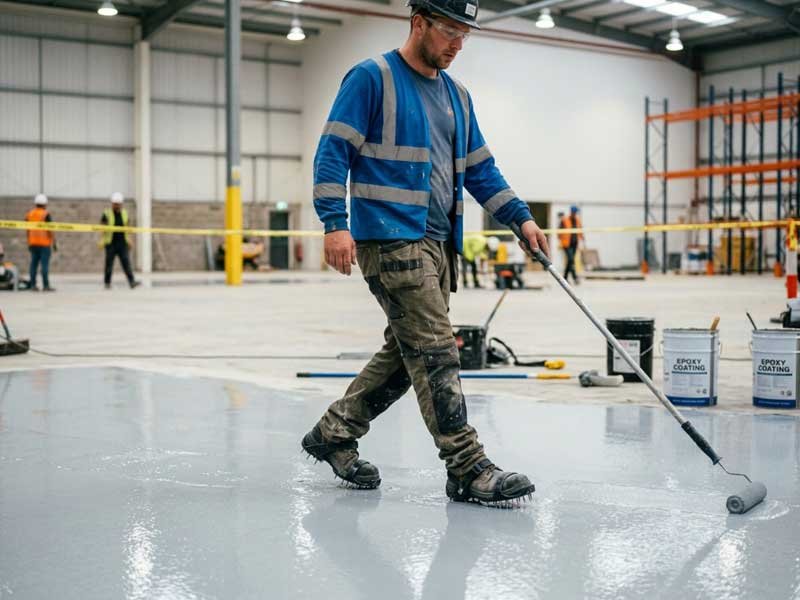
Spike length for self-leveling floors depends on three variables: the cure stage of the surface, the floor material (epoxy topcoat, self-leveling cement, or microcement), and the weight load of the worker walking on it. There is no single universal length that works across all three — matching spike geometry to the job stage matters more than picking the "longest" or "strongest-looking" spike.
Most buying mistakes happen because contractors and procurement teams treat spike length like a generic hardware spec — pick one number and move on. Below, I'll break down why that approach backfires and what actually drives the decision on real job sites.
What Determines the Right Spike Length for Self-Leveling Floors?
I've fielded a lot of customization requests over the years, and almost every buyer starts with the same question: "What's the standard length?" The honest answer is there isn't one — the floor dictates the shoe, not the other way around.
Spike length for self-leveling floors is determined by how much surface tension the material can handle at the moment a worker steps on it — not by a fixed industry number. Cure stage, material viscosity, and worker weight all shift the safe range up or down.
The Three Variables That Actually Matter
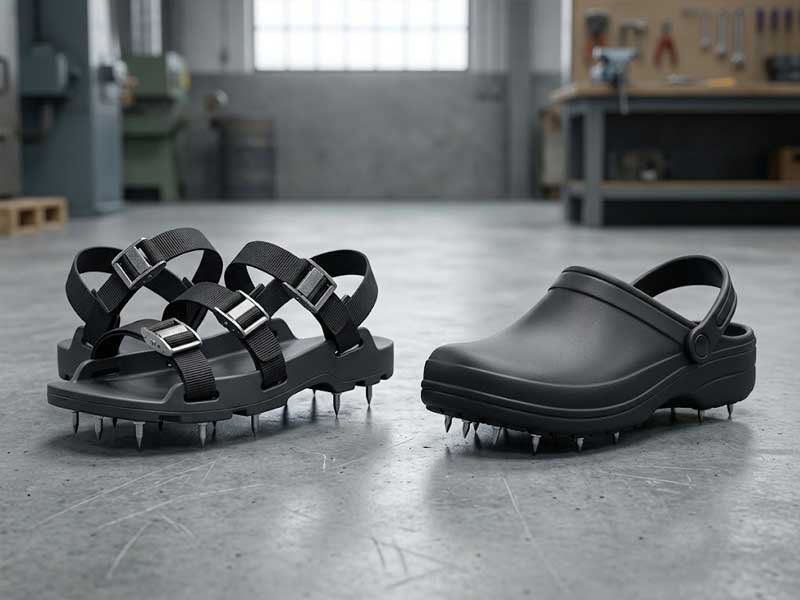
In our OEM order history, I've noticed contractors rarely ask for a length in isolation. They describe a job first, then ask what fits it. That order matters. Here's the breakdown:
- Cure stage — A surface poured 20 minutes ago behaves very differently than one setting for two hours[^1]. Early-stage pours are softer and more vulnerable to point pressure[^2].
- Floor material — Epoxy topcoats, self-leveling cement, and microcement each have different surface tension and thickness[^3]. A spike that works fine on a thick self-leveling cement pour can sink too deep into a thin microcement skim coat.
- Worker load — A 200-lb worker applies more downward force per spike than a 140-lb worker[^4]. Distributors stocking for crews with mixed body weights sometimes need a wider range in inventory, not one fixed size.
I want to be clear: I'm not citing lab-tested pressure thresholds here — those numbers should come from the flooring material manufacturer's technical sheet or a qualified applicator's field testing, not from a shoe supplier's assumption. What I can speak to is the pattern I see in real specification requests: buyers who define their cure stage and material first almost always end up happier with their order than those who ask for "the standard length" upfront.
Why Does "Longer Spike Is Safer" Fail on Self-Leveling Surfaces?
It's the most common misconception I hear from new buyers: longer spikes must mean less risk of sinking or marking the floor. That logic feels intuitive, but it ignores the part that actually matters — the tip.
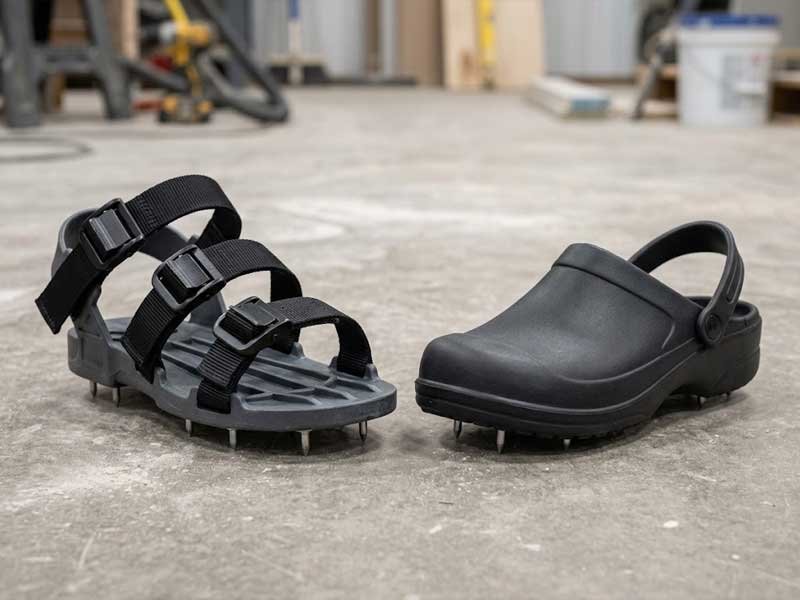
A longer spike does not automatically reduce surface damage risk. What matters more is the tip contact area and geometry relative to the floor's current cure state. A long spike with the wrong tip shape can still puncture a soft surface, while a shorter spike with the right tip geometry can distribute weight safely[^5].
Contact Area Beats Length
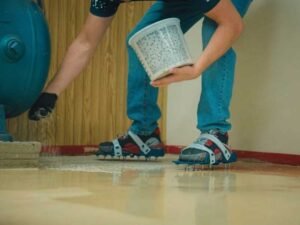
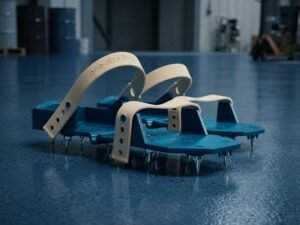
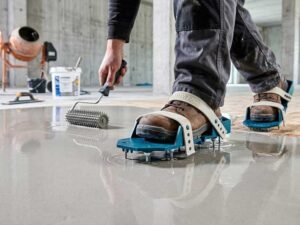
Think of it like snowshoes versus stiletto heels. Length isn't the variable that spreads weight — surface area is.[^6] A spike shoe is designed to minimize ground contact so the worker can walk across wet material without leaving footprints, but the tip still needs enough width or contact-point count to avoid concentrated pressure.
Here's a simplified way I explain it to buyers evaluating samples:
| Spike Characteristic | Effect on Surface |
|---|---|
| Long spike, narrow tip | High risk of localized puncture on soft cure stages |
| Short spike, wider multi-point tip | Better weight distribution, lower puncture risk |
| Correct length + correct tip for material | Matches cure stage, minimizes marking |
I've seen buyers request extra-long spikes assuming it would "keep them further from the floor," when what they actually needed was a tip redesign for a specific material. This is a common early-stage misstep, and it's usually caught in a sample-review round before mass production — which is why I always recommend requesting a physical sample against the actual floor material before locking in a bulk order.
If you're unsure which tip geometry fits your material, ask your supplier for a sample test on an offcut of the actual floor surface — not just a general demo pour.
How Does Floor Material Change Spike Length Requirements?
Contractors sometimes assume "leveling shoes" are one product category. In practice, epoxy topcoats, self-leveling cement, and microcement behave differently enough that spike length needs vary by material family.
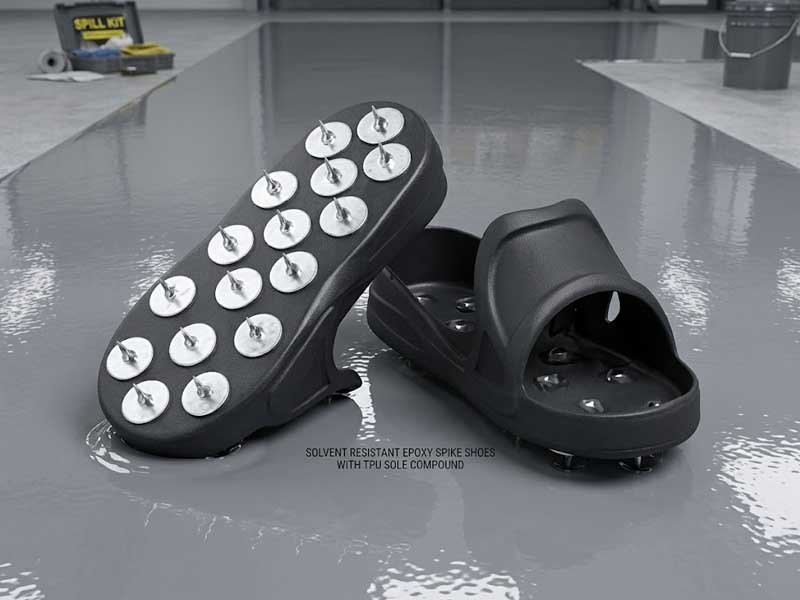
Floor material changes spike length requirements because each material category has different thickness, viscosity, and set time. Epoxy topcoats are typically thinner and set faster than self-leveling cement[^7], while microcement demands a lighter touch due to its thin application layer.
Matching Category to Application Stage
I'll break this down by what I've seen requested most often in our order history — again, not lab data, just observed patterns from real B2B customization requests:
- Epoxy topcoat contractors — These jobs often involve thinner pours and faster set times. Buyers in this category tend to request shorter, tighter-tip spikes to avoid dragging or dimpling a surface that's setting up quickly.
- Self-leveling cement crews — This material is usually poured thicker, giving workers a slightly wider safety margin. Requests here trend toward mid-range lengths, sometimes paired with wider strap support for stability on uneven early-stage surfaces.
- Microcement applicators — Because microcement layers are thin — often just a few millimeters[^8] — buyers in this niche are the most cautious about spike length. Over-length spikes here carry real puncture risk, so shorter, precision-tip designs come up frequently in customization conversations.
The mistake I see most often is a distributor stocking one "universal leveling shoe" SKU and trying to sell it across all three contractor types. It works for none of them particularly well. If your customer base spans multiple flooring categories, it's worth stocking — or requesting OEM development for — at least two spike profiles rather than forcing one spec to fit every job.
What's the Right Question to Ask Before Choosing Spike Length?
Buyers often come to us asking, "What length should I order?" That's the wrong starting question, and it usually leads to a mismatch. The better question reframes the whole decision.
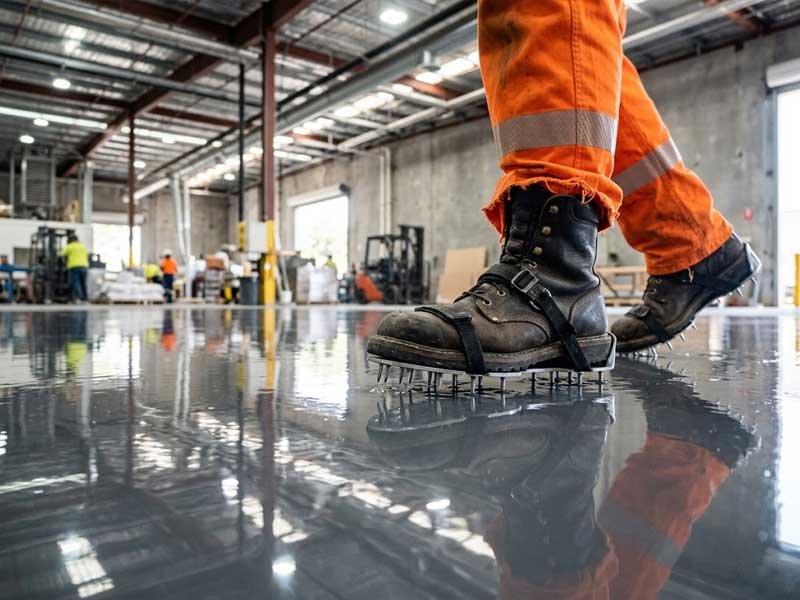
The right question isn't "what spike length should I buy" — it's "what floor system and cure stage am I working on?" Answering that first narrows the safe spike-length range naturally, and it's the filter procurement teams should apply before requesting a spec sheet from any supplier.
A Practical Filter Before You Order
I always ask three follow-up questions when a new B2B buyer requests spike shoes, and I'd recommend asking yourself the same before contacting any supplier:
- What material family is the crew applying? (Epoxy, self-leveling cement, microcement, or something else entirely.)
- At what point in the cure cycle will workers be walking on it? Early leveling stage, mid-set touch-up, or near-final inspection walk?
- What's the average worker weight and boot size range? This affects strap sizing and overall shoe stability, not just spike length.
Once those three answers are clear, spike length selection becomes a much narrower, safer conversation. Procurement teams sourcing for multiple contractor clients sometimes find it useful to build a simple internal reference sheet — material type on one axis, cure stage on the other — so their sales team can recommend the right SKU without guessing.
This reframing matters most for distributors buying in bulk. Ordering the wrong spike profile at volume isn't a small mistake — it can mean a container of stock that doesn't fit your actual customer base's job types. Asking the material-and-stage question upfront, before any length number gets discussed, is the single biggest thing I've seen prevent costly reorders.
When Do Contractors Need Custom Spike Length Development?
Standard off-the-shelf spike lengths cover the common cases well. But some job types fall outside that range entirely, and forcing a standard product onto a non-standard job usually ends in a comeback complaint.
Custom spike length development is typically needed for specialized applications like FRP lining or PU roofing waterproofing, where standard self-leveling shoe specs don't match the surface thickness, chemical exposure, or texture requirements of the job.
Where Standard Specs Run Out
From an OEM sourcing standpoint, I've seen a handful of recurring categories where clients move past standard catalog options and request custom development:
- FRP lining work — Fiberglass-reinforced plastic surfaces often need spike materials resistant to specific resin chemicals[^9], plus length adjustments for the lining's unique texture.
- PU roofing waterproofing — Roofing membranes cure differently than floor coatings, and the work surface angle (roofs aren't flat) sometimes changes strap and spike stability needs[^10].
- High-volume epoxy contractors with proprietary mixes — Some larger flooring companies use custom resin blends with unique set times, and they eventually request a length profile calibrated for their specific product line.
If your job or your client base falls into one of these categories, it's worth having a direct conversation with your supplier about custom spike length and tip geometry — rather than trying to make a catalog item work. This isn't about needing a premium tier of product; it's simply that specialized surfaces need specialized geometry, the same way a screwdriver bit needs to match its screw head[^11].
[^1]: "Testing of Selected Self-Leveling Compounds for Floors", https://nvlpubs.nist.gov/nistpubs/Legacy/IR/nistir5633.pdf. Technical literature on cementitious self-leveling compounds documents that initial setting typically begins within 15–30 minutes of mixing, with surface hardness increasing progressively through hydration; the material's resistance to point-load deformation changes substantially across these early cure phases. Evidence role: mechanism; source type: research. Supports: Self-leveling cementitious compounds undergo rapid changes in viscosity and surface hardness during the first hours after pouring, with distinct early, intermediate, and final cure stages affecting mechanical vulnerability. Scope note: Exact cure timelines vary by product formulation, ambient temperature, and humidity, so specific thresholds should be confirmed against the manufacturer's technical data sheet.
[^2]: "Testing of Selected Self-Leveling Compounds for Floors", https://nvlpubs.nist.gov/nistpubs/Legacy/IR/nistir5633.pdf. Research on cementitious self-leveling compounds shows that compressive strength development follows a characteristic hydration curve, with minimal mechanical resistance in the first 30–60 minutes after placement and progressive hardening over subsequent hours; early-stage surfaces are therefore highly susceptible to indentation and point-load damage. Evidence role: mechanism; source type: research. Supports: Cementitious self-leveling compounds develop compressive strength progressively during hydration, with very low resistance to mechanical loading in the first minutes to hours after placement. Scope note: Strength development rates vary significantly by product formulation, ambient temperature, and humidity; specific vulnerability windows should be confirmed with the material manufacturer's data.
[^3]: "Self-leveling concrete", https://en.wikipedia.org/wiki/Self-leveling_concrete. Rheological studies of cementitious self-leveling compounds show that their flow behavior, viscosity, and surface characteristics are governed by water-to-cement ratio, polymer additives, and aggregate content, all of which differ substantially between thick self-leveling pours and thin microcement coating systems. Evidence role: mechanism; source type: research. Supports: Self-leveling cementitious compounds and microcement differ in rheological properties including viscosity and surface tension, which affect how they respond to point loads during the uncured state. Scope note: The term 'surface tension' in this context is used colloquially to describe resistance to deformation rather than in the strict fluid-mechanics sense; precise rheological comparisons require product-specific testing.
[^4]: "Pressure distribution measurements for evaluation of ...", https://pubmed.ncbi.nlm.nih.gov/11081245/. Basic mechanics dictates that the load per contact point equals total applied force divided by the number of supporting points; a 200-lb worker on spiked shoes with, for example, 13 spikes per sole in contact would exert approximately 15.4 lb per spike, versus approximately 10.8 lb per spike for a 140-lb worker on the same shoes. Evidence role: mechanism; source type: education. Supports: The force exerted per spike is the worker's total weight divided by the number of spikes in contact with the surface at any given moment, meaning a heavier worker exerts proportionally more force per spike. Scope note: Actual per-spike loading depends on gait dynamics, number of spikes in simultaneous contact, and weight distribution, which vary in practice from static calculations.
[^5]: "Assessing point load strength in irregular phyllite via an ... - PMC", https://pmc.ncbi.nlm.nih.gov/articles/PMC12077679/. Hertzian contact mechanics establishes that the stress field beneath a loaded contact point is governed primarily by the contact geometry (tip radius, shape) and applied force, not by the indenter's length; a blunter or wider tip distributes the same load over a larger area, reducing peak contact pressure and puncture risk. Evidence role: mechanism; source type: education. Supports: Contact mechanics (including Hertzian contact theory) demonstrates that the geometry of a contact point — particularly its radius and shape — determines the stress distribution on a surface, with sharper or narrower tips producing higher localized stresses regardless of the indenter's overall length. Scope note: Hertzian theory assumes elastic, homogeneous materials; partially cured cementitious or polymer surfaces are viscoelastic and heterogeneous, so the theory provides directional guidance rather than exact predictions for this application.
[^6]: "Pressure", https://en.wikipedia.org/wiki/Pressure. Per the fundamental physics relationship P = F/A, pressure is defined as force per unit area; reducing the contact area (as with a narrow spike tip) increases localized pressure on the substrate, independent of the spike's overall length. Evidence role: mechanism; source type: encyclopedia. Supports: Pressure exerted on a surface is inversely proportional to the contact area over which force is distributed (P = F/A), meaning a smaller contact point creates higher localized pressure regardless of the object's length.
[^7]: "How Thick Is Epoxy Flooring & Why Does It Matter?", https://armorgarage.com/blog/how-thick-is-epoxy-flooring-why-does-it-matter/?srsltid=AU7gw4Wc_Z6L8jkcNbjaZHL55ZE3ulqK2bxQDE1HfdCmc-g0KxNBPNFA. Industry technical guides indicate that epoxy floor coatings are typically applied at film thicknesses of 0.5–3 mm with pot lives of 20–45 minutes, whereas cementitious self-leveling compounds are commonly poured at 3–25 mm with longer working times before initial set. Evidence role: general_support; source type: research. Supports: Epoxy floor topcoats are generally applied at thinner film builds (often 0.5–3 mm) and reach initial cure faster than cementitious self-leveling compounds, which are typically poured at 3–25 mm or more. Scope note: Thickness and cure time ranges vary widely by specific product formulation and environmental conditions; these are general category comparisons rather than universal specifications.
[^8]: "Our Microcement Guide", https://www.semcosurfaces.com/insights/microcement-guide. Technical product literature for microcement systems consistently describes total application thicknesses in the range of 2–3 mm, applied in multiple thin coats over a prepared substrate. Evidence role: definition; source type: research. Supports: Microcement is a thin decorative coating system typically applied in layers totaling 2–3 mm in thickness. Scope note: Exact thickness depends on the specific microcement product system and number of coats applied; some systems may be slightly thinner or thicker.
[^9]: "FRP vs. Other Tank Lining Materials: A Comparison Guide", https://americanfiberglasstank.com/feeds/blog/frp-vs-rubber-lined-tank. FRP lining systems employ thermosetting resins such as polyester, vinyl ester, and epoxy that are chemically reactive during application; tools and accessories in direct contact with uncured resin must be compatible to avoid degradation or contamination of the laminate. Evidence role: general_support; source type: research. Supports: FRP lining systems use reactive resins (polyester, vinyl ester, epoxy) that can degrade certain plastics and metals, requiring tools in contact with uncured resin to be chemically compatible. Scope note: Chemical resistance requirements depend on the specific resin system used; not all FRP resins pose the same compatibility challenges for all spike materials.
[^10]: "The Pros and Cons of Urethane Roof Coatings", https://www.americanweatherstar.com/insights/pros-and-cons-of-urethane-roof-coatings/. Polyurethane liquid waterproofing membranes typically cure via moisture-initiated polymerization, producing different surface-hardening profiles than cementitious self-leveling compounds or epoxy floor coatings; application on pitched or sloped roof surfaces further alters the biomechanical demands on workers' footwear and accessories. Evidence role: general_support; source type: research. Supports: Polyurethane liquid-applied roofing membranes cure through moisture reaction rather than the hydration or chemical crosslinking typical of cementitious or epoxy floor systems, and their application on sloped substrates introduces different traction and stability demands for workers and tools. Scope note: PU membrane formulations vary (one-component moisture-cure vs. two-component), so cure behavior generalizations may not apply uniformly across all products.
[^11]: "Notes for Math 599: Contact geometry", https://www.math.ucla.edu/~honda/math599/notes.pdf. Fundamental engineering design principles establish that the geometry of a tool's contact interface must be compatible with the properties of the workpiece to ensure effective force transmission and prevent surface damage — a principle applicable from fastener drive systems to surface-finishing tools. Evidence role: general_support; source type: education. Supports: Engineering design principles hold that tool contact geometry must be matched to the workpiece or substrate characteristics to achieve optimal force transfer and minimize damage. Scope note: This is a broad engineering principle applied by analogy; direct academic literature specifically addressing spike shoe geometry matching to flooring substrates is limited.
[^12]: "Process Validation: General Principles and Practices", https://www.fda.gov/files/drugs/published/Process-Validation--General-Principles-and-Practices.pdf. ISO 9001 and general quality management frameworks emphasize design and development validation under conditions that simulate or replicate actual use, including testing prototypes against representative materials and environments before production approval. Evidence role: expert_consensus; source type: institution. Supports: Quality management and product development best practices recommend validating prototypes or samples against actual end-use conditions and materials before committing to full production. Scope note: This is a general quality management principle; no specific industry standard exists for spike shoe validation against flooring substrates specifically.