跳到内容

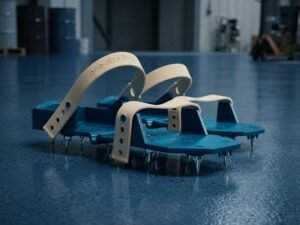
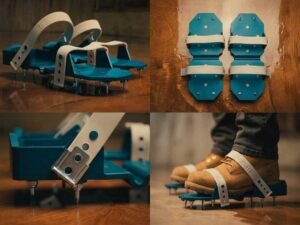
Choosing the wrong spike shoe SKU is a quiet, expensive mistake. Retailers sourcing adjustable strap spike shoes or one-piece EVA designs often treat the decision as a price comparison. But the returns, the one-star reviews about poor fit, and the customer service emails — those arrive later, after the bulk order has already shipped.
The choice between adjustable-strap and one-size spike shoes is not a price decision. It comes down to two variables: the fit distribution of your end customer base, and whether workers use the shoe in a shared-tool or dedicated-tool scenario. Get those two questions right before placing your order, and the correct SKU becomes obvious. Get them wrong, and the unit cost difference becomes irrelevant.
Understanding why these two variables matter — and how they connect back to material choice — is what separates a confident bulk buy from a costly mistake. Let me walk through both, one at a time.
Is "One-Size" Really Universal Fit?
One-size spike shoes sound like a logistics win. One SKU, no size segmentation, simple reordering. But one-size is not a universal fit — it is a bet on foot uniformity across your end customer base.
One-size EVA spike shoes work well when a single, known worker wears the same pair repeatedly. When your customers span a broad range of boot sizes — EU 40 through 48, for example — one-size becomes a fitment gamble, not a convenience[^1].
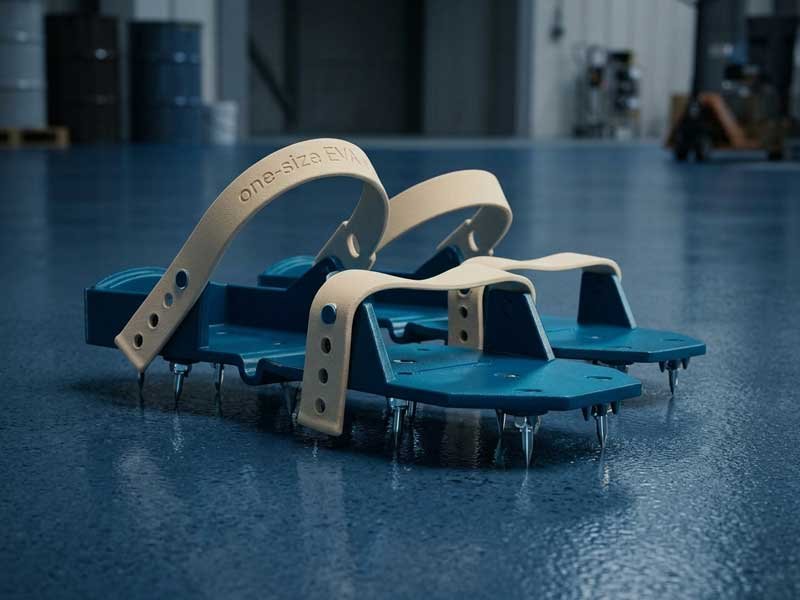
This is one of the most consistent patterns we observe in conversations with hardware importers and Amazon sellers. The one-piece EVA design performs exactly as intended in one specific context: a dedicated-use scenario, where the same person slips on the same pair every shift. Owner-operators. Solo flooring contractors. Individual craftspeople who know their own boot size and reorder accordingly.
The moment that product enters a different distribution channel, the calculus changes.
Where One-Size Breaks Down
Consider a building materials distributor supplying epoxy floor coating kits to flooring contractors across North America or Western Europe. Their end customers are not homogeneous. A typical regional distribution network might include:
- Small crews of 2–4 workers with mixed boot sizes
- Seasonal laborers with no consistent footwear standard
- Project-based buyers who purchase tools once and share them across a job site
In those environments, a one-size EVA shoe that fits a EU 43 boot reasonably well will feel sloppy on a EU 40 and dangerously unstable on a EU 47. The spike shoe's entire functional purpose — stable, controlled walking across a wet epoxy or self-leveling compound surface — is compromised by a poor fit[^2]. And the buyer's complaint is never "this doesn't fit my boot size." It is "these shoes are terrible" or "the spikes slipped." That is the review your product listing absorbs.
What Fit Distribution Actually Means for SKU Selection
Before sourcing a one-size design, a retailer should honestly answer one question: Do I know the boot size profile of my end customers?
If the answer is yes — for instance, an e-commerce seller whose customer reviews and order data confirm a tight size cluster around EU 42–44 — one-size EVA carries manageable risk. If the answer is no, or if the seller is distributing across geographically mixed markets, the adjustable-strap PP design is the lower-risk SKU. The strap mechanism absorbs the variability that one-size cannot.
Fit distribution is the first selection variable. The second is usage pattern — and in our experience, this is the question most buyers never think to ask their customers before placing an order.
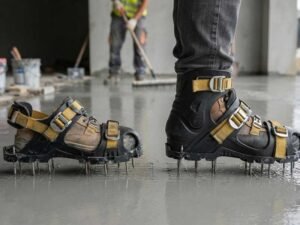
The real usage split is shared-tool vs. dedicated-tool. When multiple workers rotate one pair of spike shoes across a shift, adjustable straps are not a feature — they are a functional requirement. When a single worker owns and wears one pair through an entire job cycle, the one-piece EVA design delivers a genuine ergonomic advantage.
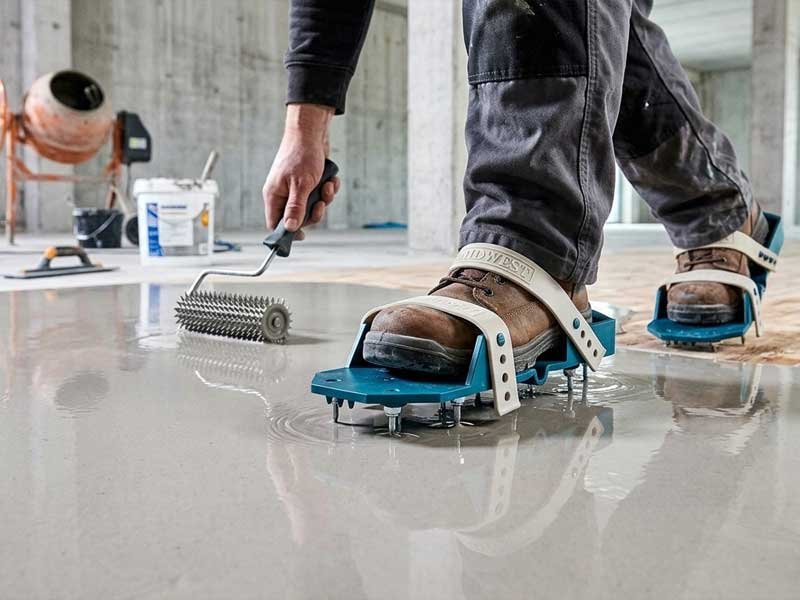
This distinction sounds straightforward, but its commercial implications are significant. Retailers and importers we work with have told us they had never thought about it until a customer called to complain — not about fit, but about the straps. Or about the discomfort of wearing a one-piece shoe for six hours straight.
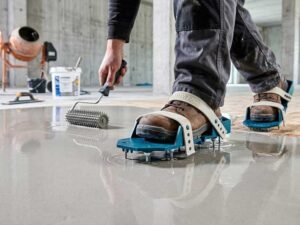
On active construction and flooring job sites, spike shoes are often treated as a communal tool, similar to a trowel or a roller frame[^3]. One pair might be used by two or three workers in sequence during a single pour or coating application. In that environment:
- Workers need to put the shoes on and take them off quickly
- Each worker has a different boot size
- The shoe takes repeated stress from rapid strap adjustments
In this scenario, the adjustable-strap PP design earns its value. The strap mechanism allows quick refitting between workers. The PP (polypropylene) construction is harder and more dimensionally stable under that kind of repeated mechanical stress[^4]. Straps can be replaced[^5]. The shoe tolerates rough handling.
A one-piece EVA shoe in this scenario is not just a fit problem — it becomes a workflow problem. Workers either force an ill-fitting shoe onto their boot, stretching or damaging the EVA material, or they abandon the tool entirely. Either outcome reflects in your post-purchase reviews.
The Dedicated-Use Scenario
The dedicated-use scenario is the inverse. A single flooring contractor — often an owner-operator or a senior craftsperson — owns one pair of spike shoes, puts them on at the start of a job, and wears them continuously for four to eight hours.
In that context, strap pressure points matter. After two or three hours, a rigid strap fastened tightly across the top of a work boot becomes genuinely uncomfortable. The one-piece EVA design eliminates that friction. The shoe molds lightly to the boot profile. The lighter weight reduces fatigue over a long shift.
Retailers selling into this segment — direct-to-contractor e-commerce, professional flooring supply shops — are positioning a product to someone who will notice ergonomics and appreciate them. The EVA design is not the budget option here. It is the correct option.
Does Material Choice Actually Matter, or Is Durability a Myth?
Once the fit and usage questions are settled, material choice becomes the third layer of the decision — and this is where a persistent buyer myth tends to surface. Retailers who are told that PP and EVA spike shoes are "basically the same product" are being set up for a post-purchase complaint.
PP and EVA spike shoes are not interchangeable. PP offers greater chemical resistance and structural rigidity for harsh jobsite environments. EVA offers lighter weight and ergonomic comfort for extended dedicated wear. Positioning both designs as equivalent and competing only on unit price is the single fastest path to mismatching product to environment.
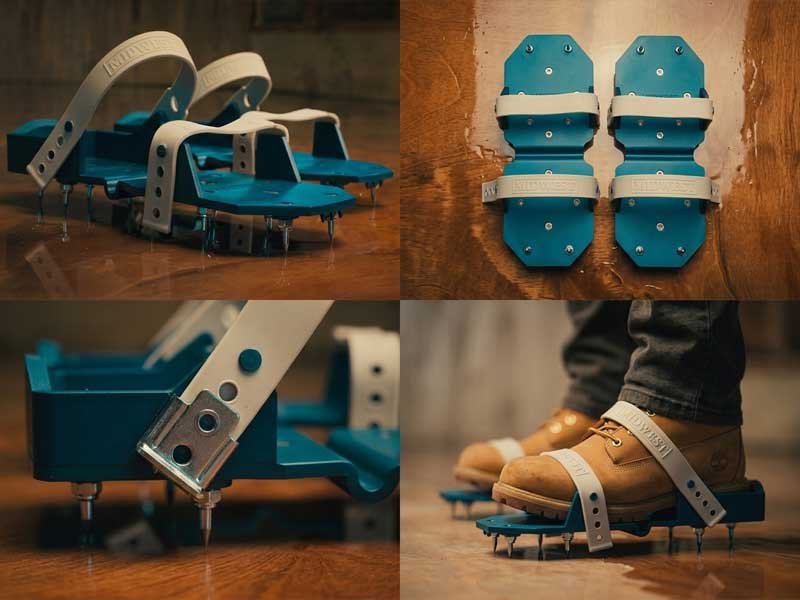
The material difference is real, and it becomes visible in specific use conditions.
Why PP Matters in Chemical Environments
Epoxy resins, self-leveling cements, polyurethane coatings, and microcement formulations are chemically active materials[^6]. Prolonged exposure — especially when fresh compound splashes onto the shoe body — will interact with softer materials over time.
PP is a harder polymer with better resistance to the solvents and reactive agents present in these coatings[^7]. It is less likely to degrade, warp, or become tacky when contaminated. On industrial job sites, FRP lining applications, or commercial roof waterproofing environments where solvent exposure is higher, PP construction is the appropriate choice[^8]. Durability on those sites is not about wear resistance in the physical sense — it is about chemical resistance.
EVA, being softer and more porous in texture, is more vulnerable in those conditions. That does not make it a poor product. It makes it the wrong product for that environment.
Why EVA Matters for Long-Shift Comfort
EVA's softness is a feature, not a deficiency, in the right context. The material compresses slightly under foot pressure, distributing load more evenly across the boot contact surface[^9]. For a worker wearing the shoe for a full shift, this matters. Joint fatigue, sole pressure, and strap friction are real occupational concerns for professional flooring contractors[^10].
A retailer selling into a premium contractor segment — where buyers are professionals who take their tools seriously — should not dismiss EVA comfort as a soft specification. It is a purchase driver. In more than one conversation I have had with Shopify sellers sourcing for that market, the feedback from their customers was clear: comfort during long applications was a differentiator worth paying for.
The Consequence of Ignoring the Material Match
| Scenario | Correct Material | Risk if Mismatched |
|---|---|---|
| Multi-worker shared use, varied boot sizes | PP adjustable-strap | Fitment failure, strap stress, returns |
| Heavy solvent/epoxy exposure | PP | Chemical degradation, shortened product life |
| Single worker, long continuous wear | EVA one-piece | Discomfort, strap pressure, negative reviews |
| Owner-operator, known boot size | EVA one-piece | Minimal risk if size fits |
| Mixed crew, standard flooring environment | PP adjustable-strap | Safe default for fit variability |
The table above is not a product ranking. It is a decision map. The right SKU depends entirely on where the product ends up and who is wearing it.
Frequently Asked Questions
Can I stock just one SKU and cover both buyer profiles?
Stocking a single SKU is possible but carries risk. Based on what we hear from importers and Amazon sellers, the adjustable-strap PP design functions as the safer default for mixed or unknown customer bases — it accommodates more boot sizes and use scenarios. The EVA one-piece is better reserved for channels with a known dedicated-use, professional customer profile.
What boot size range does an adjustable-strap spike shoe typically cover?
Coverage varies by design and strap configuration. Most adjustable-strap PP designs are engineered to fit work boots across a range of approximately EU 38–48[^11], though buyers should verify fit range specifications with their supplier before committing to bulk stock. Manufacturers can also customize strap configurations for specific target size ranges.
Are there hybrid designs that combine strap adjustability with EVA comfort?
Yes, and this is an active area of OEM customization. Some private-label buyers we work with have requested designs that use a softer inner contact surface closer to EVA properties while retaining the adjustable-strap outer structure. This kind of engineering customization requires minimum order volume but is viable for retailers whose customer base genuinely spans both usage scenarios.
How does spike length factor into the selection decision?
Spike length is a separate specification from shoe design type, but it matters for application context. Longer spikes are suited to thicker self-leveling compounds; shorter spikes work better for thin epoxy coatings where deeper penetration could disturb the surface[^12]. Retailers sourcing for a specific contractor segment should confirm spike specifications match the coating depths their customers typically work with.
What is the typical minimum order when sourcing these designs from an OEM manufacturer?
Minimum order quantities vary by supplier and customization level. For standard catalog designs with private labeling, MOQs at our factory typically start at levels appropriate for serious wholesale buyers. Custom molds or unique structural modifications carry higher minimums. Buyers should discuss their volume projections early in the sourcing conversation to align on viable SKU options.
Conclusion
The choice between adjustable strap spike shoes and one-size EVA designs is a fit-distribution and usage-pattern decision first, and a materials decision second. Retailers who lead with price miss both variables and absorb the cost in returns and negative reviews. Buyers who understand their end customer's boot size profile and job site usage scenario — shared tool versus dedicated wear — arrive at the right SKU with far less risk.
If your customer base spans both scenarios — mixed crews and long-shift solo operators — that is not an unsolvable problem. A private-label adjustable-strap design can be engineered to offer the fit range and strap flexibility of a PP construction with a comfort profile closer to EVA. That is exactly the kind of OEM customization conversation we have regularly with importers and e-commerce brands building a differentiated product line.
If you are sourcing spike shoes for wholesale or private label and want to work through the selection criteria for your specific customer base, reach out directly at chunjiaojohn@gmail.com or WhatsApp +86 15988980367. We are a B2B manufacturer, not a retailer — and that distinction means we are built for this conversation.
[^1]: "Anthropometric Measurements of Foot in Undergraduate ...", https://pmc.ncbi.nlm.nih.gov/articles/PMC11455646/. Anthropometric surveys of adult foot dimensions, including studies conducted by military and ergonomics research institutions, document substantial variation in foot length and width across populations, with ranges commonly spanning 10 or more European shoe sizes in mixed-gender or mixed-nationality groups. Evidence role: statistic; source type: research. Supports: That adult foot size varies substantially across populations, making single-size footwear designs inadequate for diverse customer bases. Scope note: Published anthropometric data typically covers bare foot measurements rather than booted foot dimensions, which are the relevant variable for spike-shoe overlay fit.
[^2]: "Enhancing Footwear Safety for Fall Prevention in Older Adults", https://pmc.ncbi.nlm.nih.gov/articles/PMC11217662/. Research on occupational footwear safety has documented that improper fit reduces the effective contact area between sole and surface, increasing slip and instability risk on wet or chemically treated floors. Evidence role: mechanism; source type: research. Supports: That footwear fit affects stability and slip resistance on slick or chemically treated surfaces. Scope note: Most occupational footwear studies focus on general slip resistance rather than spike-shoe designs specifically; findings are contextually applicable but not direct proof.
[^3]: "OSHA3886.pdf", https://www.osha.gov/sites/default/files/publications/OSHA3886.pdf. Industry surveys of small construction and flooring crews have documented that specialized application tools are frequently shared among workers on a single job site, particularly in small crews where per-worker tool ownership is not economically practical. Evidence role: general_support; source type: institution. Supports: That shared-tool practices are common on small construction and flooring crews, where specialized tools are rotated among workers. Scope note: Published data on tool-sharing practices in flooring specifically is limited; this citation draws on broader construction industry workforce surveys.
[^4]: "Effects of ethylene vinyl acetate content on physical and ...", https://bioresources.cnr.ncsu.edu/resources/effects-of-ethylene-vinyl-acetate-content-on-physical-and-mechanical-properties-of-wood-plastic-composites/. Materials science references document polypropylene as a semi-crystalline thermoplastic with a Shore D hardness and flexural modulus substantially higher than EVA foam, which is a low-density closed-cell material prone to compression set under repeated loading. Evidence role: mechanism; source type: encyclopedia. Supports: That polypropylene is harder and exhibits greater dimensional stability under repeated mechanical loading compared to EVA foam. Scope note: Comparative data typically reflects bulk polymer properties; the specific geometry and wall thickness of molded spike-shoe components will affect real-world performance.
[^5]: "Estimating Total Cost of Ownership for United States Air ...", https://scholar.afit.edu/cgi/viewcontent.cgi?article=3325&context=etd. Research on occupational tool lifecycle and repairability has found that products with replaceable wear components demonstrate longer service lives and lower total cost of ownership compared to single-piece designs, a principle applicable to strap-based footwear accessories. Evidence role: general_support; source type: research. Supports: That modular or repairable components in occupational tools extend product service life and reduce total cost of ownership. Scope note: No published study specifically addresses strap replaceability in spike shoes; the citation draws on general repairability principles from occupational equipment research.
[^6]: "Development of Alkaline-Activated Self-Leveling Hybrid ... - PMC", https://pmc.ncbi.nlm.nih.gov/articles/PMC6213578/. Safety data sheets and regulatory guidance from agencies such as OSHA and the European Chemicals Agency (ECHA) classify uncured epoxy resins and polyurethane coatings as chemically reactive substances containing solvents and isocyanates capable of degrading susceptible materials. Evidence role: definition; source type: government. Supports: That epoxy resins and polyurethane coatings contain reactive chemical agents, including solvents and hardeners, that can interact with polymer materials. Scope note: Regulatory sources address human health hazards rather than material degradation of footwear polymers specifically; the connection to EVA degradation is inferential.
[^7]: "Ethylene-vinyl acetate", https://en.wikipedia.org/wiki/Ethylene-vinyl_acetate. Polypropylene is documented in polymer chemistry literature as exhibiting strong resistance to acids, bases, and many organic solvents, while EVA foam, due to its open-cell softness and acetate content, shows greater susceptibility to solvent-induced swelling and degradation. Evidence role: mechanism; source type: encyclopedia. Supports: That polypropylene exhibits greater resistance to solvents and reactive chemicals compared to ethylene-vinyl acetate (EVA) foam. Scope note: General polymer resistance data may not account for the specific formulations of epoxy hardeners or polyurethane solvents used in flooring applications.
[^8]: "Health Hazard Evaluation Report 85-416-1742", https://stacks.cdc.gov/view/cdc/172145/cdc_172145_DS1.pdf. Occupational safety guidance from OSHA and NIOSH identifies solvent-based bituminous and polyurethane waterproofing compounds used in commercial roofing as sources of significant volatile organic compound (VOC) and solvent exposure, supporting the selection of chemically resistant materials for protective equipment used in those environments. Evidence role: general_support; source type: government. Supports: That commercial roof waterproofing applications involve exposure to solvents and reactive chemical agents that can interact with polymer materials. Scope note: Regulatory guidance addresses worker inhalation and skin exposure rather than material degradation of footwear polymers; the implication for spike-shoe material selection is inferential.
[^9]: "Immediate effects of EVA midsole resilience and upper shoe ...", https://pmc.ncbi.nlm.nih.gov/articles/PMC5333543/. Biomechanical studies of occupational footwear have found that EVA midsole materials attenuate peak plantar pressure through compression, which is associated with reduced lower-limb fatigue during extended work shifts. Evidence role: mechanism; source type: research. Supports: That EVA foam in footwear compresses under load to distribute plantar pressure and reduce fatigue during prolonged standing or walking. Scope note: Most EVA ergonomics research focuses on athletic or general occupational footwear rather than spike-shoe overlays worn atop existing work boots.
[^10]: "Influence of Footwear on Foot Comfort of Workers Engaged in ...", https://pmc.ncbi.nlm.nih.gov/articles/PMC13023067/. Occupational health bodies, including NIOSH, have identified prolonged standing and walking in work footwear as risk factors for lower-limb musculoskeletal disorders, with footwear fit and material properties identified as modifiable contributors. Evidence role: expert_consensus; source type: institution. Supports: That prolonged occupational footwear use is associated with musculoskeletal fatigue, plantar pressure, and contact-point discomfort. Scope note: General occupational standing research does not specifically address spike-shoe overlays; the connection to strap friction is inferential.
[^11]: "Sizing and Technology", https://www.lasportivausa.com/pages/sizing-technology?srsltid=AU7gw4UNW1fBg8EY_LgJ08JPFu93stEuQPo0RECrZK1UR1kDW9mG_F4c. Occupational footwear accessory standards and manufacturer specifications for adjustable-strap overshoe designs generally target coverage of the central adult boot size distribution, which in European sizing spans approximately EU 38–48 for mixed-gender working populations. Evidence role: general_support; source type: institution. Supports: That adjustable-strap spike shoe designs are intended to accommodate a wide range of boot sizes, typically spanning the majority of the adult male and female foot size distribution. Scope note: No single published standard mandates a specific fit range for spike-shoe overlays; the EU 38–48 figure cited in the article reflects common manufacturer claims rather than a regulated specification.
[^12]: "Spike Shoes are often used when applying floor coatings ...", https://www.facebook.com/BuildriteConstructionChemicals/posts/spike-shoes-are-often-used-when-applying-floor-coatings-or-self-leveling-compoun/268534385696341/. Flooring application guidelines from coating manufacturers and trade bodies indicate that tool penetration depth must be calibrated to wet film thickness to avoid surface disturbance, a principle applicable to spiked shoe selection. Evidence role: general_support; source type: other. Supports: That spike length in flooring application shoes should correspond to the wet film thickness of the coating being applied. Scope note: Specific spike-length-to-coating-depth specifications are rarely published in standardized form; this claim relies on general application principles rather than a single authoritative source.