跳到内容

Every floor installation contractor who has walked across a freshly poured epoxy coating knows the anxiety: one wrong step and the surface is ruined. For hardware tool importers and brand buyers building a spike shoe SKU, the professional floor installation spike shoe looks deceptively simple from the outside — but sourcing the wrong configuration can produce a product that fails in the exact coating environment your customers use most.
A professional floor installation spike shoe is a system of interdependent components — spike length, base plate geometry, sole material, and strap assembly — each of which must be matched to a specific coating type and application condition. Selecting any single component incorrectly does not just reduce performance; it can produce a defective floor surface, premature product failure, or a workplace safety incident.
Understanding each component through its failure mode — not just its feature list — is what separates a well-specified product from one that looks identical on a product listing but generates returns and contractor complaints after six months in the field. What follows is a component-by-component breakdown from the manufacturing side.
What Does Spike Length Actually Control?
Spike length is one of the most common sourcing errors we observe from first-time buyers. It looks like a simple size specification, but the function it performs is precise — and getting it wrong produces two distinct failure modes.
Spike length controls depth penetration into a wet coating layer. The correct length is determined by the thickness and viscosity of the specific coating system being applied, not by a general preference for longer spikes. A spike that exceeds the wet layer depth disturbs the sub-layer beneath; a spike that is too short concentrates body weight on too few contact points and creates surface deformation.
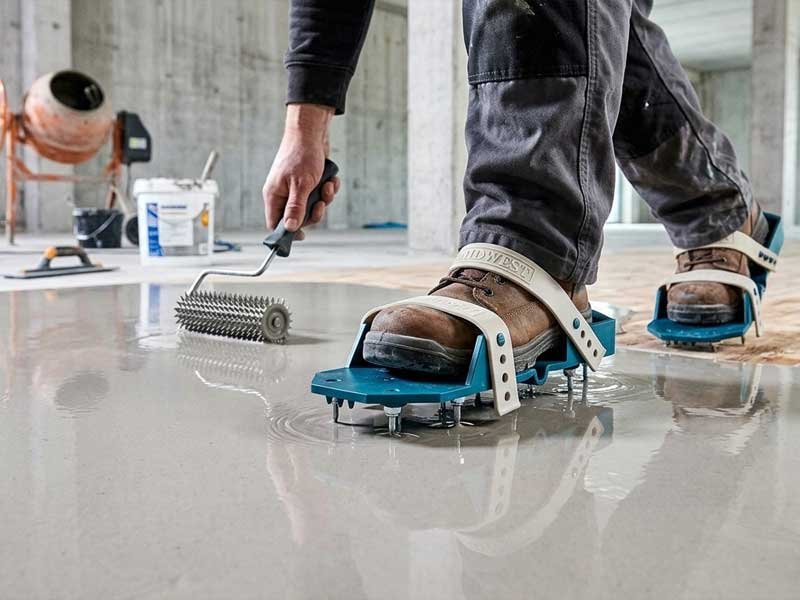
This is why spike length cannot be specified without knowing the coating system. Here is how the requirements differ across the three most common floor coating environments:
Epoxy Resin Coatings
Epoxy resin coatings are typically applied at thicknesses between 2mm and 5mm for industrial flooring systems[^1]. At this thickness range, a spike that is too long — say, 30mm or more — risks breaking through the epoxy layer entirely and dragging or disturbing the primer coat or substrate beneath. Clients working with standard epoxy systems typically request spike lengths in the 20–25mm range, based on their coating specification.
Self-Leveling Cement
Self-leveling compounds behave differently from epoxy. They are applied thicker — often 5mm to 20mm or more in a single pour[^2] — and they remain in a highly fluid state during application. A shorter spike here provides insufficient flotation. Contractors walking across a thin-spiked shoe on a fresh self-leveling pour effectively sink, displacing material and leaving craters. For self-leveling applications, longer spikes that distribute load at the base plate level — not just penetrate the surface — are the correct specification.
Polyurethane (PU) Coatings
PU coatings used in commercial and decorative floor finishing tend to be applied at thinner film builds than epoxy or self-leveling systems[^3]. They also have a longer open time and remain tacky for extended periods[^4]. Here, spike length is less about penetration depth and more about minimizing surface contact time and pressure per point. Very fine, precise spikes in the 15–20mm range are more appropriate.
The practical sourcing implication: When evaluating a factory's spike shoe SKU, ask for the intended coating thickness range that the spike length was designed for. If a supplier cannot answer that question, the specification was not deliberately engineered.
| Coating Type | Typical Thickness | Recommended Spike Length (Design Intent) |
|---|---|---|
| Epoxy Resin | 2–5mm | 20–25mm |
| Self-Leveling Cement | 5–20mm+ | 25–35mm |
| Polyurethane (PU) | 1–3mm | 15–20mm |
Does the Base Plate Design Affect Surface Quality?
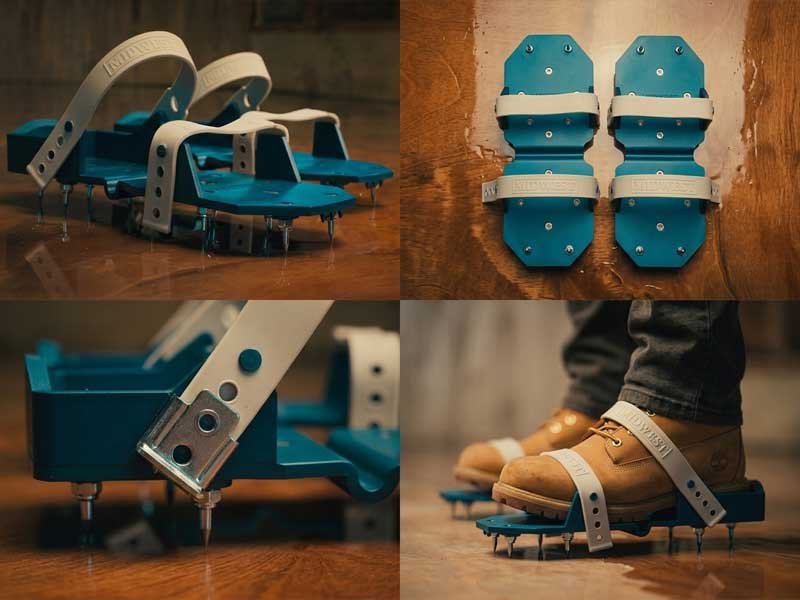
The base plate is frequently treated as a passive structural element — the thing spikes attach to. In practice, it is one of the most consequential design variables for surface finish quality, and it is the component we invest the most mold engineering time in during OEM customization projects.
Base plate surface area and spike array density determine how body weight is distributed across a wet coating surface. A larger plate with a higher spike count spreads load across more individual contact points, reducing the pressure per spike tip. For self-leveling and epoxy applications, insufficient contact distribution is a primary cause of visible dimpling, bubbling, and uneven texture in the cured surface.
Why Spike Count Is a Surface Quality Variable
Consider the physics. A contractor weighing 80kg walking across a freshly poured epoxy floor concentrates that load through whatever contact points are available[^5]. A shoe with 12 spikes on a small base plate delivers roughly 6.7kg per spike tip. A shoe with 26 spikes on a wider base plate delivers roughly 3kg per spike tip — less than half. On a coating with low viscosity or early-stage cure, that difference determines whether the surface remains level or develops micro-deformations that are only visible after the floor cures.
Base Plate Geometry and Coating Flow
In our production process, we have observed that the geometry of the spike array — not just the count — affects how coating material flows around each spike during withdrawal. Spikes arranged in a regular grid pattern on a small plate tend to create repeating surface artifacts in high-gloss coatings. A staggered array on a broader plate produces a more diffuse, less visible contact pattern[^6]. This is one of the mold geometry decisions we adjust during OEM customization for clients specifying products for premium decorative floor applications.
What to Check When Evaluating a Supplier's Base Plate
- Total base plate surface area — larger plates are not always better, but undersized plates are a common quality compromise
- Spike count and spacing — ask for the actual count, not just the plate dimensions
- Spike tip geometry — rounded tips cause more displacement than tapered tips in low-viscosity systems[^7]
- Plate rigidity — a base plate that flexes under load changes the effective spike angle, which affects how cleanly the spike enters and exits the coating
PP vs. EVA: Is Material Selection Really That Important?
Material selection for the base plate and shoe body is where buyers most commonly make cost-driven decisions without accounting for the chemical environment the product will operate in. The consequence is not an immediate product failure — it is gradual base deformation that shows up in contractor feedback three to six months after purchase.
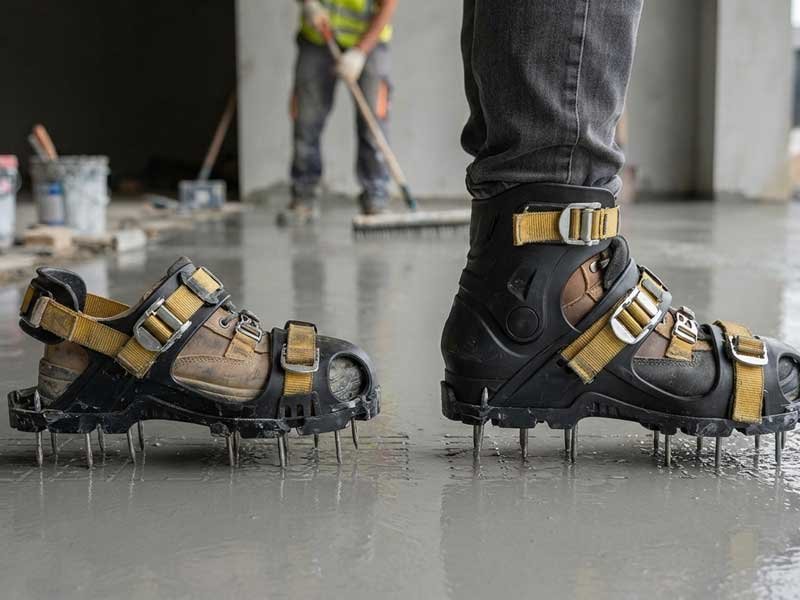
The choice between PP (polypropylene) and EVA (ethylene-vinyl acetate) for floor installation spike shoes is primarily a chemical compatibility decision. PP offers greater structural rigidity and performs adequately in low-solvent applications. EVA provides superior chemical resistance and elastic recovery under load in solvent-heavy environments[^8] such as epoxy and PU coating applications.
How Each Material Behaves in Solvent Environments
Epoxy resin systems and polyurethane coatings contain solvents and reactive compounds that remain chemically active during the application window. A contractor wears spike shoes for hours during a pour — potentially across multiple coats. During that time, the base plate has prolonged contact with solvent vapors and, occasionally, direct liquid contact.
PP under prolonged solvent contact:
- Retains shape well at room temperature under mechanical load
- Degrades gradually in high-solvent environments, becoming brittle over repeated exposure cycles
- Surface may micro-crack under combined solvent exposure and repeated flex loading
- Better choice for low-solvent applications such as self-leveling cement or microcement
EVA under prolonged solvent contact:
- Absorbs minor solvent contact without structural degradation in typical epoxy/PU environments
- Recovers its original geometry after compressive load is removed (elastic recovery)
- Maintains consistent spike alignment over extended wear — critical for uniform surface quality
- Slightly less rigid than PP under point load, which is a tradeoff worth understanding
The critical nuance: EVA is not universally superior. In applications where rigidity matters more than chemical resistance — such as certain FRP lining or roof waterproofing work where mechanical load is the primary stress — PP's structural stiffness can be advantageous. The coating environment determines the specification, not a general preference for one material.
The Sourcing Risk for Buyers
Buyers evaluating supplier samples rarely test material chemistry directly. The risk is that two spike shoes with identical dimensions and appearance — one PP, one EVA — will behave differently in the same epoxy environment, and the difference only becomes visible after real-world use. When requesting samples, ask your supplier to specify the exact polymer grade and confirm its suitability for the solvent chemistry of your target coating type.
Why Do Straps and Buckles Fail Before the Spikes Do?
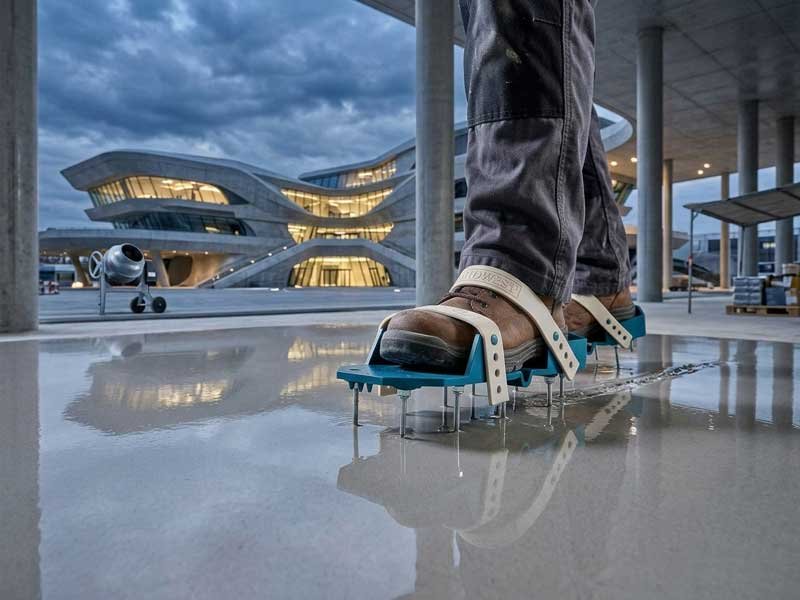
In our experience, the strap and fastening system is the first component to fail in real-use conditions — not the spikes, not the base plate. It is also the component that receives the least attention during product evaluation. Buyers focus on spikes and soles; they treat the strap assembly as hardware. This is a mistake.
Strap and buckle failure in a floor installation spike shoe creates two simultaneous problems: a safety hazard from an unsecured shoe shifting on the foot, and a surface contamination risk if a detached shoe must be retrieved from a wet coating. Strap degradation in solvent environments, buckle release under load, and imprecise adjustment mechanisms are the three primary strap failure modes to evaluate during supplier qualification.
Strap Material in Solvent Environments
Standard nylon webbing degrades measurably in prolonged contact with epoxy solvents and PU thinners[^9]. The degradation is not always visible — the webbing retains its appearance but loses tensile strength. Under load, a strap that has experienced repeated solvent exposure can snap or pull free from its anchor point.
Chemical-resistant webbing materials — typically coated nylon or polypropylene webbing — are specified for solvent-heavy applications. In our production process, we select webbing materials based on the declared coating environment during the OEM design brief. A strap specified for a lawn aerator shoe is not the same material as one specified for an epoxy floor shoe, even if they appear identical.
Buckle Closure Types and Their Tradeoffs
| Buckle Type | Adjustment Speed | Security Under Load | Solvent Resistance |
|---|---|---|---|
| Ratchet buckle | Fast | High | Dependent on material grade |
| Cam lever buckle | Moderate | Moderate | Good |
| Hook-and-loop (Velcro) | Fast | Low | Degrades quickly in solvents |
| Screw-tighten buckle | Slow | Very high | Good |
For professional epoxy floor applications, ratchet or screw-tighten buckles are the appropriate specification. Hook-and-loop closures are unsuitable in any environment with solvent exposure — the adhesive face of the loop material degrades rapidly[^10], and the closure loses retention force within weeks of regular use.
Strap Anchor Point Design
The point where the strap connects to the base plate is a mechanical stress concentration. Inadequate anchor depth, poor overmolding, or thin plastic tabs at this junction are the most common failure initiation points we see in competitor samples submitted for comparison during OEM inquiries. When evaluating a supplier's product, apply a sharp lateral load to the strap anchor during sample inspection. It should show no flex or movement relative to the base plate.
Frequently Asked Questions
What is the difference between an epoxy spike shoe and a lawn aerator shoe?
An epoxy spike shoe is engineered for walking on wet floor coatings — spike length, base plate geometry, and material chemistry are all selected to minimize surface disturbance. A lawn aerator shoe is designed to penetrate compacted soil. The two products share a similar form but have entirely different structural specifications and materials.
Can I use the same spike shoe for self-leveling cement and epoxy resin applications?
Not without checking the specifications carefully. Self-leveling cement is typically applied thicker and behaves more fluidly than epoxy, which changes the optimal spike length and base plate size. A shoe specified correctly for one coating type may be under- or over-penetrating in the other.
How do I evaluate whether a supplier's material is chemically compatible with my target coating?
Request the specific polymer grade designation — not just "PP" or "EVA." Ask the supplier to confirm suitability for the solvent chemistry of your coating system. Reputable manufacturers can provide this information because they selected the material deliberately. If a supplier cannot specify the polymer grade, treat that as a qualification risk.
What minimum order quantity is typical for OEM-customized spike shoe specifications?
This varies by supplier and customization scope. Custom spike lengths or base plate mold modifications typically require higher MOQs to amortize tooling costs. Private-label branding on an existing mold can often be accommodated at lower quantities. Clarify tooling ownership and amortization terms before committing.
Are spike shoes subject to any certifications or safety standards?
Spike shoes for floor installation are not universally subject to a single mandatory standard[^11] — but buyers supplying professional contractors, or selling on regulated marketplaces, should verify applicable occupational safety or product standards in their target markets. Treat supplier certification claims as documents to verify independently rather than assumptions to accept at face value.
Conclusion
A professional floor installation spike shoe is not a commodity product — it is a system where spike length, base plate design, sole material, and strap assembly must each match the specific coating type, application thickness, and environmental chemistry. Getting any single variable wrong produces a product that looks correct on a listing page but fails in the contractor's hands.
The core takeaway is this: spike length is a coating-thickness variable; base plate geometry is a surface-quality variable; material selection is a chemical-compatibility variable; and strap construction is a safety-critical variable. Because these specifications must be matched to a particular application, off-the-shelf products are rarely optimal for every end-user context — which is precisely why specification-driven customization exists.
If you are evaluating floor installation spike shoe suppliers for a new SKU or seeking a manufacturing partner who can translate a coating specification into a product requirement, we welcome the technical conversation. Contact us at chunjiaojohn@gmail.com or via WhatsApp at +86 15988980367 to discuss your application requirements.
[^1]: "How Thick Should an Epoxy Floor Coating Be?", https://industrial.sherwin-williams.com/na/us/en/resin-flooring/contractor-center/technical-articles/thick-epoxy-floor-coating.html. Industry technical literature on epoxy floor coating systems generally specifies application thicknesses of 2–5mm for standard industrial builds, with high-build systems occasionally exceeding this range depending on substrate condition and performance requirements. Evidence role: general_support; source type: research. Supports: That industrial epoxy floor coatings are commonly applied at wet film thicknesses in the 2–5mm range. Scope note: Exact thickness ranges vary by product formulation, manufacturer specification, and application method; no single universal standard governs all industrial epoxy floor systems.
[^2]: "How thick can you go with self leveling concrete?", https://www.reddit.com/r/Concrete/comments/6i47r9/how_thick_can_you_go_with_self_leveling_concrete/. Technical data sheets from major self-leveling compound manufacturers and construction industry guidelines typically specify single-pour application depths of 3–25mm, with some high-flow formulations rated for depths exceeding 50mm, consistent with the 5–20mm range cited for standard applications. Evidence role: general_support; source type: institution. Supports: That self-leveling cementitious compounds are commonly applied at thicknesses ranging from approximately 5mm to 20mm or more per pour. Scope note: Maximum pour depth varies significantly by product formulation and manufacturer; the stated range represents common practice rather than a universal standard.
[^3]: "How Thick Should an Epoxy Floor Coating Be?", https://industrial.sherwin-williams.com/na/us/en/resin-flooring/contractor-center/technical-articles/thick-epoxy-floor-coating.html. Polyurethane floor coating systems are generally specified at lower dry film thicknesses than epoxy systems, with typical commercial applications ranging from 0.5mm to 3mm depending on the number of coats and the intended wear environment. Evidence role: general_support; source type: research. Supports: That polyurethane floor coatings are typically applied at thinner film builds than epoxy systems, often in the 1–3mm range for commercial and decorative applications. Scope note: Some high-build polyurethane systems can approach epoxy thicknesses; the 1–3mm range applies primarily to standard commercial and decorative finishes rather than all PU formulations.
[^4]: "9+ Factors: How Long for Polyurethane to Dry Fast?", https://bigblue.atlantisuniversity.edu/how-long-for-polyurethane-to-dry/. Coatings technology literature indicates that many polyurethane floor coating formulations exhibit longer open times and extended tack-free periods compared to typical two-component epoxy systems, owing to differences in crosslinking chemistry and solvent evaporation rates. Evidence role: general_support; source type: research. Supports: That polyurethane floor coatings generally exhibit longer open times and extended tack phases compared to standard epoxy resin systems. Scope note: Cure times and tack behavior vary widely by specific formulation, ambient temperature, humidity, and film thickness; some fast-cure PU systems may have shorter open times than slow-cure epoxies.
[^5]: "Contact mechanics", https://en.wikipedia.org/wiki/Contact_mechanics. Basic contact mechanics principles establish that for a given applied force, increasing the number of contact points proportionally reduces the pressure at each point, thereby reducing the likelihood of plastic deformation in compliant or viscoelastic surfaces. Evidence role: mechanism; source type: encyclopedia. Supports: That distributing a given load across more contact points reduces pressure per point, which in turn reduces localized surface deformation. Scope note: The simplified calculation assumes equal load distribution across all spikes, which may not hold during dynamic walking where weight shifts unevenly across the base plate.
[^6]: "Normalized metal artifact reduction in head and neck ...", https://pubmed.ncbi.nlm.nih.gov/22659592/. Principles of visual perception and surface finishing indicate that regularly spaced repeating patterns are more readily detected by the human eye than staggered or pseudo-random arrangements; this principle is applied in various manufacturing contexts to minimize visible surface artifacts. Evidence role: mechanism; source type: research. Supports: That staggered or irregular contact point arrangements produce less perceptible surface patterns than regular grid arrangements on reflective or high-gloss surfaces. Scope note: Direct research on spike shoe array patterns in wet floor coatings is limited; the claim is supported by analogy to broader principles of pattern perception and surface engineering rather than coating-specific studies.
[^7]: "Fluid interfaces with very sharp tips in viscous flow - PMC", https://pmc.ncbi.nlm.nih.gov/articles/PMC7768759/. Fluid mechanics and penetration studies demonstrate that sharper, more tapered probe geometries produce less volumetric displacement and lower drag forces when penetrating viscous or viscoelastic materials, compared to blunt or hemispherical geometries, due to reduced frontal cross-section and more gradual material parting. Evidence role: mechanism; source type: paper. Supports: That tapered or pointed tips displace less material during penetration into a viscous fluid than blunt or rounded tips of equivalent diameter. Scope note: Most published research addresses probe penetration in controlled laboratory conditions; direct studies on spike tip geometry in wet floor coatings are not widely available in the literature.
[^8]: "Investigation of the Rheological Properties and Storage ... - PMC", https://pmc.ncbi.nlm.nih.gov/articles/PMC10179077/. Polymer reference literature indicates that ethylene-vinyl acetate copolymers generally exhibit good resistance to a range of organic solvents and superior elastic recovery compared to polypropylene, which, while chemically inert to many substances, can become brittle under prolonged solvent exposure and cyclic mechanical stress. Evidence role: mechanism; source type: encyclopedia. Supports: That EVA exhibits greater elastic recovery and chemical resistance in certain solvent environments compared to polypropylene. Scope note: Chemical resistance of both polymers varies significantly with specific solvent type, concentration, temperature, and polymer grade; blanket superiority claims require qualification by application context.
[^9]: "Microbial and Enzymatic Degradation of Nylon - PMC - NIH", https://pmc.ncbi.nlm.nih.gov/articles/PMC13215870/. Polyamide fibers, including nylon 6 and nylon 6,6, are known to be susceptible to degradation from certain organic solvents and strong acids; prolonged exposure can cause swelling, plasticization, and reduction in tensile strength, even when visual degradation is not apparent. Evidence role: mechanism; source type: research. Supports: That nylon (polyamide) webbing can experience measurable tensile strength reduction when subjected to prolonged contact with organic solvents commonly found in epoxy and polyurethane coating systems. Scope note: Degradation rates depend on the specific solvent type, concentration, exposure duration, and nylon grade; some solvent formulations may have minimal effect on nylon webbing.
[^10]: "Halco Polyester Hook and Loop for Outdoor Use", https://www.halcousa.com/choosing-a-halco-nylon-or-polyester-hook-and-loop-fastener-for-outdoor-use/. Hook-and-loop fastener performance is known to degrade in chemically aggressive environments; organic solvents can attack the polymer fibers (typically nylon or polyester) and any adhesive backing, reducing loop engagement strength and overall closure retention over repeated exposure cycles. Evidence role: general_support; source type: research. Supports: That hook-and-loop fastener systems experience reduced retention force and material degradation when exposed to organic solvents. Scope note: Some specialty hook-and-loop products are engineered for chemical resistance; the claim applies primarily to standard commercial-grade closures rather than all hook-and-loop systems.
[^11]: "California Code of Regulations, Title 8, Section 3385. Foot ...", https://www.dir.ca.gov/title8/3385.html. Major occupational safety frameworks such as OSHA (United States) and EU PPE Regulation 2016/425 establish requirements for protective footwear but do not include a specific mandatory standard for floor installation spike shoes as a distinct product category; applicable requirements vary by jurisdiction and intended use classification. Evidence role: general_support; source type: government. Supports: That floor installation spike shoes are not covered by a single universal mandatory product safety standard across major markets. Scope note: Specific markets or applications may impose relevant requirements through general PPE, workplace safety, or product liability regulations; the absence of a dedicated standard does not mean no regulations apply.