跳到内容

Picking the best spiked shoes for industrial flooring feels like a simple shopping decision until your crew scars a half-cured epoxy floor or a strap dissolves mid-shift. Contractors who chase "best" as a ranking often end up with rework costs and returned inventory. The real fix starts with matching shoe structure to your actual job conditions.
There is no single "best" spiked shoe for industrial flooring — the right choice depends on your floor's cure stage, chemical exposure, and shift length. Partially cured epoxy needs shorter, controlled spikes to avoid scarring. Solvent-heavy environments need chemical-resistant materials. Long shifts favor ergonomic one-piece designs over strapped versions.
Instead of ranking brands, I want to walk through how flooring contractors and distributors actually evaluate spiked shoes when they call our factory. The pattern-matching approach below saves more money than any generic "top pick" ever will.
Why Do Buyers Assume Longer Spikes Mean Better Performance?
Contractors often assume more aggressive spikes equal more capability. It's an intuitive assumption — bigger tool, tougher job, right? But on flooring specifically, this logic backfires more often than it helps.
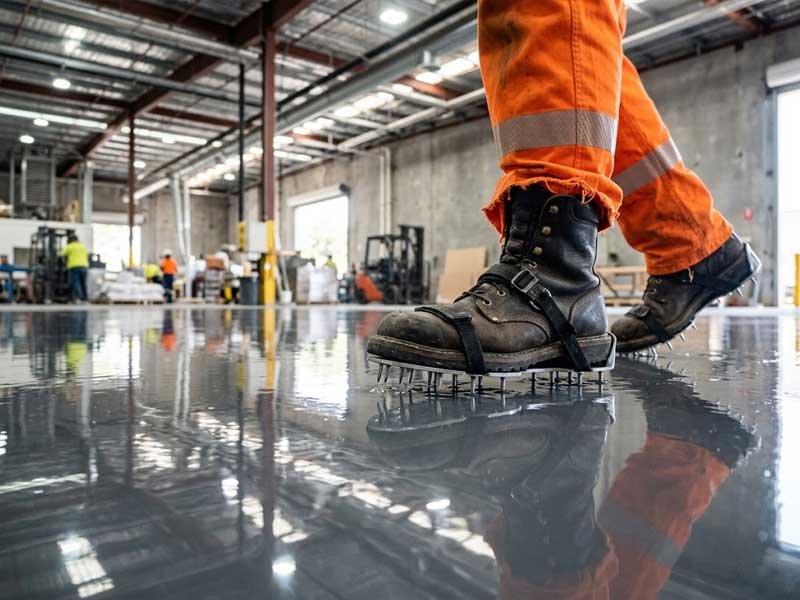
Longer or sharper spikes are not automatically better for industrial flooring. On partially cured or finished epoxy and self-leveling surfaces, oversized spikes increase the risk of surface scarring, pinholes, and costly rework[^1] — a hidden cost many buyers underestimate.
The Scarring Problem Nobody Budgets For
I get sourcing inquiries fairly often from distributors who want "the longest spike we can make." My first question back is always: what stage is the floor in when your crew walks on it?
Here's the distinction that matters:
- Wet/uncured self-leveling cement[^2] — Workers need enough spike length to stay above the surface without sinking, but not so much that they punch deep holes that need patching before the topcoat.
- Partially cured epoxy (walkable but not fully hardened) — This is where oversized spikes cause the most damage. The surface is soft enough to scar but firm enough that deep punctures leave visible marks[^3].
- Fully cured floors during finishing/inspection walks — Shorter, minimal-contact spikes reduce any risk of marking a floor that's already done.
Matching Spike Form to Job Stage
| Floor Stage | Recommended Spike Approach | Risk of Oversized Spikes |
|---|---|---|
| Wet self-leveling cement | Moderate length, wide base for stability | Sinking too deep, uneven walk pattern |
| Partially cured epoxy | Shorter, minimum-contact spikes | Surface scarring, rework cost |
| Fully cured/finishing stage | Minimal spike, near-flat sole | Visible marks on finished topcoat |
A common sourcing mistake I see: buyers request maximum spike length assuming it's a durability feature. It's actually a surface-interaction variable. Spike length should track the floor's cure state, not a generic "tougher is better" instinct.
Should You Choose Strapped PP Shoes or One-Piece EVA Shoes?
This decision gets treated like a coin flip in a lot of sourcing conversations. Buyers pick based on unit price alone, then get complaints about fit or wear rate a few months later. It's a structural decision, not a random SKU choice.
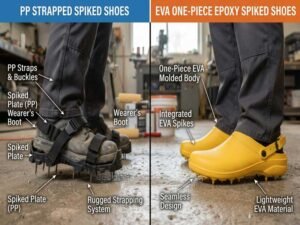
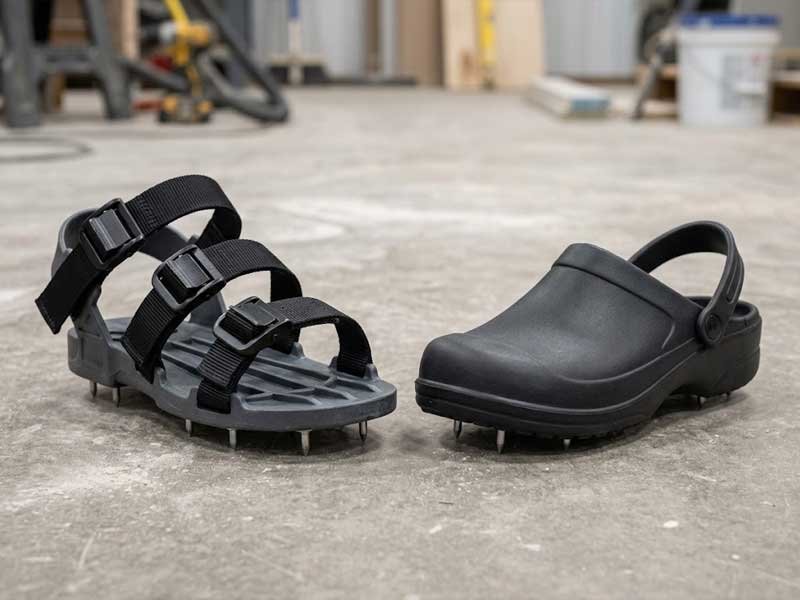
Strapped PP spiked shoes suit variable boot sizes and heavy-duty rotation across multiple workers. One-piece EVA spiked shoes suit comfort and ergonomics during long, single-worker shifts. The wrong pick for your crew's work pattern leads to poor fit or premature wear.
Structural Differences That Actually Matter
I've spent years sourcing and molding both formats, and the difference isn't cosmetic. It's functional.
Strapped Type (PP material):
- Fits over a range of existing work boot sizes — useful when a crew shares equipment or rotates workers across shifts.
- Straps are the wear point. Under repeated flexing and chemical exposure, strap material degrades faster than the spike base itself.[^4]
- Better suited to distributors who need one SKU to fit many boot sizes without stocking multiple shoe sizes.
One-Piece Integrated Type (EVA material[^5]):
- No straps to loosen, snap, or dissolve — the shoe is one continuous piece.
- Lighter weight and more ergonomic for workers standing or walking for extended shifts.
- Less size flexibility — closer to a shoe-size-specific fit, which means distributors need a size run rather than one universal SKU.
A Simple Way to Decide
Ask these three questions before ordering:
- Does your crew rotate boots or workers frequently? If yes, strapped PP is usually the more practical structure.
- Are your shifts long (6+ hours standing/walking[^6])? If yes, one-piece EVA reduces fatigue-related complaints.
- Are you reselling to multiple contractor types? If yes, stocking both formats often outperforms betting on one.
A pattern I notice in customization requests: distributors who only compare price per pair, without asking these three questions, tend to reorder the wrong format within one buying cycle. Structure should drive the decision before price does.
How Much Does Chemical Exposure Affect Spiked Shoe Lifespan?
This is the criterion most buyers skip entirely, and it's the one I can speak to most directly from material sourcing. Epoxy and PU solvents are aggressive on both metal and plastic components, and generic "durable" claims don't tell you much.
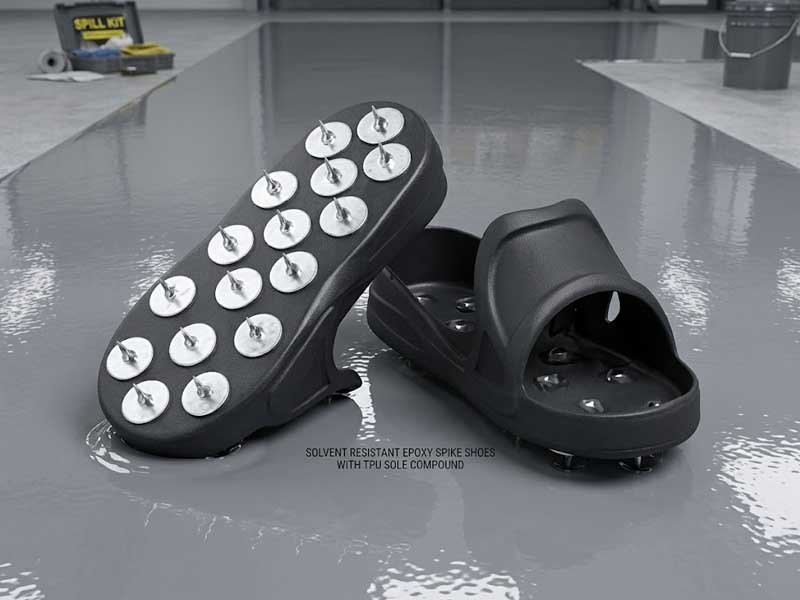
Chemical resistance is an overlooked but critical selection factor for spiked shoes. Metal spikes and plastic straps degrade faster under epoxy, polyurethane, and solvent exposure if the material grade isn't specified. Buyers should ask suppliers directly which polymer and steel grades resist their specific coating chemistry.
Where Degradation Actually Happens
From what I see in material sourcing conversations, degradation shows up in two places first:
- Strap material — Standard PP can soften or discolor under repeated solvent contact[^7]. Chemical-resistant PP grades hold up longer, but this needs to be specified at the order stage, not assumed as a default.
- Spike/metal base — Uncoated or low-grade steel spikes corrode faster in humid, solvent-heavy environments[^8], especially in facilities running epoxy and PU systems back to back with minimal downtime.
Questions Worth Asking Any Supplier
"What material grade resists epoxy and PU solvents?" is a more useful sourcing question than "how long do your shoes last?"
Buyers evaluating suppliers should ask:
- Is the strap material rated for repeated solvent exposure, or is it a generic PP grade?
- What steel treatment (if any) is used on the spikes to slow corrosion?
- Has the supplier tested materials specifically against epoxy/PU chemistry, or only general wear?
I want to be direct here: unless a supplier can show you an actual material spec sheet, treat any chemical-resistance claim as unverified marketing language. This applies to us too — buyers should always ask for documentation, not just a sales pitch.
Should Coating Distributors Bundle Spiked Shoes With Their Products?
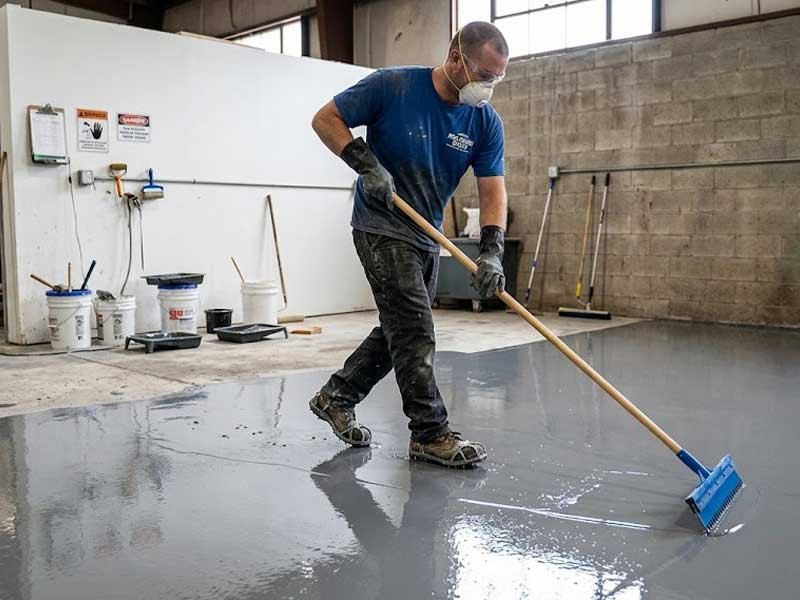
Distributors selling epoxy, resin, or self-leveling cement often get asked if they can also supply the tools contractors need to apply those products. Bundling sounds like an easy upsell, but it only works if the tool matches the coating system.
Distributors bundling spiked shoes with coatings should match tool durability to the specific coating chemistry they sell, not choose a generic "best shoe" for all product lines. A mismatch between coating chemical intensity and shoe material grade creates returns and support issues.
Why Generic Bundling Backfires
A building material wholesaler selling both light-duty sealers and heavy-duty epoxy systems can't reasonably bundle the same spiked shoe SKU across both product lines. The chemical intensity differs, and so should the tool spec.
Practical bundling logic looks like this:
- Light-duty sealers/coatings — Standard PP strapped shoes are often sufficient; lower solvent exposure means less material stress.
- Heavy-duty epoxy/PU systems — Chemical-resistant material grades become worth the higher unit cost, since replacement frequency drops.
- High-volume contractor accounts — One-piece EVA may reduce support complaints related to strap wear, especially for accounts running long, continuous shifts.
Private Label Considerations
This is where OEM/ODM customization becomes relevant for distributors, not just brands. A wholesaler private-labeling spiked shoes alongside their coating line can specify[^9]:
- Strap or spike material grade matched to their specific resin/epoxy chemistry
- Branded packaging that positions the shoe as a companion tool, not a standalone accessory
- Spike form factor suited to the primary use case their customer base actually works in
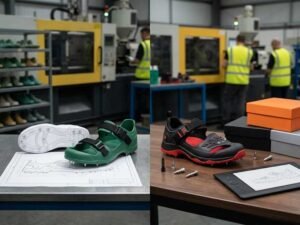
I've had these conversations with distributors who initially just wanted "a shoe to sell alongside our epoxy." The more useful outcome usually comes from working backward from their coating chemistry and typical job site conditions, then specifying the shoe structure to match — not picking a shoe first and hoping it fits every use case downstream.
Frequently Asked Questions
What's the difference between spiked shoes for flooring and lawn aerator shoes?
Flooring spiked shoes use short, minimal-contact spikes designed to avoid marking epoxy or self-leveling surfaces. Lawn aerator shoes use longer, more aggressive spikes meant to penetrate soil deeply[^10]. They're built for entirely different surfaces and shouldn't be substituted for each other.
Are metal spikes always better than plastic spikes for epoxy floors?
Not necessarily. Metal spikes can offer more precise, minimal-contact points[^11], but they're also more prone to corrosion under chemical exposure if the steel grade isn't specified. The right choice depends on your chemical environment and how the supplier treats the metal.
How do I know if a supplier's "chemical-resistant" claim is legitimate?
Ask for an actual material spec sheet listing polymer grade and steel treatment. If a supplier can't provide documentation beyond marketing language, treat the claim as unverified. This applies to any supplier, including ours — always request specs.
Can one shoe design work for both epoxy and self-leveling cement jobs?
Sometimes, but it depends on cure stage and chemical exposure at each job. A design that works well on wet self-leveling cement might scar a partially cured epoxy surface. It's safer to evaluate spike length and material against each specific job condition.
Should I order strapped or one-piece shoes for a crew with mixed boot sizes?
Strapped PP designs generally handle mixed boot sizes better since they adjust to fit over different work boots. One-piece EVA designs are closer to fixed sizing, which works better when workers have consistent, individually assigned footwear.
[^1]: "Walking on epoxy… on purpose Spike shoes allow installers ...", https://www.instagram.com/reel/DUGVTEbDXhU/?hl=en. Technical literature on epoxy floor installation notes that foot traffic during the gel or partial-cure phase can introduce surface defects such as pinholes and indentations, particularly when spike penetration exceeds the film's elastic tolerance at that cure stage. Evidence role: mechanism; source type: research. Supports: That walking on partially cured epoxy with oversized spikes causes surface defects including scarring and pinholes that require rework. Scope note: Most available guidance addresses general foot traffic rather than spike-specific damage; direct experimental data on spike length versus cure-stage scarring may be limited.
[^2]: "Why You Need Spike Shoes For Self Leveling Floor Compound ...", https://www.youtube.com/watch?v=ETNtVUPocO0. Manufacturer application guides for self-leveling compounds typically specify the use of spiked shoes during and immediately after pouring, with spike length recommendations calibrated to the nominal pour thickness to allow worker mobility without disrupting the leveling process. Evidence role: general_support; source type: other. Supports: That spiked shoes are the standard method for traversing freshly poured self-leveling cement, and that spike length must be calibrated to the pour depth to avoid excessive penetration. Scope note: Specific spike length recommendations vary by product and manufacturer; no universal industry standard governs this parameter.
[^3]: "Investigation of Cure Kinetics of Advanced Epoxy Molding ...", https://tsapps.nist.gov/publication/get_pdf.cfm?pub_id=936408. During the gel-to-vitrification transition in epoxy curing, the material transitions from a viscous liquid through a rubbery gel state to a glassy solid; in the intermediate rubbery phase, the surface is compliant enough to deform under localized pressure yet sufficiently cross-linked to retain permanent marks rather than self-level. Evidence role: mechanism; source type: paper. Supports: That epoxy resins pass through an intermediate gel/partial-cure phase where the material has sufficient rigidity to retain deformation marks but insufficient hardness to resist surface indentation. Scope note: Cure profiles vary significantly by epoxy formulation, ambient temperature, and film thickness; the duration and vulnerability of the intermediate phase is system-specific.
[^4]: "Experimental Study of Fatigue and Fracture Behavior of ... - PMC", https://pmc.ncbi.nlm.nih.gov/articles/PMC9147575/. Polymer fatigue literature indicates that thin, flexible polymer components such as straps experience accelerated crack initiation and propagation under cyclic flexural loading, a process further hastened by environmental stress cracking when solvents are present. Evidence role: mechanism; source type: research. Supports: That polymer straps subjected to repeated flexural stress and chemical exposure exhibit accelerated fatigue and degradation compared to the more rigid base components they are attached to. Scope note: General polymer fatigue data supports the mechanism, but specific failure-rate comparisons between PP straps and spike bases in flooring shoe applications have not been published.
[^5]: "Nanocomposite Foams with Balanced Mechanical Properties ...", https://pmc.ncbi.nlm.nih.gov/articles/PMC9968182/. EVA foam is widely used in footwear midsoles due to its low density, high energy absorption, and cushioning properties, which have been shown in biomechanical studies to reduce ground reaction forces and perceived fatigue during prolonged standing and walking. Evidence role: general_support; source type: research. Supports: That EVA (ethylene-vinyl acetate) foam is lighter and provides superior cushioning and shock absorption compared to rigid polypropylene, making it preferable for extended-wear footwear applications. Scope note: Most ergonomic research on EVA pertains to conventional footwear midsoles rather than spiked industrial overshoes specifically.
[^6]: "Evidence of Health Risks Associated with Prolonged Standing ...", https://pmc.ncbi.nlm.nih.gov/articles/PMC4591921/. Occupational health research indicates that prolonged standing exceeding approximately 4 hours per shift is associated with increased lower-extremity discomfort, fatigue, and musculoskeletal disorder risk, with symptoms escalating progressively with additional hours (e.g., Waters & Dick, 2015, in Ergonomics). Evidence role: statistic; source type: paper. Supports: That prolonged standing or walking beyond approximately 4–6 hours per shift is associated with significantly increased musculoskeletal discomfort and fatigue in occupational settings. Scope note: The cited research addresses general prolonged standing; the specific interaction between spiked shoe design and fatigue reduction has not been independently studied.
[^7]: "An Overview of the Sustainable Depolymerization ... - PMC - NIH", https://pmc.ncbi.nlm.nih.gov/articles/PMC11207091/. Polypropylene exhibits good resistance to many acids and bases but can be attacked by strong oxidizing agents and certain organic solvents, leading to swelling, softening, or stress cracking depending on concentration and exposure duration (see, e.g., chemical compatibility tables in polymer engineering references). Evidence role: mechanism; source type: encyclopedia. Supports: That polypropylene can degrade, soften, or discolor when exposed to certain organic solvents commonly found in epoxy and polyurethane coating systems. Scope note: General polymer compatibility data may not precisely replicate the intermittent, mixed-solvent exposure conditions found on industrial flooring job sites.
[^8]: "Effect of Relative Humidity on Corrosion of Steel under ...", https://www.osti.gov/servlets/purl/1367735. Corrosion science literature confirms that elevated relative humidity combined with chemical contaminants significantly accelerates the oxidation rate of uncoated low-carbon steel, with corrosion rates increasing nonlinearly above approximately 60% RH in polluted or chemically active atmospheres. Evidence role: mechanism; source type: research. Supports: That uncoated or low-grade carbon steel corrodes at accelerated rates in high-humidity environments, particularly when combined with chemical exposure. Scope note: Most corrosion studies focus on atmospheric or marine environments; direct data on steel spike corrosion in epoxy/PU solvent atmospheres specifically may be sparse.
[^9]: "OEM vs ODM vs Private Label Cosmetics: Key Differences ...", https://arisecosmetic.com/oem-vs-odm-vs-private-label-cosmetics/. OEM (Original Equipment Manufacturer) and ODM (Original Design Manufacturer) arrangements are established supply chain models in which buyers specify material grades, design parameters, and branding for products manufactured by a third party, a practice common across industrial tools and accessories. Evidence role: general_support; source type: other. Supports: That OEM/ODM manufacturing arrangements allow distributors to specify custom material grades, branding, and design parameters for private-label industrial accessories. Scope note: The general OEM/ODM model is well-documented, but specific application to spiked flooring shoes as a product category is niche and not widely covered in trade literature.
[^10]: "Aeration Shoes for Lawn, Free Installation, Universal Size ...", https://www.amazon.com/ROSGEL-Uniquely-Stainless-Installation-Healthier/dp/B08RS93FSF. Lawn aerator shoes or sandals feature spikes typically ranging from 2 to 3 inches in length, designed to create channels in compacted soil to improve water and nutrient penetration — a purpose and spike geometry distinct from the short, minimal-contact spikes used in flooring installation tools. Evidence role: definition; source type: encyclopedia. Supports: That lawn aerator shoes are designed with spikes typically 2–3 inches long intended to penetrate compacted soil for aeration, a fundamentally different application from the short-spike designs used for walking on wet flooring materials. Scope note: No formal product standard distinguishes the two categories; the comparison relies on typical commercial product specifications rather than a regulatory definition.
[^11]: "Speaker Spikes or Rubber Speaker Feet? - Blog", https://www.axiomaudio.com/blog/speaker-spikes-speaker-feet. Steel's higher yield strength and machinability allow spike tips to be formed to finer geometries with smaller contact radii than is typically achievable with injection-molded thermoplastics, which require minimum wall thicknesses and draft angles that limit tip sharpness. Evidence role: mechanism; source type: research. Supports: That metal (steel) spikes can be manufactured to finer tip geometries than injection-molded plastic spikes, resulting in smaller contact areas per spike point. Scope note: This reflects manufacturing capability rather than direct field-test evidence comparing surface marking outcomes between metal and plastic spikes on epoxy floors.