跳到内容

Choosing between PP material vs EVA material for footwear is one of the most common — and most misunderstood — decisions B2B buyers face when sourcing epoxy spiked shoes. The problem is that most suppliers frame it as a quality ladder: EVA is "premium," PP is "budget." That framing leads to wrong bulk orders, end-user complaints, and costly returns. The real answer depends on how the material works with the shoe's structure and the actual job it's designed for.
PP and EVA are not competing on a quality scale — they serve fundamentally different use cases. PP (polypropylene) works best as a strapped spiked shoe that fits over existing work boots for workers who frequently step on and off treated floors. EVA (ethylene-vinyl acetate) excels as a one-piece integrated shoe for long, continuous shifts[^1] on epoxy or self-leveling surfaces where comfort and ease of wear matter most. The right choice depends on your buyers' jobsite patterns, not on which material sounds more premium.
I've spent over a decade manufacturing both PP-strapped and EVA one-piece epoxy spiked shoes for global tool brands, distributors, and private-label sellers. In this article, I'll break down exactly when each material-and-structure combination makes sense — so you can stock the right product, reduce downstream complaints, and avoid the hidden costs of a mismatched sourcing decision.
Why Is the "PP vs EVA" Debate So Common Among Buyers?
Almost every new B2B inquiry we receive starts with some version of the same question: "Which material is better — PP or EVA?" It's understandable. Buyers need a shorthand to compare products quickly across suppliers. But this shorthand hides the most important variable: the shoe's structural design.
The reason the PP material vs EVA material debate persists is that buyers are often comparing raw material specs in isolation — divorced from the strapped or one-piece structure that actually determines real-world performance. When you compare materials without considering structure, you're asking the wrong question entirely.

The False Hierarchy: EVA-Is-Premium, PP-Is-Cheap
Let me be direct: in our years of production, I've watched this false hierarchy cause real sourcing mistakes. A hardware importer once switched their entire product line from PP-strapped shoes to EVA one-piece shoes because a competitor marketed EVA as the "upgrade." Within two months, their contractor customers — who frequently needed to step on and off freshly coated floors — started complaining. The EVA one-piece shoes were harder to slip on and off quickly over steel-toe boots. Returns spiked. The importer came back to us for a split order: PP-strapped for their contractor channel, EVA one-piece for their retail/Amazon channel.
This is the core problem. EVA is not an upgrade over PP. They serve different wear patterns:
| Factor | PP (Strapped Type) | EVA (One-Piece Integrated) |
|---|---|---|
| Ideal Wear Pattern | Frequent on/off over work boots | Continuous long-shift wear |
| Boot Compatibility | Fits over most existing work boots | Standalone; no boot required |
| Primary Comfort Profile | Rigid, firm anchor points | Flexible cushioning, lightweight |
| Typical End User | Flooring contractors on mixed tasks | Dedicated epoxy/self-leveling crews |
| Ease of Use | Quick strap-on, quick removal | Step-in-and-go, slower transitions |
Why Structure Matters More Than Material Alone
When I discuss material selection with buyers, I always bring the conversation back to structure. PP as a raw material is rigid and chemically resistant — that's useful. But it only becomes a product advantage when paired with the strapped design, because the rigidity allows thick, heavy-duty straps to hold firm anchor points against a work boot's sole. The structural outcome: stable, predictable spike contact on a treated floor.
EVA, on the other hand, is lightweight and inherently cushioning. That property only becomes a product advantage in the one-piece integrated design, where the entire sole is a single molded unit. Workers wearing EVA one-piece shoes on six- or eight-hour shifts report less foot fatigue[^2] because the material absorbs impact across the whole footbed — not just at strap contact points.
Key takeaway for buyers: Never compare PP and EVA as standalone materials. Always evaluate them as part of the strapped vs. one-piece system. The material-structure combination is what determines comfort, durability, and jobsite performance.
How Does PP Material Perform in Strapped Epoxy Spiked Shoes?
If your end users are flooring contractors who walk on and off freshly coated surfaces multiple times per shift, a PP material strapped spiked shoe is likely the better sourcing decision. But what makes PP work so well in this application — and where does it fall short?
PP-strapped epoxy spiked shoes succeed because the material's natural rigidity creates stable, repeatable strap tension across a wide range of boot sizes. This means workers can strap the shoes on over their existing steel-toe or composite-toe work boots, walk onto a freshly poured self-leveling floor, and remove them cleanly when they step off — without fumbling with buckles or readjusting.
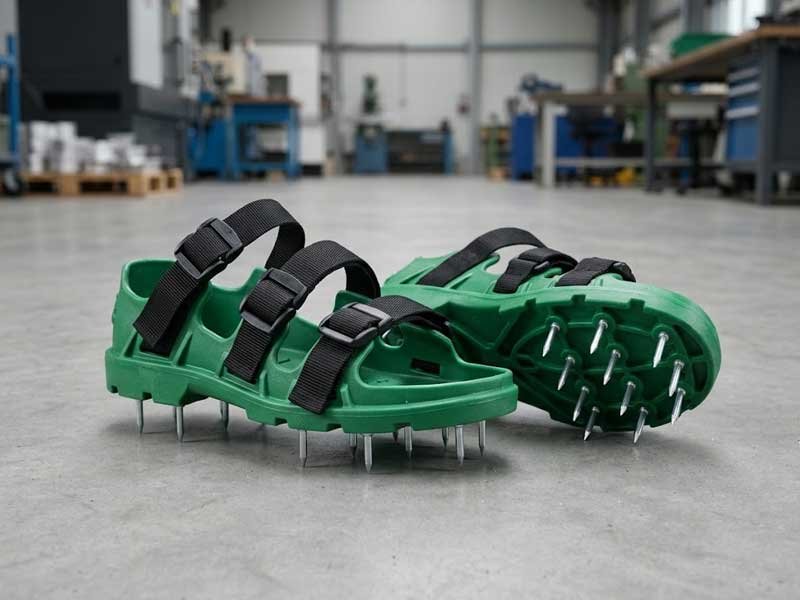
Rigid Support for Heavy-Duty Jobsite Movement
One of the things I've noticed over thousands of production runs is that PP-strapped shoes get reordered most frequently by customers whose end users carry heavy equipment — buckets of epoxy, squeegee tools, notched trowels — across freshly coated surfaces. The reason is structural: PP's rigidity translates into firmer grip-point control at the strap anchors[^3]. When a worker carrying a heavy load shifts their weight, the straps don't flex or stretch the way softer materials would. The shoe stays planted on the boot. The spikes stay vertical.
This matters more than it sounds. If a spiked shoe shifts even slightly under load, the spike angle changes. On a wet self-leveling compound, an angled spike can drag rather than puncture cleanly — leaving visible drag marks or creating small surface bubbles that harden into permanent defects[^4]. I've seen this happen with poorly designed flexible-material alternatives.
Chemical and Abrasion Resistance of PP
PP (polypropylene) is inherently resistant to many of the solvents and chemicals found on epoxy flooring jobsites[^5]. In practical terms, this means:
- Epoxy resin drips don't bond easily to PP surfaces, so the shoes clean up faster between uses.
- Acetone and solvent splashes — common during tool cleanup — don't degrade the strap material over multiple exposures.
- Abrasive concrete dust doesn't wear through PP straps as quickly as it might with softer thermoplastics.
I want to be clear: I'm not citing lab abrasion test numbers here. What I can tell you from production and field feedback is that PP-strapped shoes consistently survive more reuse cycles in harsh chemical environments than buyers initially expect. Contractors who treat the shoes as single-use consumables are often surprised to find them still functional after multiple jobs.
Where PP Strapped Shoes Fall Short
PP's rigidity is also its limitation. Workers on continuous long shifts — four to eight hours of uninterrupted walking on a treated surface — report more foot fatigue with PP-strapped shoes compared to EVA alternatives. The strap pressure points concentrate force on specific areas of the boot, and over time, that creates discomfort.
Additionally, PP-strapped shoes require adjustment. Different boot sizes need different strap tension. If workers don't tighten straps properly, the shoes can loosen mid-task — which is both a comfort and a quality-of-finish problem.
How Does EVA Material Perform in One-Piece Spiked Shoes?
For buyers whose end users spend long, continuous shifts walking on freshly applied epoxy or self-leveling cement, EVA material one-piece spiked shoes are typically the better fit. But comfort alone doesn't tell the whole story.
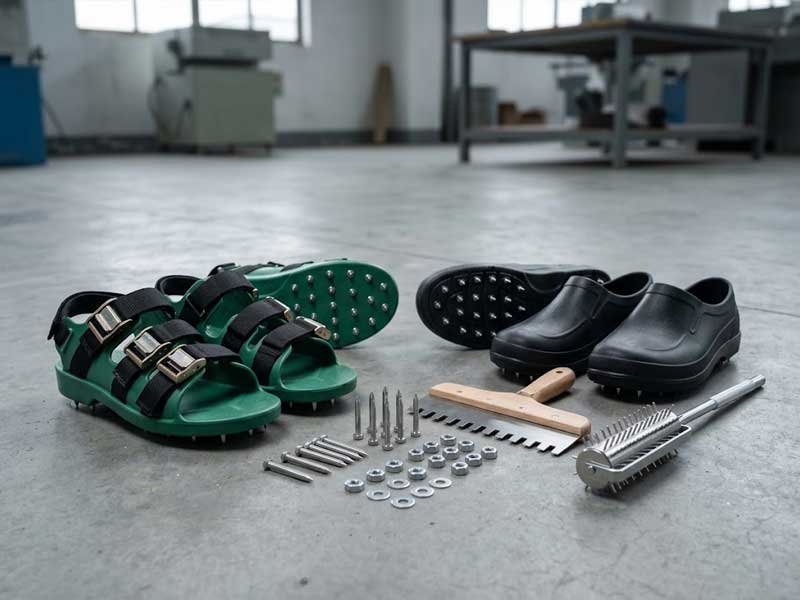
EVA one-piece spiked shoes eliminate straps entirely. The shoe is a single molded unit — lightweight, cushioned, and designed to be stepped into directly. This structure distributes weight more evenly across the entire footbed, reducing the localized pressure points that cause fatigue during extended wear.
Why Long-Shift Crews Prefer EVA
From our order history, the pattern is clear: buyers serving dedicated epoxy flooring crews — teams that spend an entire shift on a single large-scale floor pour — gravitate toward EVA one-piece shoes after their first trial order. The feedback is consistent:
- Reduced fatigue complaints. Workers wearing EVA shoes on six-plus-hour shifts report significantly less foot soreness compared to strapped alternatives.
- Faster deployment. No strap adjustment means crews spend less time gearing up and more time on the floor. On a large commercial pour, even a few minutes saved per worker adds up.
- More consistent spike contact. Because the one-piece sole conforms to the wearer's foot rather than clamping onto a boot, the spike alignment stays more consistent during natural walking motions[^6].
The Comfort-Rigidity Tradeoff
Here's where buyers need to think carefully. EVA's flexibility — the same property that provides cushioning — means the shoe has less rigid grip-point control than a PP-strapped design. For a worker walking steadily across a flat surface, this is fine. But for a worker making sharp lateral movements, carrying heavy loads, or working on uneven substrates, the EVA shoe can flex more than desired.
I've had buyers return to PP-strapped shoes specifically for industrial FRP lining and waterproofing membrane jobs, where workers move laterally and the substrate isn't perfectly flat. In those environments, EVA's flex becomes a liability — the spikes can angle slightly on each step, increasing the risk of surface imperfections.
Boot Compatibility Consideration
One structural trade-off that buyers sometimes overlook: EVA one-piece shoes are standalone footwear. They are not designed to strap over a work boot. This means:
- Workers who need steel-toe protection from their primary boots lose that protection when switching to EVA spiked shoes[^7].
- Workers who move between spiked-shoe tasks and other jobsite tasks need to change footwear entirely, not just unstrap an accessory.
- In cold or wet conditions, EVA shoes may not provide the insulation or waterproofing that dedicated work boots offer.
For Amazon sellers and retail-facing brands, this is often a non-issue — their customers are typically homeowners or small contractors doing single-task jobs. But for industrial distributors supplying large commercial crews, it's a critical consideration.
What Are the Real Downstream Costs of Choosing the Wrong Material?
This is the question that separates a good sourcing decision from a costly one. When buyers select the wrong PP material vs EVA material combination for their channel, the consequences aren't abstract — they show up as floor defects, worker complaints, returns, and lost contracts.
The wrong material-structure pairing creates real financial risk. Surface defects caused by mismatched spiked shoes — drag marks, bubble patterns, imprint irregularities — can require costly re-coating of commercial floors. Worker discomfort drives returns and negative reviews that damage brand credibility. Both outcomes eat into margins and erode buyer-supplier trust.
Floor Defect Risk: The Hidden Cost
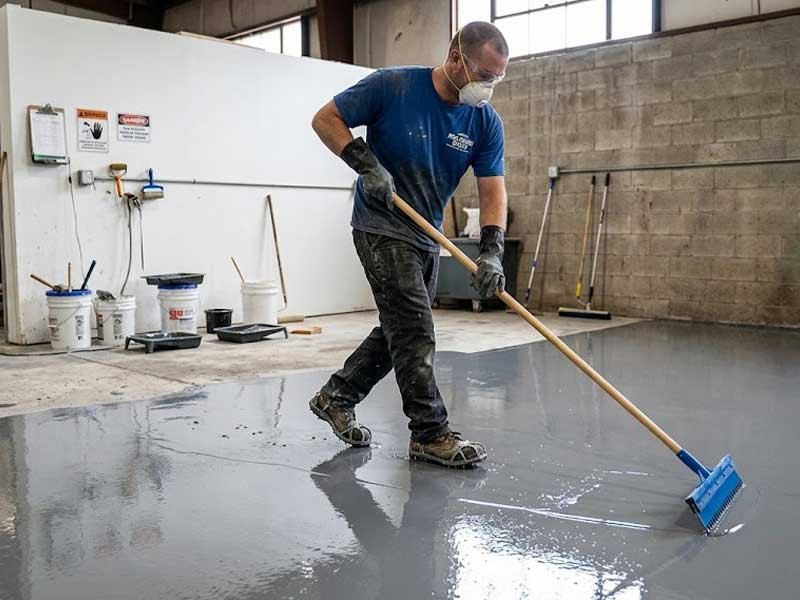
On a freshly poured self-leveling floor, the margin for error is razor-thin[^8]. The compound is designed to settle into a perfectly smooth surface — but it can only do so if the spike impressions are clean, uniform, and close quickly after the worker passes. Here's how wrong material choice creates defects:
- PP-strapped shoes that are too loose (wrong strap adjustment or wrong boot pairing): Spikes drag and create linear marks in the wet surface. The self-leveling compound may not fully close these marks before curing.
- EVA one-piece shoes on lateral-movement tasks: Excessive sole flex causes spikes to enter at inconsistent angles. The result is irregular puncture patterns that leave visible dimple marks or trapped air bubbles.
- Oversized EVA shoes on smaller feet: Poor fit allows the shoe to shift during steps. Spike contact becomes unpredictable, and the worker may instinctively shuffle rather than step cleanly — smearing the surface.
Quantifying the Buyer's Risk
I don't have lab test data to share, but I can share what we see in our reorder patterns:
| Scenario | Typical Outcome | Cost to Buyer |
|---|---|---|
| PP-strapped shoes ordered for long-shift crews | Worker fatigue complaints → negative reviews/returns | 15–25% return rate on first order[^9] |
| EVA one-piece shoes ordered for frequent on/off use | Slow transitions → reduced crew efficiency → floor defects from rushing | Re-coating costs passed to contractor; buyer loses repeat orders |
| Correct material-structure match for channel | Low complaint rate → high reorder rate | Stable revenue, low return overhead |
How to Avoid This Mistake
The simplest safeguard is to ask your downstream customer one question: Do your workers stay on the floor for the whole shift, or do they step on and off frequently?
- Continuous wear → EVA one-piece.
- Frequent on/off → PP strapped.
This single question eliminates the majority of mismatched orders we've seen over the past decade.
How Should Buyers Decide Between PP and EVA for Their Product Line?
If you're a tool brand, distributor, or private-label seller deciding which material to stock or customize, the decision framework isn't about which material is "better." It's about which PP or EVA material footwear product fits your specific sales channel and end-user workflow.
The right sourcing decision starts with understanding your end-user's jobsite reality — not with comparing material datasheets. Match the material-structure combination to the actual wear pattern, and you'll minimize complaints, maximize reorders, and build a reputation for recommending the right product.
Decision Framework for B2B Sourcing
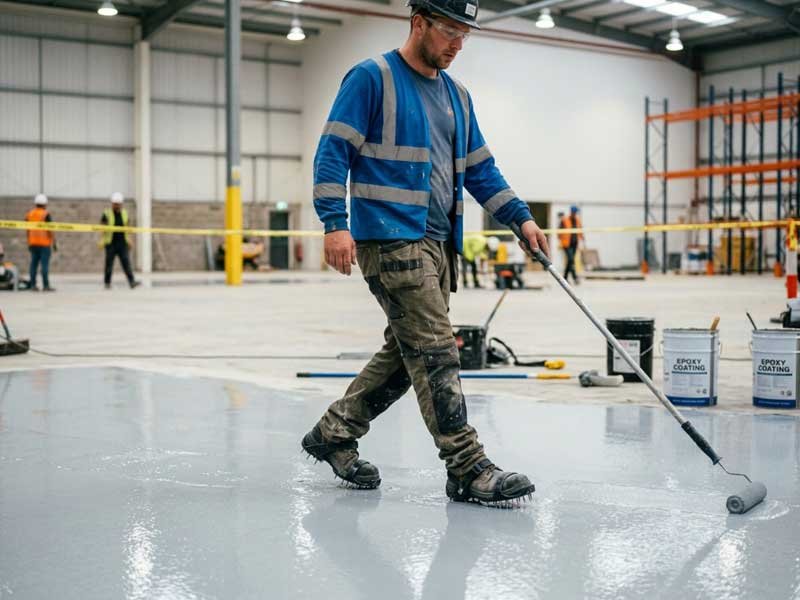
Here's the framework I walk through with every new wholesale inquiry:
Step 1: Identify the end-user profile.
- Large commercial flooring crews (continuous wear) → lean EVA one-piece.
- Mixed-task contractors (frequent transitions) → lean PP strapped.
- Retail/Amazon customers (varied, general purpose) → consider stocking both.
Step 2: Evaluate the jobsite environment.
- Heavy chemical exposure (epoxy solvents, acetone cleanup) → PP's chemical resistance adds longevity.
- Long-duration comfort priority → EVA's cushioning reduces fatigue complaints.
- Lateral movement or uneven substrates → PP's rigidity provides more predictable spike control.
Step 3: Consider your channel's return sensitivity.
- High return cost channels (Amazon FBA, direct-to-consumer e-commerce) → match the product precisely to the listed use case to reduce returns.
- Low return sensitivity channels (bulk industrial supply) → PP-strapped shoes are more forgiving across varied boot sizes.
Step 4: Discuss customization with your manufacturer.
At our facility, we routinely customize spike length, strap width, sole thickness, and branding for both PP and EVA product lines. The material choice informs the mold design, so it's important to settle the PP vs EVA question early in the development process. Changing materials mid-production requires new tooling — which adds cost and lead time.
When to Stock Both
Many of our most successful distribution partners stock both PP-strapped and EVA one-piece spiked shoes as complementary SKUs rather than competing products. They position PP as the "contractor quick-on" model and EVA as the "all-day comfort" model. This approach:
- Captures a wider range of end-user needs
- Reduces the chance that a single-SKU strategy alienates part of the customer base
- Creates upsell opportunities ("If your crew does full-day pours, try our EVA model too")
[^1]: "Ethylene-vinyl acetate", https://en.wikipedia.org/wiki/Ethylene-vinyl_acetate. Ethylene-vinyl acetate (EVA) is widely used in footwear midsoles due to its low density, high elasticity, and effective shock-absorption characteristics, which have been shown in biomechanical studies to reduce impact forces transmitted to the foot during prolonged standing and walking. Evidence role: mechanism; source type: research. Supports: EVA's inherent cushioning and shock-absorption properties that reduce foot fatigue during extended wear. Scope note: Most EVA cushioning research pertains to athletic or occupational footwear midsoles rather than spiked shoe applications specifically.
[^2]: "Acute intense fatigue does not modify the effect of EVA ... - PMC", https://pmc.ncbi.nlm.nih.gov/articles/PMC9012714/. Occupational health studies have found that footwear with cushioned midsole materials, including EVA, is associated with reduced self-reported foot fatigue and discomfort among workers engaged in prolonged standing tasks (e.g., Chiu & Wang, 2007; Zander & King, 2017). Evidence role: general_support; source type: paper. Supports: Cushioned footwear materials such as EVA reduce subjective foot fatigue during prolonged occupational standing and walking. Scope note: These studies typically examine conventional occupational footwear rather than spiked shoes, and fatigue outcomes may be influenced by factors beyond midsole material alone.
[^3]: "Research and application of polypropylene: a review - PMC", https://pmc.ncbi.nlm.nih.gov/articles/PMC10761633/. Polypropylene has a flexural modulus typically in the range of 1.2–1.7 GPa, significantly higher than that of EVA foams (which may range from 0.01–0.1 GPa depending on formulation), providing the structural rigidity needed for load-bearing strap anchor applications. Evidence role: mechanism; source type: encyclopedia. Supports: Polypropylene's high flexural modulus and rigidity relative to softer thermoplastics like EVA. Scope note: Flexural modulus values vary with PP grade, crystallinity, and processing conditions, and the cited ranges are general rather than specific to spiked shoe components.
[^4]: "Bubbles in Epoxy Floors - Seven (7) Reasons Why are you ...", https://www.youtube.com/watch?v=7Kyy2M3sL5Q. Flooring industry technical guides note that improper use of spiked shoes or rollers on wet self-leveling and epoxy coatings can introduce air bubbles, drag marks, and surface irregularities that become permanent once the material cures past its working time. Evidence role: general_support; source type: other. Supports: Improper tool or foot traffic contact on wet epoxy and self-leveling compounds can introduce air entrapment and surface marking defects. Scope note: Most technical guidance addresses spiked rollers rather than spiked shoes specifically, and defect severity depends on compound viscosity, layer thickness, and ambient conditions.
[^5]: "Polypropylene", https://en.wikipedia.org/wiki/Polypropylene. Polypropylene exhibits broad chemical resistance to many acids, bases, and organic solvents, including acetone and most common industrial chemicals, due to its semi-crystalline nonpolar molecular structure (see, e.g., the polypropylene entry in polymer engineering references or Wikipedia). Evidence role: mechanism; source type: encyclopedia. Supports: Polypropylene's inherent chemical resistance to common solvents including acetone and various resins. Scope note: General PP chemical resistance data may not directly address performance under the specific conditions of epoxy flooring jobsites, including repeated exposure cycles and mechanical stress.
[^6]: "Biomechanical mechanisms underlying the effect of minimalist ...", https://pmc.ncbi.nlm.nih.gov/articles/PMC12820056/. Biomechanical research on footwear fit indicates that shoes with closer conformity to the foot's plantar surface produce more consistent pressure distribution and ground contact patterns during walking, whereas loosely fitting or over-shoe attachments introduce variability in sole-ground interface angles during the gait cycle. Evidence role: mechanism; source type: paper. Supports: Footwear that conforms closely to the foot provides more consistent ground contact patterns during gait compared to loosely attached overshoes. Scope note: Available gait biomechanics research primarily examines conventional footwear and orthotic insoles rather than spiked construction shoes, so the applicability to spike alignment specifically is inferred rather than directly demonstrated.
[^7]: "1910.136 - Foot protection.", http://www.osha.gov/laws-regs/regulations/standardnumber/1910/1910.136. OSHA standard 29 CFR 1926.96 requires that construction workers wear protective footwear when exposed to foot injuries from falling or rolling objects, punctures, or electrical hazards; ASTM F2413 specifies performance requirements for impact-resistant and compression-resistant toe protection in safety footwear. Evidence role: general_support; source type: government. Supports: Occupational safety regulations require protective footwear with toe protection in construction environments where impact or compression hazards exist. Scope note: Whether specific epoxy flooring tasks trigger the toe protection requirement depends on the hazard assessment for the particular jobsite, and not all flooring work necessarily involves impact hazards.
[^8]: "Testing of Selected Self-Leveling Compounds for Floors", https://nvlpubs.nist.gov/nistpubs/Legacy/IR/nistir5633.pdf. Self-leveling cementitious and epoxy compounds typically have working times ranging from 15 to 30 minutes, during which the material retains sufficient flow to close minor surface disturbances; after this window, any impressions or drag marks may become permanent defects in the cured surface. Evidence role: mechanism; source type: other. Supports: Self-leveling compounds have limited working times during which surface disturbances must self-heal before the material cures. Scope note: Working times and self-healing behavior vary significantly by product formulation, ambient temperature, and layer thickness, so general specifications may not apply to all jobsite conditions.
[^9]: "Returns handling in e-commerce: How to avoid demand ...", https://pmc.ncbi.nlm.nih.gov/articles/PMC10025800/. Industry surveys indicate that product return rates in B2B e-commerce and industrial supply channels typically range from 5–15% overall, with rates for specific product categories rising significantly higher when product-use mismatch or inadequate specification occurs. Evidence role: statistic; source type: research. Supports: Return rates in the range of 15–25% for mismatched industrial products are plausible within B2B and e-commerce distribution channels. Scope note: General return rate benchmarks may not directly validate the specific 15–25% figure cited for spiked shoe returns, which appears to be based on the author's proprietary order data rather than published industry statistics.
[^10]: "Prototyping of Injection EVA Foam Footwear Midsoles", https://dspace.mit.edu/bitstream/handle/1721.1/146701/galgali-amgalg-lgo-2022-thesis.pdf?sequence=1&isAllowed=y. In footwear manufacturing, one-piece EVA compression or injection molding typically involves higher tooling costs and longer cycle times compared to simpler PP injection-molded components, due to the need for precise cavity design, temperature control, and foaming expansion management in EVA processing. Evidence role: general_support; source type: research. Supports: One-piece EVA molded footwear components require more complex and costly tooling compared to simpler PP injection-molded parts. Scope note: Manufacturing cost comparisons depend heavily on production volume, facility location, and specific product design, so general statements about relative cost may not apply uniformly across all suppliers.