跳到内容

Sourcing factory-direct tools from China sounds straightforward — cut out the middleman, pay less, get more control. But hardware importers and e-commerce sellers discover quickly that the reality is messier. The wrong sourcing model for your order profile can cost you more than a trading company markup ever would — in defective bulk orders, missed deadlines, or SKUs you can never truly own.
The honest answer is that neither factory-direct sourcing nor trading companies is universally superior for tool procurement. The better question is which model fits your specific order volume, customization requirements, and internal sourcing capacity. For buyers placing large, single-SKU custom orders, a direct factory relationship typically delivers lower total cost and tighter quality control. For buyers consolidating multiple product categories below factory MOQ thresholds, a reputable trading company often makes more practical sense.
I run a spiked-shoe factory in Taizhou, Zhejiang. We manufacture epoxy spiked shoes and lawn aerator shoes exclusively for B2B buyers — hardware importers, Amazon sellers, building-material distributors. Over ten years, I have watched buyers switch from trading companies to us, and occasionally I have told buyers they are probably better off staying with a trader — at least for now. This article reflects that real operational experience, not a sales pitch for factory-direct procurement.
Does "Factory-Direct" Always Mean the Lowest Price?
Many buyers assume the factory is always cheapest. The math is rarely that simple.
Factory pricing reflects your order's position within production economics — tooling amortization, MOQ tiers, and run efficiency. A trading company that consolidates ten clients' orders can sometimes deliver a lower unit price than a single buyer placing a 300-piece order directly with the same factory.[^1]

Understanding where your order sits within a factory's cost structure changes everything about how you evaluate price quotes.
The MOQ Threshold Problem
Every factory has a unit-economics floor. For our spiked-shoe production lines, a run below a certain volume does not fully amortize the mold setup, operator time, and material preparation. When a buyer comes to us with a 200-piece order for a custom spike length, the per-unit cost is genuinely higher than what a trading company might quote — because that trader is probably buying 2,000 units across five clients and passing proportional savings downstream.
This is not a trading company conspiracy. It is simple production math.
Here is how the cost dynamics typically break down across order sizes:
| Order Size | Factory-Direct Economics | Trading Company Economics |
|---|---|---|
| Below factory MOQ | Higher per-unit cost, often inflexible | Trader consolidates across buyers — may beat factory quote |
| At or near factory MOQ | Roughly equivalent; direct relationship advantage begins | Trader margin adds cost without clear benefit |
| Well above factory MOQ | Factory-direct typically wins on price and customization | Trader adds cost and reduces traceability |
| Multi-category, small per-SKU | Factory cannot serve multiple categories | Trader's core value proposition |
Where Factory-Direct Pricing Actually Wins
The math shifts decisively toward factory-direct when:
- Your order volume consistently meets or exceeds the factory's MOQ — you are no longer subsidizing other buyers' volume deficits.
- You are investing in custom tooling — a mold you pay for belongs to your product. A trader who sources from multiple factories has no reason to protect your tooling investment or your design exclusivity.
- You are reordering the same SKU repeatedly — the factory's amortized setup cost drops with each repeat run. Traders often re-source each batch, resetting that clock.
- Shipping consolidation is not a factor — if you are ordering enough volume to fill your own container, you lose one of the trader's logistical advantages.
The bottom line: do not evaluate factory-direct pricing on a single sample quote. Evaluate it across your projected 12-month order volume and reorder frequency.
Is the "Factory" You Found on Alibaba Actually a Factory?
This is the question I am asked most often by buyers who have been burned. The short answer is: not always.
Many suppliers listed as "manufacturers" on B2B platforms are trading companies operating a showroom-level assembly space or renting occasional access to production equipment. Verifying actual manufacturing capability requires specific documentation requests — not just a factory tour video or a Gold Supplier badge.[^2]

The tells are practical, not philosophical. Here is what I recommend buyers request, and what those requests reveal.
Documentation That Separates Real Factories from Traders
Mold room photos with date-stamped inventory records. A factory manufacturing injection-molded products — like spiked shoes — owns physical molds. Ask for photos of the mold room, including the mold numbering system and any maintenance logs. A trading company sourcing from a third-party factory will either deflect this request or provide photos they do not actually control.
In-process quality control records. Real manufacturers generate QC data during production — dimensional checks, material batch records, defect tallies. Ask for a sample QC report from a previous production run, with product specifications matching your category. Generic certificates do not substitute for process-level documentation.
Raw material purchase receipts or supplier invoices. A factory buying PP resin, steel spike rod, or EVA foam directly will have purchase records from material suppliers. A trader sourcing finished goods will not have these — or will struggle to produce them quickly.
Capacity evidence. Ask how many production lines run the product you need, and what monthly output they can sustain. Then ask what the current lead time is and why. A factory with genuine capacity can answer specifically. A trader relaying information from a third-party factory will give vague ranges.
Video call during production hours. Request a live video walkthrough of the production floor during your product's relevant process — molding, assembly, or packaging. This is a reasonable request for any significant B2B order. A real factory can accommodate it. A trading company operating from a showroom cannot.
From our own experience: When buyers ask us for mold room access during a video call, we walk them through our injection mold storage directly. That single request filters out a surprisingly large number of misrepresentations in the market.
Can the Supplier Actually Deliver Your Customization?
Customization capability is not a factory default. It is a function of engineering investment, mold ownership, and operational willingness — and small factories often lack all three.
Real OEM/ODM tool manufacturing — covering new spike geometries, anti-corrosion material specifications, and private-label packaging — requires a factory that owns its own tooling, employs in-house engineering, and is willing to commit capital to new mold development. Many "factories" on sourcing platforms can only run standard molds and rebrand existing products.
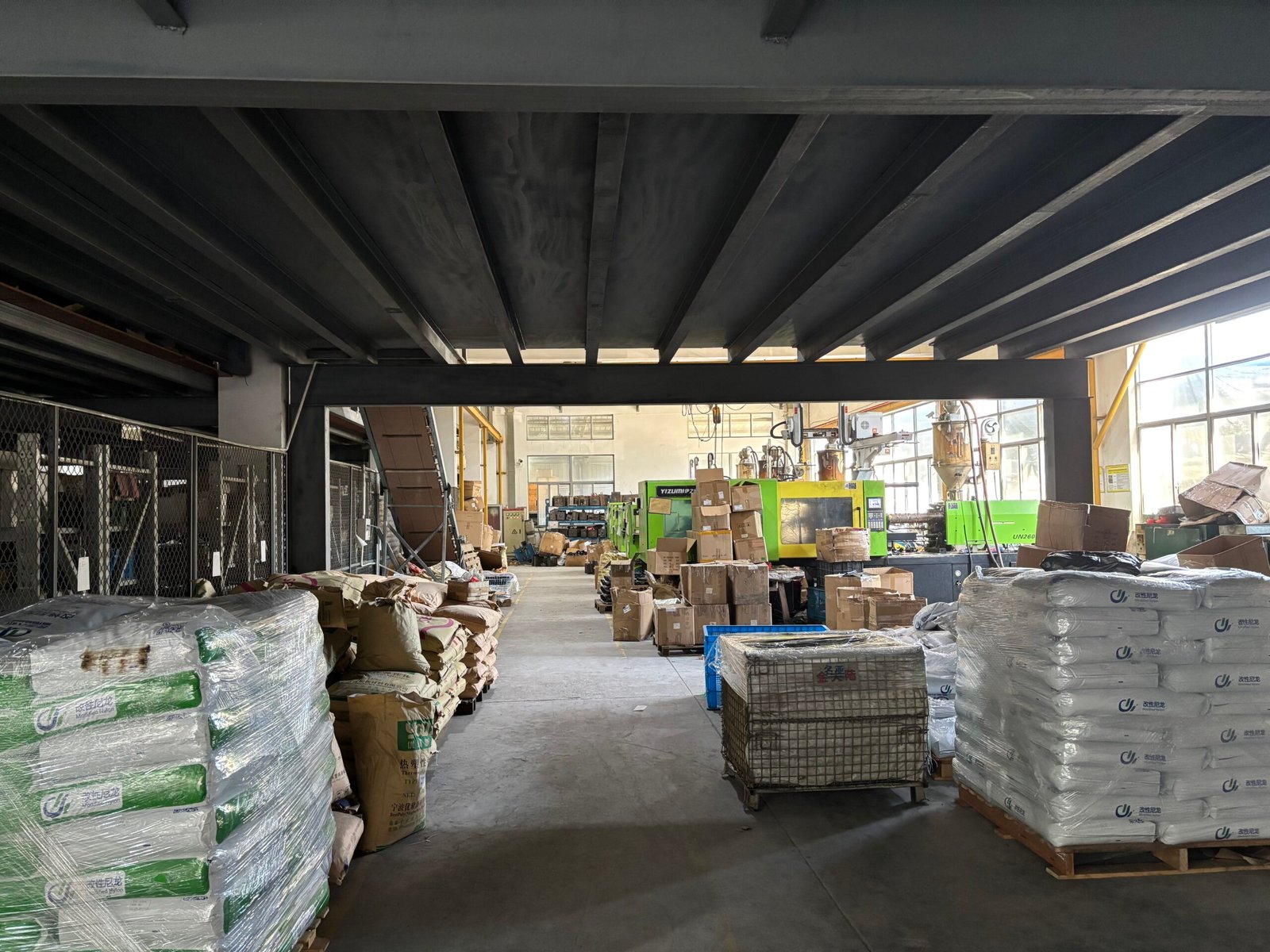
This is where the factory-vs-trader question gets genuinely complicated — because a well-connected trading company with a vetted factory network can sometimes deliver customization more flexibly than a single small factory.
What Real OEM/ODM Capability Looks Like
When buyers come to us needing a custom spike configuration — for example, a longer spike for FRP lining work, or a chemical-resistant PP formulation for polyurethane roofing environments — the process involves:
- Concept and specification review — understanding the application environment, load requirements, and surface compatibility.
- 3D prototype development — before any mold investment, prototypes confirm fit and function.
- Mold investment decision — this is where commitment becomes real. New spike geometries require new tooling. We own our molds; buyers who invest in custom tooling with us retain exclusivity on that design.
- Material sourcing and testing — anti-corrosion applications require material verification against the specific chemical environment, not just a generic "chemical resistant" label.
- Sample approval with documented deviations — the sample approval stage must produce a written specification document that governs bulk production. Without it, bulk deviation from the approved sample has no accountable reference point.
Where Trading Companies Can Outperform on Customization
A specialized trading company with relationships across five or six factories can sometimes source a custom configuration faster than a single factory that would need to invest in new tooling. This matters when:
- Your required customization is adjacent to something another factory already produces — the trader can source from a factory with the existing mold.
- Your order volume does not justify the tooling investment a dedicated factory would require.
- You need customization across multiple product categories simultaneously — a trader coordinating three factories may execute faster than you managing three direct factory relationships independently.
The caveat: if the customization is product-defining — if the spike configuration or material spec is your competitive differentiation — you need to own the tooling. A trading company cannot guarantee design exclusivity across its factory network.
Who Actually Owns Your Quality Variance?
Quality control is not a factory-vs-trader question about which supplier is "better." It is a structural question about who owns the variance when bulk production deviates from the approved sample.
When a trading company sources from different factories across batches, the buyer loses production traceability. The trader owns the commercial relationship but not the manufacturing process. For e-commerce sellers whose store ratings depend on consistent product performance, that structural gap in accountability is a genuine operational risk.[^3]

I want to be careful here. Trading companies are not inherently low-quality suppliers. Many operate rigorous pre-shipment inspection programs and manage their factory networks professionally. The structural issue is accountability — not intent.
The Batch-Switching Problem
Here is a scenario I have heard from buyers multiple times:
"Our first order was perfect. Second order, the spike height was slightly shorter and the strap buckles cracked within a month. The trader said it was within tolerance. We had no way to verify which factory produced which batch."
When a trading company sources from Factory A in Q1 and Factory B in Q2 — because Factory A was full, or because Factory B offered a lower price — the buyer's approved sample becomes a reference point that no single factory is contractually bound to replicate.[^4] The trader holds the contract; neither factory owns the quality commitment.
With factory-direct procurement, the accountability chain is direct:
- Your approved sample is on file at the factory that produced it.
- Your tooling — if custom — is physically in that factory.
- Your QC records reference that factory's specific process.
When bulk deviates, you can trace the variance to a specific machine, operator, or material batch. You have someone to hold accountable, not just someone to negotiate a credit with.
What Buyers Should Build Into Any QC System
Regardless of sourcing channel, these practices reduce quality risk:
- Written sample approval with dimensional tolerances — not just "approved" but "approved with maximum deviation of X mm on spike height."
- Pre-shipment inspection by a third party — especially for first orders with any supplier.
- Retain reference samples from every approved batch — physically, not just photographically.
- Request material test reports for each production batch — not just a one-time certification.
When Does Switching From a Trading Company to Factory-Direct Make Sense?
Buyers already working with a trading company often ask this — and the answer depends on switching costs, not just potential savings.
Transitioning from a trading company to factory-direct procurement involves re-sampling, renegotiating payment terms, self-managing logistics, and potentially investing in custom tooling.[^5] The transition makes financial sense when your order volume is large enough and stable enough that these one-time friction costs are recovered within two or three order cycles.

What the Transition Actually Involves
Re-sampling from scratch. Even if you have an approved sample from your current supplier, a new factory needs to produce and approve its own reference sample. This takes time — typically two to four weeks for standard configurations — and may reveal specification gaps your previous approval process glossed over.
New payment terms negotiation. Factories often require higher upfront deposits than trading companies, especially for new buyer relationships.[^6] This affects your cash flow until trust is established.
Self-managed logistics. Trading companies often handle freight forwarding, customs documentation, and consolidation as part of their service. Going factory-direct means owning these logistics functions — either in-house or through a freight forwarder you manage directly.
Tooling investment for custom products. If your product requires custom tooling, you are now paying for that mold. This is a switching cost — but also an investment that protects your design going forward.
Scenarios Where the Switch Is Worth It
- You are reordering the same SKU every quarter and volume consistently exceeds the factory's MOQ.
- Your product has been copied or your specifications have drifted — and you need to lock down your design through owned tooling.
- Your store ratings or client relationships are suffering from quality inconsistency that traces back to batch-switching.
- You have built enough internal sourcing capacity — or a reliable freight forwarder relationship — to absorb the logistics overhead.
Scenarios Where Staying With a Trader Makes Sense
- You source five or more product categories and each SKU volume is below factory MOQ for the respective category.
- Your business is in early growth and you need sourcing flexibility more than cost optimization.
- You lack the internal bandwidth to manage direct factory relationships, sampling coordination, and self-managed logistics simultaneously.
Frequently Asked Questions
What is the real difference between a factory and a trading company for tool sourcing?
A factory manufactures products directly — owning the production equipment, tooling, and process. A trading company sources from factories and adds a margin for coordination, logistics, and multi-category sourcing services. The distinction matters for customization depth, quality traceability, and pricing at higher volumes.
How do I verify that a Chinese supplier is actually a factory?
Request mold room photos, in-process QC records, and raw material purchase receipts. Ask for a live video walkthrough during production hours. Legitimate factories can provide all three. Trading companies typically cannot, or will provide documentation they do not directly control.
Can a trading company deliver better customization than a factory?
Sometimes, yes. A well-connected trading company with a vetted factory network can source adjacent custom configurations without requiring new tooling investment. However, for product-defining customization — new spike geometries, proprietary materials, private-label packaging — buyers need owned tooling and a direct factory relationship to guarantee design exclusivity.
What is a realistic MOQ for factory-direct spiked shoe procurement?
MOQ thresholds vary by product type and customization level. Standard configurations typically carry lower MOQs than fully custom molds. For application-specific products — such as anti-corrosion spikes for FRP or polyurethane environments — buyers should discuss MOQ requirements directly with qualified manufacturers, as tooling investment and material sourcing affect the minimum viable run size.
How long does switching from a trading company to factory-direct procurement take?
Allow four to eight weeks minimum for a smooth transition — covering re-sampling, sample approval, tooling confirmation (if custom), and first-order production. Buyers who skip re-sampling to save time frequently encounter bulk deviations that cost more than the transition savings justified.
Conclusion
The factory-direct vs. trading company decision for tools is fundamentally about matching your sourcing model to your order profile, not chasing a universal best practice. Factory-direct procurement delivers the clearest advantages when order volume is consistent, customization is product-defining, and quality traceability directly affects your business reputation. Trading companies remain the smarter choice when you are consolidating multiple small-volume SKUs, building sourcing flexibility in early growth stages, or relying on logistics bundling you cannot yet manage independently.
I am transparent that I run a factory — but I hope this article demonstrates that the honest answer serves buyers better than a sales pitch does. If you are evaluating factory-direct sourcing for spiked shoes or similar niche construction tools, and your order profile fits the scenarios outlined here, I am glad to discuss what a direct manufacturing relationship would actually look like for your business.
Contact us at chunjiaojohn@gmail.com or WhatsApp +86 15988980367 to request samples, discuss MOQs, or explore OEM/ODM customization for your product line.
[^1]: "Intermediate Goods Imports in Key U.S. Manufacturing ...", https://www.usitc.gov/research_and_analysis/trade_shifts_2017/specialtopic.htm. Research on supply chain intermediaries documents that trading companies can leverage aggregated order volumes to negotiate pricing below what individual small buyers could achieve directly with manufacturers, a function of fixed-cost amortization across larger production runs. Evidence role: mechanism; source type: research. Supports: That intermediaries can achieve lower per-unit costs through order aggregation and volume consolidation across multiple buyers.. Scope note: Most supply chain literature addresses intermediary economics broadly; direct empirical data specific to Chinese tool manufacturing consolidation is limited.
[^2]: "Evaluating the drivers of B2B performance - PMC - NIH", https://pmc.ncbi.nlm.nih.gov/articles/PMC11244795/. Alibaba's own documentation indicates that Gold Supplier status primarily reflects membership payment and basic identity verification rather than independent assessment of production capacity or manufacturing authenticity. Evidence role: definition; source type: institution. Supports: What Alibaba's Gold Supplier designation actually verifies and what it does not cover regarding manufacturing capability.. Scope note: Platform certification criteria change over time; buyers should consult current Alibaba documentation for the most accurate description of what each badge verifies.
[^3]: "How Fake Customer Reviews on Amazon Distort Markets", https://anderson-review.ucla.edu/how-fake-customer-reviews-on-amazon-distort-markets/. E-commerce platform research documents a strong relationship between product quality complaints and negative seller ratings, with review systems on major platforms amplifying the reputational impact of inconsistent product performance across order batches. Evidence role: general_support; source type: research. Supports: That product quality inconsistency generates negative reviews and seller metric degradation on e-commerce platforms, creating measurable business risk for sellers.. Scope note: Most available research addresses review dynamics generally rather than isolating the specific contribution of supply chain batch-switching to quality variance.
[^4]: "Supply chain resilience: A review from the inventory ... - PMC", https://pmc.ncbi.nlm.nih.gov/articles/PMC11997565/. Supply chain management literature identifies multi-tier supplier opacity as a structural quality risk, noting that intermediaries who allocate orders across factory networks based on capacity or price introduce variability that buyers cannot trace to specific production processes. Evidence role: general_support; source type: research. Supports: That supply chain intermediaries sourcing from multiple factories across order cycles create quality traceability gaps for buyers.. Scope note: Most literature addresses multi-tier supply chain opacity in broader contexts such as apparel or electronics; direct evidence specific to Chinese tool trading companies is limited.
[^5]: "Transaction Cost Economics As a Theory of Supply Chain ...", https://josephmahoney.web.illinois.edu/BA549_Fall%202018/Session%202/Ketokivi%20and%20Mahoney_%202020.pdf. Transaction cost economics and procurement research identify supplier switching costs as comprising relational, operational, and asset-specific components — including re-qualification, renegotiation, and sunk investments in tooling or process documentation — that must be weighed against anticipated savings from a new supply arrangement. Evidence role: mechanism; source type: research. Supports: That switching between supplier types in procurement involves identifiable categories of transition costs beyond simple price comparison.. Scope note: Academic switching cost frameworks are typically generalized; the specific cost magnitudes for China tool sourcing transitions depend on product complexity and buyer operational capacity.
[^6]: "China - Methods of Payment | export.gov", https://legacy.export.gov/article?id=China-Methods-of-Payment. Trade finance and export procurement guides document that Chinese manufacturers typically require 30–50% upfront deposits from new buyers before commencing production, a practice reflecting the absence of established credit relationships and the capital requirements of production setup. Evidence role: general_support; source type: institution. Supports: That Chinese manufacturers commonly require substantial upfront deposits from new international buyers, reflecting credit risk management in export manufacturing.. Scope note: Payment term norms vary by factory size, product category, and buyer history; the claim that factories require higher deposits than trading companies specifically is a generalization that may not hold across all sourcing contexts.