跳到内容

Most importers build their flooring tools catalog from a checklist: trowels, spreaders, mixers, spiked shoes. The list looks complete. Then the returns arrive — punctured self-leveling floors, snapped straps, angry contractors. The risk was never the tool category. It was the spec inside it.
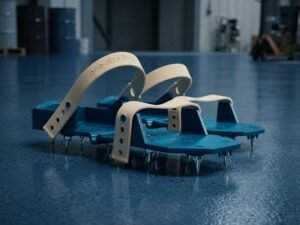
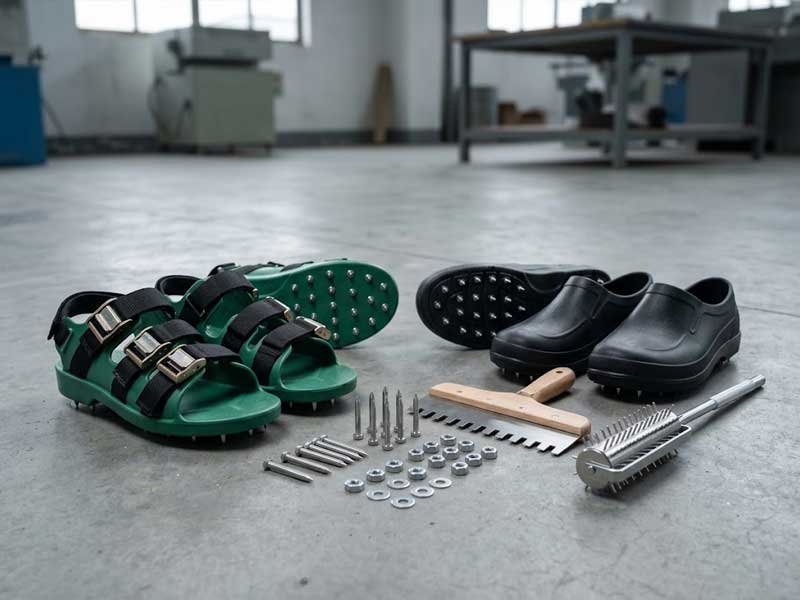
Among all flooring tools an importer stocks, spiked shoes carry the highest hidden liability, because spike length, spike density, and strap or sole material must match the specific substrate — epoxy, self-leveling cement, polyurethane, or microcement. Importers should vet spec-to-surface compatibility and supplier OEM capability before price, not after the first complaint.
Every other tool on a contractor's cart leaves a mark that can be fixed. A wrong spiked shoe leaves a hole in a cured surface. Below, I break down how we see importers get this wrong — and the exact questions that prevent it.
Which flooring tools actually carry the most sourcing risk for importers?
Importers usually rank flooring tools by unit value. Mixers and power screeds get scrutiny. Spiked shoes get a quick price check. That ranking is backwards from a liability standpoint, and I see it in almost every first inquiry we receive.
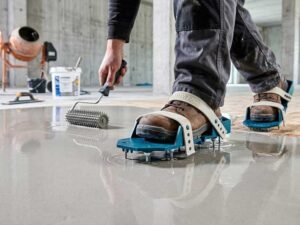
Among common flooring tools, spiked shoes carry disproportionate sourcing risk because they are the only item that physically penetrates a fresh, high-value coated surface. A €12 consumable can compromise a €6,000 commercial epoxy floor[^1], which is why spec accuracy matters more than unit cost.
Why the risk profile is asymmetric
Think about failure consequences rather than failure rates.
| Flooring tool | Typical failure mode | Who absorbs the cost |
|---|---|---|
| Notched squeegee | Uneven spread thickness | Installer reworks a section |
| Mixing paddle | Bent shaft, poor blend | Installer replaces the part |
| Spiked shoes (self-leveling / epoxy) | Punctured or dented cured surface, strap failure mid-pour | End client, then the contractor, then the brand on the strap |
| Moisture meter | Misread substrate | Delayed schedule |
Only the spiked shoe pushes the cost up the chain to the importer's brand label[^2]. That is the core reason I argue importers should treat spiked shoes as a technical component, not a low-margin accessory thrown into a flooring tools bundle.
What this changes about your buying process
In our OEM quoting conversations, the importers who avoid trouble do three things differently:
- They ask what substrate their end customer works with before requesting a quote.
- They request the spike drawing, not just a product photo.
- They treat spike geometry as a variable, not a fixed factory default.
The importers who struggle usually ask only two questions: price and MOQ. I understand why — margins are thin in hardware distribution. But a single liability claim erases the margin on thousands of pairs[^3]. Application-specific suitability should always be confirmed by the contractor or a qualified flooring professional on the buyer's side, since they know the resin system and cure schedule in use.
Why do longer, denser spikes fail on self-leveling and epoxy floors?
A recurring request in our inbox reads something like: "Can you make the spikes longer and add more of them? Our customers want maximum grip." The logic feels sound. In practice, this is the single most common misconception I correct when quoting self-leveling spiked shoes.
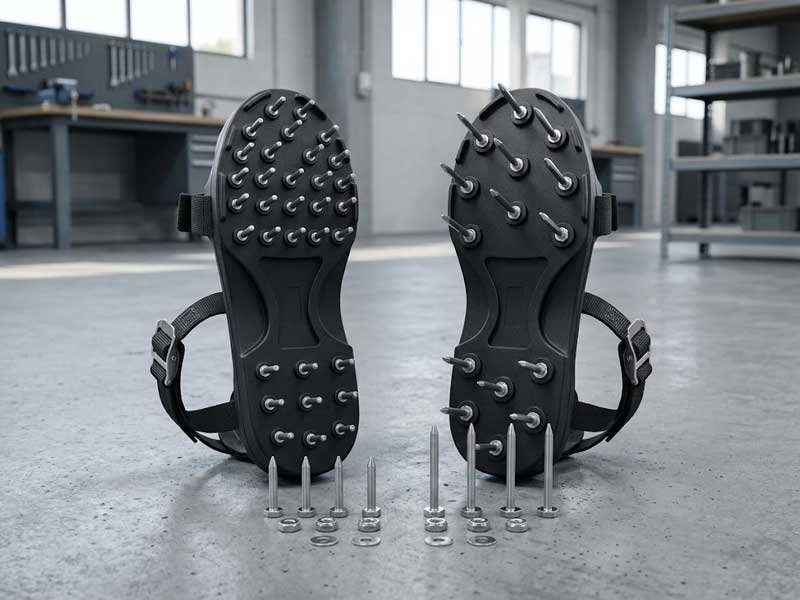
Longer and denser spikes increase the total displacement a shoe creates in a semi-cured surface. Self-leveling compounds and epoxy coatings rely on self-closing flow after the spike exits[^4]. Excess spike length or count leaves holes that do not close, producing visible pinholes, ridges, and callbacks.
Geometry is a trade-off, not an upgrade
Three variables interact, and importers often adjust one in isolation:
- Spike length — determines penetration depth relative to coating thickness. A spike longer than the pour depth contacts the substrate and can lift material as the boot rises.
- Spike count and spacing — controls load distribution. More spikes mean lower pressure per spike, but more total entry points in the surface.
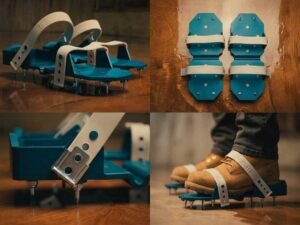
- Spike diameter and tip profile — a fine tapered tip displaces less material than a thick blunt one at the same length.
The engineering goal for self-leveling and epoxy work is minimum surface contact with adequate stability — enough spikes to keep the operator upright, in the slimmest profile the application tolerates. That is the opposite of "more is better."
How this shows up as a commercial problem
If you private-label a shoe with aggressive spike geometry and market it on "maximum traction," you are advertising the exact property that causes complaints. I have seen importers unknowingly do this because the factory's stock mold was originally designed for soil penetration, not resin flooring[^5].
A spike profile tuned for lawn aeration is not a coating-safe profile. Same product shape, different physics.
A practical safeguard: ask any supplier to state, in writing, the coating thickness range each spike length is intended for. If they cannot, you are buying a shape rather than a specification. Then have your contractor customers evaluate samples on their own systems before you commit to volume.
Can one pair of spiked shoes work on epoxy, self-leveling cement, PU, and microcement?
This is the second question I field almost weekly. Importers want one SKU that covers every flooring job, because one SKU means simpler inventory, simpler listings, and simpler photography. I understand the appeal. The substrates disagree.
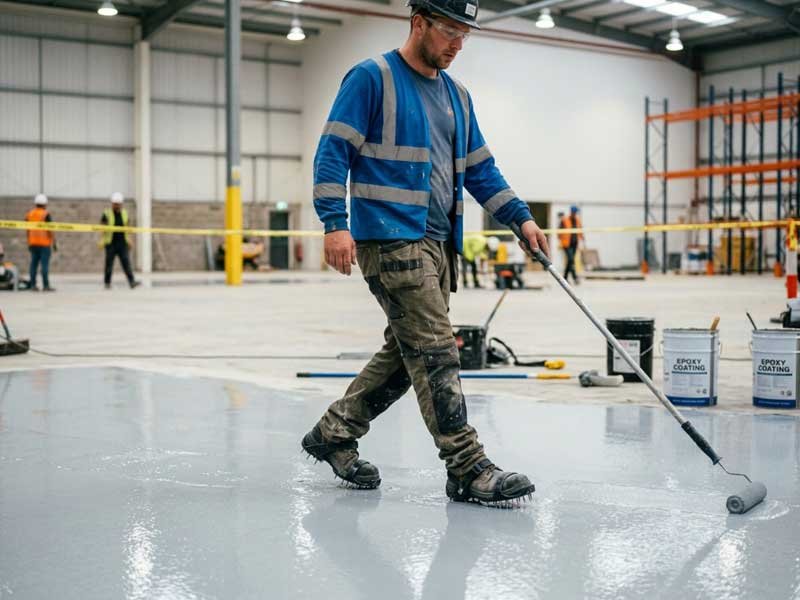
No single spiked shoe suits epoxy, self-leveling cement, polyurethane, and microcement equally. These systems differ in cure hardness, open time, thickness, and self-closing behaviour. A universal shoe is a compromise on every surface, and marketing it as universal transfers risk to the importer's brand.
Substrate behaviour differs in ways that matter
| Substrate | General thickness range | Behaviour importers should consider |
|---|---|---|
| [Self-leveling cement | 3–10 mm typical](https://nvlpubs.nist.gov/nistpubs/Legacy/IR/nistir5633.pdf)[^6] | Flows and closes well early; window closes fast[^7] |
| [Epoxy coating / screed | 0.3–6 mm depending on system](https://industrial.sherwin-williams.com/na/us/en/resin-flooring/contractor-center/technical-articles/thick-epoxy-floor-coating.html)[^8] | Thin builds leave little margin for spike length error |
| Polyurethane | Thin to mid build | More elastic; tip profile and exit angle matter[^9] |
| [Microcement | Very thin, hand-finished](https://www.youtube.com/watch?v=dPE9Br6H-8U)[^10] | Frequently finished by hand; spiked access is often limited |
These are general ranges drawn from product literature, not measurements I have taken on site. The point is the spread: a spike length reasonable for a 8 mm self-leveling pour is unreasonable for a 0.5 mm epoxy topcoat.
The practical fix for importers
Instead of one universal SKU, most importers we work with settle on a two or three tier range:
- Short-spike tier — thin-build coatings, where minimal displacement dominates.
- Standard-spike tier — general self-leveling and mid-build epoxy work, the volume seller.
- Specialty tier — corrosion-resistant or longer-strap configurations for FRP lining and roof waterproofing contractors.
This structure does three commercial things at once. It raises your average order value, it gives your sales team a real reason to ask the customer a qualifying question, and it stops one bad match from contaminating your whole flooring tools line. Customization of spike length is straightforward at the tooling stage, which is precisely why it should be decided during sourcing rather than after launch.
PP strapped or EVA one-piece — which flooring tool construction should you stock?
Once spike geometry is settled, the next fork appears: strapped shoes over work boots, or an integrated one-piece unit. Importers often pick based on photos. The materials behave differently in chemical environments, and that difference drives returns.
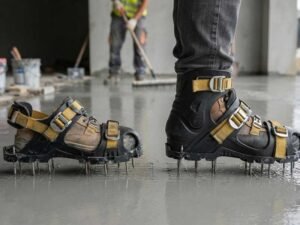
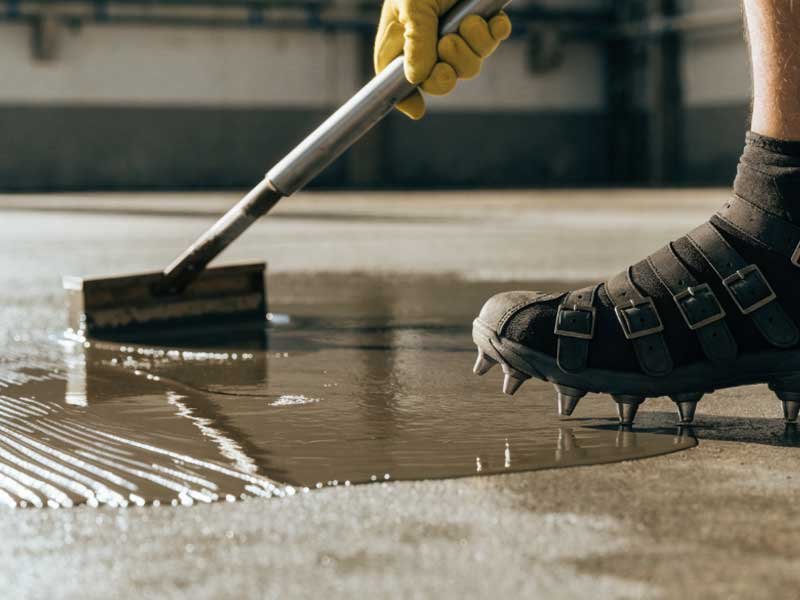
Strapped PP spiked shoes fit over existing work boots and suit shared or rental use, while one-piece EVA units are lighter, strap-free, and favoured for long shifts. PP resists chemical exposure and abuse on straps[^11]; EVA prioritises comfort and speed of use. Stock both if your customer base is mixed.
Comparing the two constructions
| Factor | Strapped (PP base) | One-piece (EVA) |
|---|---|---|
| Fit | Adjustable over most work boots | Sized, worn directly |
| Put-on time | Slower, buckles and straps | Fast, step-in |
| Shared use | Good — crews pass them around | Limited by size |
| Weight | Higher | Lower |
| Typical complaint | Strap wear, buckle failure | Sizing mismatch |
| Buyer profile | Contractor crews, rental yards | Solo applicators, long shifts |
What to scrutinise in each
For strapped types, the strap and buckle are the failure point, not the plate. In our own production we specify heavy-duty strap webbing for this reason, and I would tell any importer to request strap tensile and buckle details from whichever factory they use. Ask what happens after repeated exposure to epoxy solvents and cleaning agents.
For one-piece EVA units, the questions shift to density, sizing accuracy, and spike anchoring. An EVA body that is too soft lets spikes rock under load[^12]. Too hard, and the comfort advantage disappears. Consistent sizing across production
[^1]: "Epoxy Flooring Cost Per Sq Ft: 2026 DIY vs Installed Prices", https://armorgarage.com/blog/epoxy-flooring-cost-per-square-foot/?srsltid=AU7gw4XqlTjiLfpd5EPOZkGuE00ICC7Byexs1Xi6-CJcG87oZxoIM7mH. Industry cost guides for commercial epoxy flooring systems report installed costs that can reach several thousand euros for moderate-sized projects, supporting the claim that accessory-level tool failures can cause disproportionate financial damage relative to their unit cost. Evidence role: statistic; source type: research. Supports: Typical cost ranges for commercial epoxy floor installations to contextualize the financial risk of tool-related damage. Scope note: Costs vary significantly by region, resin system, and project scope; a single benchmark figure may not represent all markets.
[^2]: "products liability | Wex | US Law | LII / Legal Information Institute", https://www.law.cornell.edu/wex/products_liability. Under the EU Product Liability Directive (85/374/EEC, revised 2024), importers who place products on the EU market under their own brand may be held liable as producers for damage caused by defective products, establishing a legal basis for liability to travel upstream from the end user to the importer. Evidence role: general_support; source type: government. Supports: The legal framework under which importers bear product liability for branded tools that cause damage to end-user property. Scope note: The directive addresses general product liability; its specific application to flooring tool failures would depend on case-specific circumstances and national implementation.
[^3]: "Managing the Product Recall Process", https://rbr.business.rutgers.edu/sites/default/files/documents/rbr-060109.pdf. Industry analyses of product liability in hardware and construction tool distribution indicate that legal defense costs, settlements, and associated recall expenses for a single claim can reach tens of thousands of euros, far exceeding cumulative margins on low-unit-value consumable products. Evidence role: general_support; source type: research. Supports: The disproportionate financial impact of product liability claims relative to per-unit profit margins for low-cost imported hardware products. Scope note: Specific claim costs vary enormously by jurisdiction, severity of damage, and whether the case is settled or litigated.
[^4]: "A critical review of rheological models in self-compacting ...", https://pmc.ncbi.nlm.nih.gov/articles/PMC10693590/. Research on the rheology of self-leveling cementitious compounds describes their yield stress and viscosity profiles, which govern the material's ability to flow back into displaced areas and achieve a smooth surface after localized disturbance. Evidence role: mechanism; source type: paper. Supports: The rheological behavior of self-leveling cementitious and epoxy systems that allows displaced material to flow back and close small voids. Scope note: Most rheological studies focus on mix design and placement rather than specifically on spike shoe penetration and recovery.
[^5]: "Aerating Shoes? : r/lawncare", https://www.reddit.com/r/lawncare/comments/fveiqm/aerating_shoes/. Product catalogs and trade references indicate that spiked shoe designs marketed for flooring applications frequently share spike geometry and sole plate dimensions with lawn aeration sandals, reflecting shared manufacturing tooling rather than application-specific engineering. Evidence role: historical_context; source type: other. Supports: The design lineage of spiked shoes sold for flooring work, many of which share tooling with lawn aeration products. Scope note: Documented evidence of this tooling crossover is largely anecdotal and found in trade forums rather than formal publications.
[^6]: "Testing of Selected Self-Leveling Compounds for Floors", https://nvlpubs.nist.gov/nistpubs/Legacy/IR/nistir5633.pdf. Technical data sheets from major self-leveling compound manufacturers and guidance from flooring trade associations typically specify application thicknesses in the range of 2–10 mm for standard self-leveling underlayments, consistent with the 3–10 mm range cited. Evidence role: general_support; source type: institution. Supports: Standard application thickness ranges for self-leveling cementitious compounds used in flooring. Scope note: Specific thickness ranges vary by product formulation and manufacturer; some specialty products allow thicknesses up to 30 mm or more.
[^7]: "Working with Self-Leveling Underlayments", https://piprolink.com/working-with-self-leveling-underlayments/. Technical data sheets for self-leveling cementitious compounds typically report working times of 15–30 minutes at 20°C, after which the material's viscosity increases rapidly and its ability to flow and self-level diminishes significantly. Evidence role: mechanism; source type: research. Supports: The limited open/working time of self-leveling cementitious compounds during which the material remains fluid enough to self-close. Scope note: Working times vary considerably with ambient temperature, humidity, and product formulation.
[^8]: "How Thick Should an Epoxy Floor Coating Be?", https://industrial.sherwin-williams.com/na/us/en/resin-flooring/contractor-center/technical-articles/thick-epoxy-floor-coating.html. Industry classifications for resinous flooring systems, such as those published by the International Concrete Repair Institute (ICRI) and resin flooring trade bodies, distinguish thin-film coatings (typically under 1 mm) from self-leveling epoxy systems (commonly 2–6 mm), broadly consistent with the 0.3–6 mm range cited. Evidence role: general_support; source type: institution. Supports: Typical build thickness ranges for epoxy floor coating and screed systems. Scope note: Classification systems vary by organization, and some high-build epoxy mortar systems exceed 6 mm.
[^9]: "Epoxy vs Polyurethane Flooring: Understand the differences", https://www.youtube.com/watch?v=oD2Cio0m3TM. Comparative studies of resinous flooring materials report that polyurethane systems typically exhibit significantly higher elongation at break and flexibility than epoxy systems, which influences how the cured or semi-cured film deforms around and recovers from localized point loads. Evidence role: mechanism; source type: paper. Supports: The higher elasticity and elongation at break of polyurethane flooring systems compared to epoxy, which affects how the material responds to spike penetration and withdrawal. Scope note: Mechanical properties vary widely across PU and epoxy formulations; the comparison holds as a general trend rather than a universal rule.
[^10]: "Detailed Application Video for Microcement Wall and Shower ...", https://www.youtube.com/watch?v=dPE9Br6H-8U. Technical literature from microcement system manufacturers describes application in multiple thin layers, typically 1–3 mm total build, applied and finished by hand with trowels, which inherently limits the use of spiked access shoes due to the minimal film thickness and manual finishing process. Evidence role: definition; source type: institution. Supports: The typical application thickness and hand-finishing technique used for microcement flooring systems. Scope note: Microcement is a broad category with varying formulations; some systems may differ in thickness and application method.
[^11]: "CHEMICAL COMPATIBILITY CHART", https://www.wisconsin.edu/ehs/download/Fisher-Scientific-Chemical-Compatibility-Chart.pdf. Standard polymer reference sources and chemical compatibility charts indicate that polypropylene exhibits good to excellent resistance to a wide range of acids, bases, and organic solvents commonly encountered in flooring installation environments. Evidence role: general_support; source type: encyclopedia. Supports: The chemical resistance properties of polypropylene when exposed to common flooring chemicals including epoxy resins and solvents. Scope note: Resistance depends on concentration, temperature, and exposure duration; some aggressive solvents used in flooring (e.g., MEK, xylene) can degrade PP over prolonged contact.
[^12]: "Nanocomposite Foams with Balanced Mechanical Properties ...", https://pmc.ncbi.nlm.nih.gov/articles/PMC9968182/. Research on EVA foam in footwear and industrial applications demonstrates that compression modulus and resistance to lateral deformation increase with foam density, and that lower-density EVA exhibits greater deformation under point loads, which would reduce the stability of embedded spike anchors. Evidence role: mechanism; source type: paper. Supports: The relationship between EVA foam density/hardness and its ability to rigidly anchor embedded components under compressive and lateral loads. Scope note: Most published EVA research focuses on footwear midsole cushioning rather than spike anchoring in flooring tools specifically.