跳到内容

Lawn aeration shoe benefits are frequently misunderstood — not because the category lacks value, but because buyers evaluate the wrong variables. If you're sourcing a lawn aerator shoe at volume, a generic "more spikes = better aeration" assumption will cost you returns, repositioning, or worse, a damaged brand relationship with your distribution channel.
Lawn aeration shoes deliver measurable soil health benefits — improved water infiltration, root zone oxygenation, and reduced surface compaction[^1] — but only when spike geometry (length, count, and spacing) is matched to the target soil type. A product with the wrong spike configuration does not simply underperform; it creates a specific, identifiable failure mode that shows up as customer complaints and return requests.
The real decision you're making when you source a lawn aerator shoe is not aesthetic. It's an engineering decision dressed up as a product category. The sections below break down each spec variable, what it controls agronomically, and what happens when it's wrong in your product line.
How Do Lawn Aeration Shoes Actually Work?
Most buyers come to us with a reasonably clear picture: spikes go into the ground, holes form, grass breathes better. The mechanism is correct in outline but vague in the details that actually determine product performance.
Lawn aeration shoes work by driving steel spikes into compacted soil under the user's body weight, creating narrow vertical channels that allow air, water, and nutrients to penetrate below the root-blocking thatch layer. This mechanical decompaction is fundamentally different from walking on a lawn without spikes — unspike shoe soles compress and seal soil rather than open it.
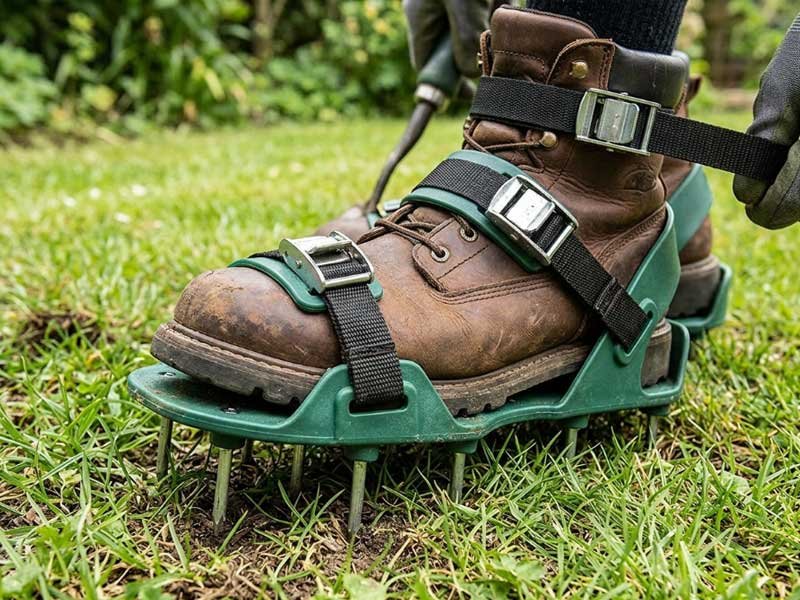
Understanding this distinction — compression versus perforation — is the first filter for evaluating whether a product you're sourcing will actually deliver the benefit your customers expect.
Why Ordinary Footwear Fails at Aeration
Spike-based aeration works on the opposite principle:
- Concentrated load at a small point — the spike tip focuses pressure to penetrate, not distribute[^3]
- Vertical channel formation — the spike body displaces soil radially outward, leaving a cylindrical void when withdrawn[^4]
- Sustained open structure — unlike surface compression, a properly formed spike hole retains its shape long enough to allow infiltration before soil naturally backfills
From a manufacturing standpoint, the spike tip geometry and material hardness are what make this work. We produce spikes in hardened steel specifically because softer or blunted tips cannot maintain this focused penetration, especially in clay-dominant soils.
B2B implication: If you're selling into a market where buyers include commercial lawn care operators or landscaping contractors, they will notice the difference between a spike that genuinely perforates and one that only dimples the surface. That difference is in the metallurgy and tip geometry of the spike, not the strap design.
What "Decompaction" Means in Practice
Soil compaction typically builds up in the top two to four inches of the soil profile — precisely the zone where turf root systems are most active[^5]. When this layer becomes dense, roots cannot extend laterally, water pools at the surface rather than infiltrating, and fertilizer applications lose efficiency because they cannot reach the root zone[^6].
A correctly specced lawn aerator shoe addresses this zone directly. The channels created allow:
- Oxygen exchange at root depth — roots require oxygen, not just water and nutrients[^7]
- Water infiltration — surface water moves down through channels rather than running off
- Improved fertilizer uptake — liquid or granular inputs applied post-aeration reach root zone more efficiently[^8]
None of these outcomes are hypothetical. They are the mechanical consequence of creating open channels in compacted soil. But they only occur if the spike penetrates far enough and at sufficient density — which brings us to the variable most buyers underweight.
Why Does Spike Count and Spacing Matter as Much as Length?
This is the most common specification error I encounter in buyer conversations. Nearly every initial inquiry we receive specifies a spike length. Very few specify a spike count or pattern. That imbalance is a sourcing risk.
Spike count and spacing determine how many aeration channels are created per square foot of lawn surface in a single pass. A product with long spikes but low spike density will create deep but infrequent channels — this can actually increase uneven soil structure rather than improve it. Spike density and arrangement are co-equal engineering variables, not secondary details.

The practical downstream effect of ignoring spike density shows up predictably: buyers receive a product that looks correct, test it on moderate soil, and initially see no obvious problem. The failure mode emerges when their customers use it on heavily compacted suburban lawns — and the sparse spike pattern creates visible divots rather than even aeration.
The Spike Density Tradeoff
More spikes per sole is not always the correct answer. This is where the engineering judgment matters:
| Spike Configuration | Best Fit | Risk If Misapplied |
|---|---|---|
| High density, short spikes (e.g., 20+ spikes, 1.5–2") | Light sandy or loamy soil, residential turf | Insufficient depth on compacted clay; surface-only effect |
| Medium density, medium spikes (e.g., 14–18 spikes, 2–2.5") | Mixed residential/commercial turf, general-purpose positioning | Acceptable middle ground for multi-market product lines |
| Low density, long spikes (e.g., 10–12 spikes, 3"+) | Heavy clay, heavily compacted commercial turf | Uneven channel distribution; stress concentration on fewer spike bases |
From the production configurations we've built for clients positioning products in the North American hardware channel, the medium-density medium-length configuration tends to generate the fewest field complaints. It covers the broadest range of residential soil conditions without creating the failure modes at either extreme.
Load Distribution and Spike Fatigue
Here is a detail that rarely appears in product discussions but matters at volume production: how load is distributed across the spike base.
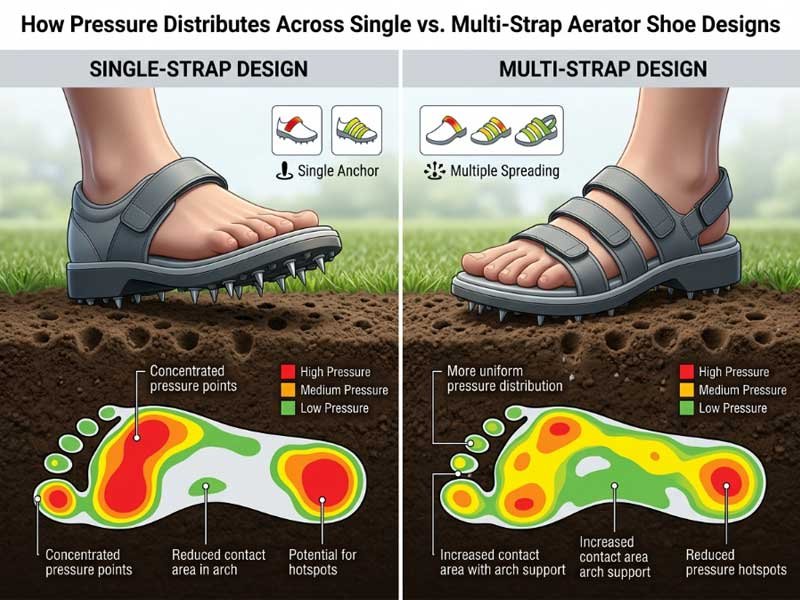
When a user walks in lawn aerator shoes, their body weight — typically 150–250 lbs — transfers through the shoe platform into the spike array[^9]. If spike count is low, each individual spike absorbs a higher share of that load. This creates two problems:
- Higher spike fatigue and potential bending — especially relevant if spike steel is not properly hardened
- Greater per-spike soil displacement — each spike creates a larger, less uniform hole
We use thicker-gauge hardened steel and a wider spike base plate specifically to manage this load distribution issue across different density configurations. Buyers evaluating samples should check for spike wobble under manual lateral pressure — it's a reliable proxy for steel quality and base attachment integrity.
How Does Soil Type Change the Spec Decision?
Soil type is the variable that most buyers cannot directly observe during product development — but it is the real selector variable determining whether a lawn aerator shoe delivers its benefit or frustrates the end customer.
Sandy soils and heavy clay soils respond to aeration differently. Sandy soils are loose enough that shorter spikes create effective channels; clay soils require longer spikes and more force to achieve the same depth[^10]. A product specced for sandy residential turf will fail visibly in clay-heavy markets — and vice versa. Soil type should drive the spike geometry decision before market positioning is finalized.
I've seen this mismatch surface in buyer conversations more than once. A client sourcing for the UK market, for example, did not initially flag that their target customer base included gardeners working with heavy clay-dominant soils. The medium-spike product they initially selected performed acceptably in samples but generated a clear pattern of "doesn't penetrate" feedback once distributed.
A Practical Spec Reference by Soil Category
Rather than prescribing exact specifications — which would require knowing your target market's soil profile in detail — the framework below gives B2B buyers a starting orientation:
Sandy or Loamy Soil:
- Typically low to moderate compaction
- Spike length of 1.5–2 inches is usually sufficient for channel formation
- Higher spike density is beneficial — more channels per pass improves nutrient distribution
- Spike material hardness is less critical than in clay applications
Mixed or Transitional Soil:
- Variable compaction; common in suburban residential markets
- Medium spike length (2–2.5 inches) with medium density offers the broadest market fit
- This is typically the safest general-purpose configuration for hardware channel positioning
Heavy Clay Soil:
- High compaction; presents significant resistance to spike penetration
- Spike length of 2.5–3+ inches is often required to reach below the compaction layer
- Spike tip geometry becomes critical — a sharper, narrower tip reduces entry resistance
- Steel hardness matters most here; undertreated steel will bend on first use
Manufacturing note: We can produce spike configurations across all three categories. What changes between them is tip geometry, steel treatment, and spike base plate dimensions — not just the length specification buyers typically request.
Why This Is a Sourcing Risk, Not Just an Agronomic Detail
For Amazon or Shopify sellers, this distinction has a direct financial consequence. A product listed without clear soil type guidance will attract buyers across all categories. If the spec is optimized for sandy soil but a significant portion of buyers have clay lawns, the product generates a predictable cluster of negative reviews around penetration failure.
That review pattern is not recoverable through listing copy changes. It reflects a spec decision made at the sourcing stage.
Frequently Asked Questions
What is the minimum spike length required for effective lawn aeration?
There is no universal minimum, but from the specifications our clients commonly request, spikes shorter than 1.5 inches typically do not reach below the thatch layer in most residential soils. For compacted clay soils, 2.5–3 inches is the more common threshold for effective channel formation.
How many spikes should a lawn aerator shoe have?
Most commercial configurations we produce range from 12 to 26 spikes per shoe. Higher spike counts distribute load more evenly and create more channels per pass, but very high counts can reduce per-spike penetration force on harder soils. Medium-density configurations (14–20 spikes) tend to perform across the widest range of soil conditions.
What material should lawn aerator shoe spikes be made from?
Hardened steel is the standard for functional spikes[^11]. The key variable is steel treatment — insufficiently hardened steel will bend or deform under repeated load, especially in clay-heavy applications. Buyers should request a material specification sheet and check for spike rigidity in physical samples before placing a volume order.
Can the same lawn aerator shoe product serve both residential and commercial markets?
Not reliably at the same spec. Commercial turf applications often involve higher-compaction soils and more frequent use cycles, which increases demand on spike integrity and strap durability. If you're positioning a product for both channels, a medium-density, longer-spike configuration with heavier-gauge steel is the better hedge — though it will carry a higher unit cost.
What certifications should B2B buyers verify when sourcing lawn aerator shoes?
Material compliance documentation (such as REACH or RoHS for chemical content in the shoe body)[^12], structural load test reports, and quality control inspection records are the documents we recommend buyers request. Specific certification requirements vary by destination market; buyers should verify applicable standards with a qualified regulatory consultant for their region.
Conclusion
Lawn aeration shoe benefits are real — but they are conditional on specification decisions made before a single unit ships. The agronomic value of decompaction, improved water infiltration, and root zone oxygenation only materializes when spike length, density, and tip geometry are matched to the target soil type. For B2B buyers sourcing at volume, this is a risk management question as much as a product selection one: the wrong spec configuration creates an identifiable failure mode that shows up in returns and reviews, not in the factory sample.
At AeratorShoes.com, our manufacturing experience spans the full range of spike configurations and material treatments across these categories. If you are evaluating lawn aerator shoe specifications for a private label program, hardware channel listing, or Amazon product line, we are available to walk through configuration options based on your target market. Contact us at chunjiaojohn@gmail.com or via WhatsApp at +86 15988980367 to begin a sourcing conversation.
[^1]: "Blog • Aerating Your Lawn", https://www.wellingtoncolorado.gov/Blog.asp?IID=20. Turfgrass management research has documented that mechanical aeration treatments increase soil macroporosity, improve saturated hydraulic conductivity, and reduce bulk density in the treated zone, supporting improved root development and water movement. Evidence role: general_support; source type: research. Supports: That mechanical aeration of compacted turf soils produces measurable improvements in water infiltration rates, gas exchange at root depth, and reductions in bulk density. Scope note: Most published trials involve hollow-tine core aeration rather than solid-spike aeration shoes; benefit magnitudes from spike-type tools may differ and are less extensively documented
[^2]: "Soil compaction | UMN Extension", https://extension.umn.edu/natural-resources/conservation/agricultural-soil-and-water/soil-compaction. Soil compaction research documents that repeated surface loading from pedestrian traffic increases bulk density and reduces total porosity, with the greatest structural disruption occurring in the uppermost soil layers subject to direct pressure. Evidence role: mechanism; source type: research. Supports: That distributed surface loads from foot traffic increase soil bulk density and reduce macroporosity through particle rearrangement. Scope note: The article's specific claim about lateral versus vertical particle displacement is a simplification; actual compaction mechanics involve complex stress distribution patterns not fully captured by this description
[^3]: "Instrumented Cone Penetrometer for Dense Layer ... - PMC", https://pmc.ncbi.nlm.nih.gov/articles/PMC7600036/. Engineering mechanics principles establish that stress is inversely proportional to contact area; cone penetrometer design literature applies this principle to explain how tapered tips achieve soil penetration at lower total loads than blunt or flat instruments. Evidence role: mechanism; source type: research. Supports: That reducing contact area at a probe tip increases local stress concentration, enabling penetration of resistant materials at lower total applied force. Scope note: The article applies this principle qualitatively; actual penetration force requirements depend on tip angle, soil cohesion, and friction along the spike shaft, which are not addressed
[^4]: "Healthy lawns in South Carolina: Why aeration matters", https://news.clemson.edu/healthy-lawns-in-south-carolina-why-aeration-matters/. Soil aeration literature distinguishes between hollow-tine and solid-tine methods; solid-tine penetration is characterized by radial soil displacement rather than core removal, producing channels whose persistence depends on soil cohesion, moisture content, and the degree of elastic rebound. Evidence role: mechanism; source type: research. Supports: That solid-tine or spike-type aeration tools displace soil laterally during insertion and create channels that persist temporarily after withdrawal. Scope note: Void persistence after spike withdrawal is highly variable; in cohesive clay soils, elastic rebound can substantially reduce effective channel diameter, limiting the duration of the aeration benefit
[^5]: "Assessing and Addressing Soil Compaction in Your Yard", https://njaes.rutgers.edu/fs1313/. Research on turfgrass soil physics indicates that compaction-induced reductions in macroporosity are most pronounced in the upper soil horizon, generally within the first several inches of the profile, where the majority of fibrous turf roots are concentrated. Evidence role: general_support; source type: research. Supports: That soil compaction in managed turf systems typically accumulates in the uppermost inches of the soil profile, coinciding with the primary root zone. Scope note: Exact depth thresholds vary by soil texture, traffic load, and turf species; a single universal figure may oversimplify site-specific conditions
[^6]: "Compaction and Cultivation : Turf", https://www.umass.edu/agriculture-food-environment/turf/fact-sheets/compaction-cultivation. Studies on soil hydraulic properties demonstrate that compaction-induced reductions in macropore continuity significantly decrease saturated hydraulic conductivity, increasing surface runoff and limiting the downward transport of water-soluble fertilizer inputs. Evidence role: mechanism; source type: research. Supports: That soil compaction measurably reduces hydraulic conductivity and water infiltration rates, and that reduced macroporosity limits the movement of soluble nutrients toward the root zone. Scope note: Magnitude of effect varies substantially with soil texture, compaction severity, and fertilizer formulation; the article's framing implies a universal outcome
[^7]: "Minimum levels of atmospheric oxygen from fossil tree roots ...", https://pmc.ncbi.nlm.nih.gov/articles/PMC8248171/. Plant physiology literature establishes that root cells rely on aerobic respiration for ATP production; soil compaction reduces oxygen diffusion rates, creating hypoxic conditions that impair root elongation and nutrient uptake. Evidence role: mechanism; source type: education. Supports: That plant roots depend on aerobic respiration and require adequate soil oxygen diffusion for normal metabolic function. Scope note: Oxygen thresholds for impairment differ across turfgrass species and are modulated by soil moisture content, so the mechanism is well-established but its severity is context-dependent
[^8]: "Effects of Root Zone Aeration on Soil Microbes Species in a ...", https://pmc.ncbi.nlm.nih.gov/articles/PMC9611397/. Turfgrass agronomic research has examined the interaction between aeration timing and fertilizer application, with some studies indicating that aeration-created channels facilitate more direct nutrient transport to the root zone compared to application on intact compacted surfaces. Evidence role: general_support; source type: research. Supports: That aeration prior to fertilizer application improves nutrient delivery to the root zone by creating channels that facilitate downward movement of soluble inputs. Scope note: Evidence is stronger for core aeration than for spike aeration; the magnitude of the fertilizer efficiency benefit from spike-type aeration specifically is not well-quantified in published literature
[^9]: "Body Measurements - FastStats", https://www.cdc.gov/nchs/fastats/body-measurements.htm. National health and anthropometric surveys, such as those conducted by the U.S. Centers for Disease Control and Prevention, report mean adult body weights that fall within or near the stated range, supporting its use as a design load parameter for consumer products. Evidence role: statistic; source type: government. Supports: That the 150–250 lb range is a reasonable representation of the adult user population weight distribution relevant to product load calculations. Scope note: The article does not account for dynamic loading during walking, which can produce instantaneous forces exceeding static body weight; the 150–250 lb figure represents static load only
[^10]: "Managing Soil Compaction - Oklahoma State University", https://extension.okstate.edu/fact-sheets/managing-soil-compaction. Soil mechanics literature and agronomic penetrometer studies consistently show that clay-textured soils exhibit higher cone index values than sandy soils at equivalent moisture contents, reflecting greater resistance to mechanical penetration. Evidence role: general_support; source type: research. Supports: That clay-dominant soils exhibit substantially higher penetration resistance than sandy or loamy soils, requiring greater mechanical force to achieve equivalent probe depth. Scope note: Penetration resistance in clay soils is highly sensitive to soil moisture; the article's framing implies a static soil property, whereas resistance varies considerably with antecedent moisture conditions
[^11]: "Walensee Aerator Lawn Tool, 15-Spike Manual ...", https://www.amazon.com/Walensee-Manual-Aerator-Spikes-Garden/dp/B0B1M88HBV. Agricultural and horticultural tool standards generally specify hardened or tempered steel for soil-engaging components to resist deformation under cyclic loading; material hardness requirements are typically defined by Rockwell or Vickers hardness scales in relevant manufacturing standards. Evidence role: expert_consensus; source type: institution. Supports: That hardened or heat-treated steel is the appropriate material for soil-penetrating implements subject to repeated impact and bending loads. Scope note: No single universally adopted standard for lawn aerator shoe spike material was identified; the claim reflects general engineering practice rather than a codified product-specific specification
[^12]: "RoHS", https://en.wikipedia.org/wiki/RoHS. The European Chemicals Agency administers REACH (Registration, Evaluation, Authorisation and Restriction of Chemicals), which imposes substance restriction and disclosure obligations on articles placed on the EU market; RoHS (Restriction of Hazardous Substances) restricts specific substances in electrical and electronic equipment, though its direct applicability to non-electronic garden tools is limited. Evidence role: definition; source type: government. Supports: That REACH and RoHS are EU regulatory frameworks governing chemical substance restrictions in products placed on the European market, with potential applicability to consumer goods including garden tools. Scope note: RoHS is primarily scoped to electrical and electronic equipment; its citation alongside REACH as equally applicable to lawn aerator shoes may overstate its relevance to this specific product category