跳到内容

Finding the best lawn aerator shoes for wholesale is not about picking a single winning product. Buyers waste weeks comparing spike lengths on retail listings, then discover their real problem: no factory behind those listings can customize, private-label, or scale to their order size.
Snippet paragraph:
The "best" lawn aerator shoes for wholesale aren't a specific SKU — they're the output of a factory that can match spike design, strap or molded fixation, and material choice to your target soil conditions and market. Wholesale buyers should evaluate supplier OEM/ODM capability[^1], private-label flexibility, and MOQ terms, not chase a single "top-rated" model.
I'll walk through why spike length alone misleads buyers, what engineering variables actually separate a good factory from a mediocre one, and how to avoid sourcing confusion with a related but different product category. By the end, you'll have a checklist ready for your next supplier call.
Is Spike Length the Best Signal for Lawn Aerator Shoes?
Many buyers open negotiations by asking, "How long are your spikes?" That's a reasonable starting question, but it's incomplete. Spike length alone tells you very little about how the shoe will perform once it reaches end users with different lawns and soil types.
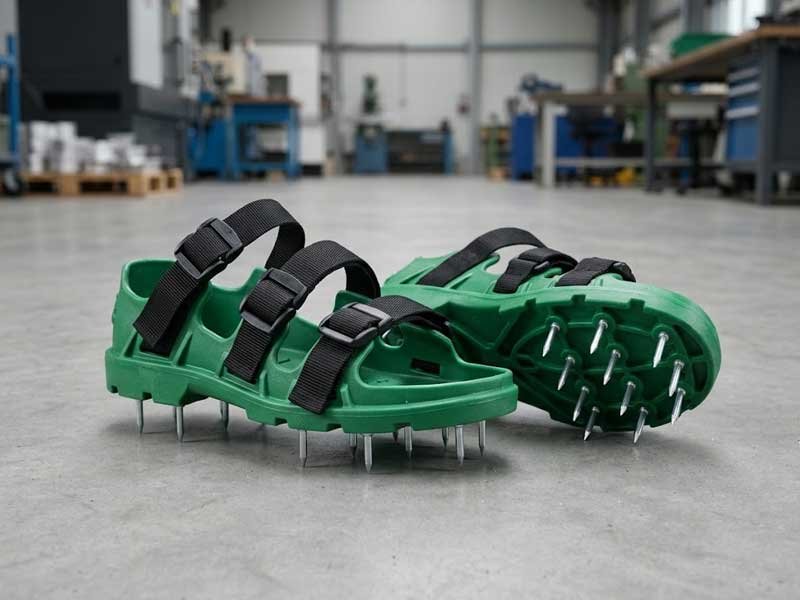
Spike length matters, but it's secondary to soil-type fit. Compacted clay soils generally need longer, more rigid spikes with wider spacing; sandy or loamy soils common in residential lawns often work with shorter, denser spike patterns.[^2] The right factory adjusts spike geometry to your target market, not a generic "one-size" spec.
Why "Longer Spikes = Better" Is a Myth
When brand buyers come to us asking for the "biggest spikes possible," we typically ask them a follow-up question first: who is the end user, and what soil are they aerating?
- Residential lawn care buyers (garden retailers, e-commerce sellers) usually serve customers with looser, maintained soil. Shorter spikes with higher density often perform better and cost less per unit[^3].
- Commercial landscaping distributors may serve crews working compacted or clay-heavy ground. Longer, more widely-spaced spikes with reinforced fixation points are usually the better fit[^4].
- Mixed-market importers sometimes need two SKUs, not one, to cover both segments properly.
I want to flag something clearly: any specific "spike penetration depth" or "aeration efficiency" number floating around online is largely industry-general or unverified — we have not run independent soil-lab testing, and neither has most of the supply chain. Treat those figures as marketing shorthand, not lab fact.
A smarter framing for buyers:
| Question to Ask Supplier | Why It Matters |
|---|---|
| Can you adjust spike length per target soil type? | Signals real engineering flexibility |
| Do you offer spike density options? | Affects aeration coverage per step |
| Can spike spacing change without new tooling? | Impacts cost and lead time for custom runs |
Reframing "best" as "best-fit" changes the entire conversation with your factory — and usually gets you a better product for your actual buyers.
What Should Wholesale Buyers Really Be Evaluating in a Supplier?
Buyers often start their search asking, "Which shoe should I stock?" But that question puts you in a retail buyer's mindset, not a wholesale one. The real evaluation target is the factory itself.
A wholesale buyer should evaluate a supplier's OEM/ODM capability, not a single hero product. Key criteria include customization flexibility (spike design, materials, branding), minimum order quantity (MOQ) terms, private-label support, and production scalability. The right factory match matters more than the right product listing.

Reframing the Buying Question
I've had this conversation many times with importers and tool brands: they come in with a specific shoe image saved from a competitor's listing, asking us to "make that one." Our first response is usually to ask about their target market and branding goals — because copying a photo doesn't tell us your soil-type target, your strap preference, or your logo placement needs.
Here's what actually separates a strong OEM/ODM partner from a basic reseller:
- Customization depth — Can the factory change spike length, density, and strap materials without excessive tooling fees?
- Private-label readiness — Does the supplier offer laser-engraved logos, custom woven tags, or branded packaging as standard service, not a rushed add-on?
- MOQ flexibility — Can they scale from a small private-label test batch to a full container order without renegotiating everything?
- Material sourcing transparency — Do they clearly state whether straps are PP, spikes are treated steel, and whether components resist rust in outdoor storage conditions?
Buyers who focus only on unit price at this stage often regret it later — usually when a reorder reveals the factory can't replicate specs consistently, or refuses small-batch private-label runs.
A good rule of thumb: if a factory can answer your customization questions specifically, in detail, without deflecting to a fixed catalog — that's a stronger signal than any single product spec sheet.
What Engineering Differences Actually Affect Lawn Aerator Shoe Quality?
Buyers sometimes assume all lawn aerator shoes are functionally similar aside from spike count. In reality, fixation method and material choice drive most of the durability and cost differences you'll negotiate with a factory.
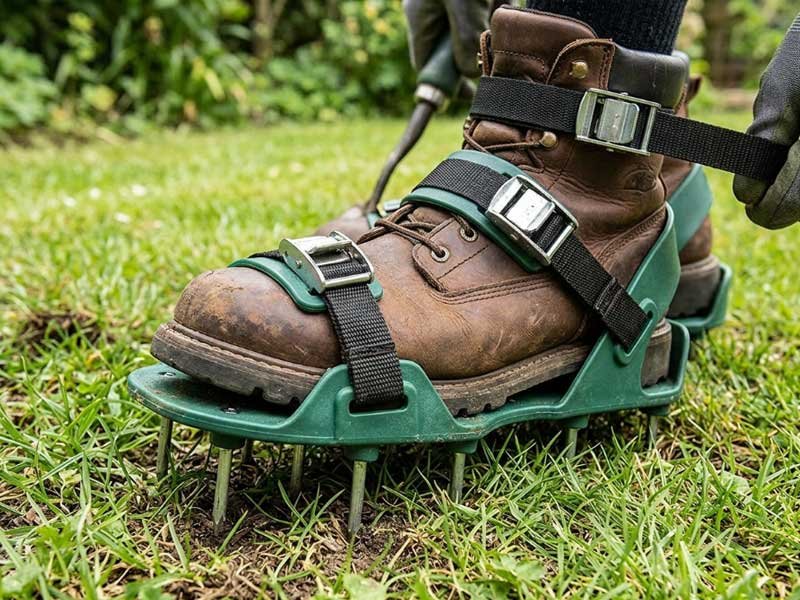
The main engineering variables are spike fixation method (molded-in vs. strapped-on) and material treatment (PP straps vs. rust-resistant steel spikes). Molded fixation tends to be more durable for repeated commercial use; strapped designs are typically more cost-efficient and easier to adjust for fit. Both are valid choices depending on target price point.
Fixation Method: Molded vs. Strapped
- Molded-in spikes are set directly into a base plate during production. This generally reduces the risk of spikes loosening under repeated pressure, which matters for landscaping crews using shoes daily.
- Strapped spike plates attach over the wearer's own footwear using adjustable straps, usually PP (polypropylene) material for its resistance to moisture and everyday wear[^5]. This design is often preferred by residential-market sellers because it fits a wider range of shoe sizes without multiple SKUs.
Material Treatment: What Buyers Should Ask About
Steel spikes without proper treatment can develop rust when stored outdoors or shipped through humid ports[^6]. When brand buyers ask us about durability, we recommend they specifically request:
- Anti-corrosion coating specs on spike metal
- UV-resistant plastic grades for base plates exposed to sun during storage or retail display
- Strap material certification documents — buyers should always verify these directly rather than accept a verbal claim
A Simple Comparison Table
| Feature | Molded Fixation | Strapped Fixation |
|---|---|---|
| Typical use case | Commercial landscaping | Residential/general retail |
| Durability under repeated use | Generally higher | Moderate, depends on strap quality |
| Fit flexibility | Lower (fixed sizing) | Higher (adjustable) |
| Customization cost | Higher (tooling-dependent) | Lower, faster iteration |
Neither option is universally "better" — it depends entirely on your target buyer's use pattern and your price positioning.
Are Lawn Aerator Shoes the Same as Epoxy Spiked Shoes?
This mix-up happens more often than you'd expect. Buyers researching "spiked shoes" sometimes land on epoxy/self-leveling spiked shoe listings and assume they're interchangeable with lawn aerator shoes. They are not.
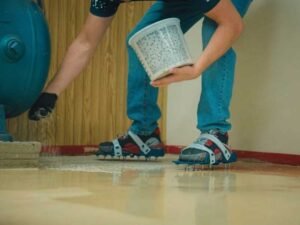
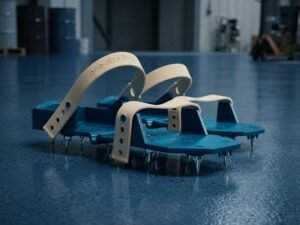
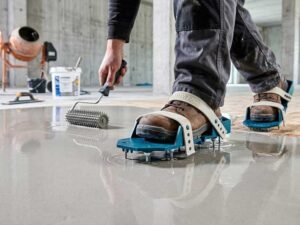
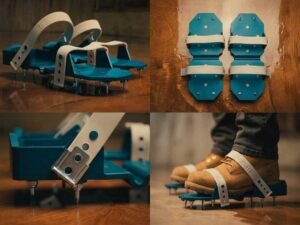
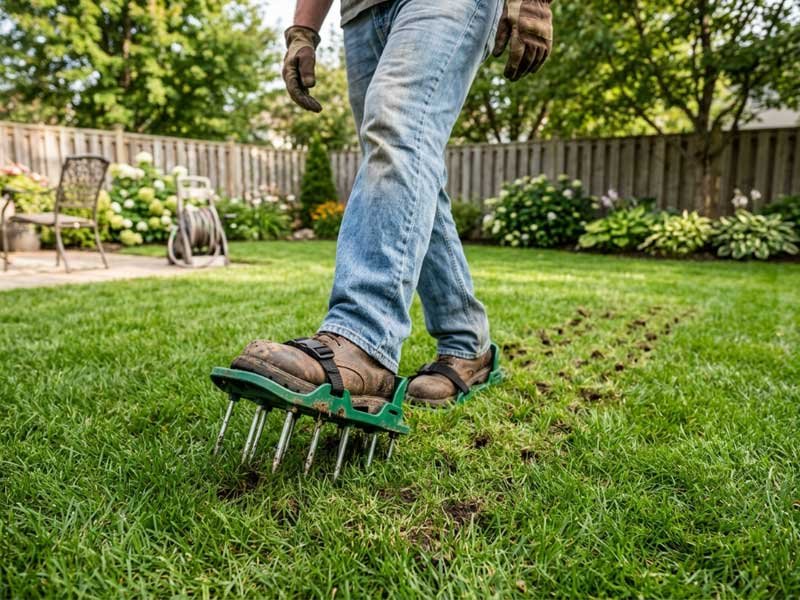
Lawn aerator shoes and epoxy/self-leveling spiked shoes are different product lines with different spike geometry and purpose. Lawn aerator shoes use longer, wider-spaced spikes to penetrate soil for aeration. Epoxy spiked shoes use short, minimal-contact spikes designed to avoid damaging wet flooring surfaces during construction work.[^7]
Why This Confusion Matters for Sourcing
If a buyer requests "spiked shoes" without specifying the category, a factory might quote the wrong product line entirely — costing time and, in worse cases, delivering unusable stock.
Here's the clear distinction:
-
Lawn Aerator Shoes
- Purpose: soil aeration for lawn care
- Spike length: generally longer, built to penetrate ground
- Market: landscaping companies, garden retailers, lawn-care e-commerce sellers
-
Epoxy/Self-Leveling Spiked Shoes
- Purpose: walking on wet epoxy, self-leveling cement, or microcement without leaving marks[^8]
- Spike design: minimal surface contact, short spikes to avoid disturbing the flooring
- Market: flooring contractors, industrial coating applicators
When importers reach out to us mentioning "spiked shoes for flooring guys" but describing lawn-penetration use cases, we always clarify the category before quoting. It saves both sides from a costly miscommunication.
Practical tip for buyers: always specify the end-use (lawn vs. flooring) in your first inquiry email. It's a small detail that prevents a big sourcing mistake.
Frequently Asked Questions
What spike length is standard for lawn aerator shoes?
There's no single industry-standard length — it varies by soil type and manufacturer design. Buyers should ask their factory about adjustable spike length options rather than relying on a fixed "standard" figure, since compacted vs. sandy soil needs differ.
Can lawn aerator shoes be private-labeled?
Yes, most qualified OEM/ODM factories support private labeling, including custom logos, branded packaging, and woven tags. Buyers should confirm this capability and minimum order requirements directly with their chosen supplier before committing to a purchase order.
What MOQ should I expect for wholesale lawn aerator shoes?
MOQ varies significantly by factory and customization level. Basic private-label runs may start smaller than fully custom mold projects. Always request MOQ terms in writing and clarify whether smaller test-batch orders are available before scaling to full container volume.
Are PP strap and EVA one-piece designs interchangeable?
Not exactly — they serve different comfort and cost positioning. PP straps generally fit over existing footwear and cost less; EVA one-piece designs are typically more ergonomic for extended wear[^9]. Buyers should choose based on target customer comfort expectations and price point.
How do I verify a supplier's material or safety claims?
Request documentation directly — material certificates, coating specs, and any safety compliance paperwork. Verbal claims aren't sufficient for B2B sourcing decisions. Qualified suppliers should provide these documents without hesitation when asked during the evaluation process.
[^1]: "Original design manufacturer", https://en.wikipedia.org/wiki/Original_design_manufacturer. An OEM (Original Equipment Manufacturer) produces goods to a buyer's specifications and branding, while an ODM (Original Design Manufacturer) designs and manufactures products that buyers can rebrand; both models are standard in international B2B sourcing for customized and private-label goods. Evidence role: definition; source type: encyclopedia. Supports: The definitions and distinctions between OEM (Original Equipment Manufacturer) and ODM (Original Design Manufacturer) sourcing models.
[^2]: "1505 – Lawn Aeration - PlantTalk Colorado", https://planttalk.colostate.edu/topics/lawns/1505-lawn-aeration/. University turfgrass extension programs generally recommend deeper aeration (3–4 inches) for compacted clay soils, while lighter or sandier soils may benefit from shallower treatment, as soil bulk density and pore structure differ significantly across soil textures. Evidence role: mechanism; source type: education. Supports: That compacted clay soils require deeper aeration penetration than sandy or loamy soils for effective decompaction. Scope note: Extension recommendations typically address core aeration equipment rather than spike-shoe aeration specifically, so the transferability to spike-shoe design parameters is indirect.
[^3]: "Compaction and Cultivation : Turf", https://www.umass.edu/agriculture-food-environment/turf/fact-sheets/compaction-cultivation. University turfgrass management guidelines note that closer tine spacing increases the percentage of soil surface area affected per pass, which can be advantageous on moderately compacted or well-maintained residential lawns where deep penetration is less critical. Evidence role: general_support; source type: education. Supports: That tine spacing and density affect aeration coverage and that closer spacing can improve surface-level soil relief on less compacted soils. Scope note: Most extension research addresses mechanical core aerators rather than spike-shoe products, so direct applicability to spike-shoe density configurations is inferred rather than proven.
[^4]: "Compaction and Cultivation : Turf", https://www.umass.edu/agriculture-food-environment/turf/fact-sheets/compaction-cultivation. Turfgrass management research from university extension programs recommends deeper aeration depths (up to 4+ inches) for heavily compacted clay soils, noting that wider tine spacing reduces soil resistance and allows for more effective penetration in dense substrates. Evidence role: general_support; source type: education. Supports: That deeper aeration penetration is recommended for heavily compacted soils, and that wider tine spacing can reduce resistance and improve penetration depth in dense soil. Scope note: These recommendations are based on powered mechanical aerators; extrapolation to body-weight-driven spike shoes involves different force dynamics.
[^5]: "Polypropylene", https://en.wikipedia.org/wiki/Polypropylene. Polypropylene has a moisture absorption rate near 0.01–0.03% and demonstrates strong resistance to many chemical solvents, acids, and bases, making it suitable for outdoor and moisture-exposed applications (see polypropylene material properties). Evidence role: mechanism; source type: encyclopedia. Supports: That polypropylene exhibits low moisture absorption and good resistance to environmental degradation. Scope note: General polymer properties may vary depending on specific PP grade, additives, and manufacturing process used in strap production.
[^6]: "Marine Atmospheric Corrosion of Carbon Steel: A Review - PMC", https://pmc.ncbi.nlm.nih.gov/articles/PMC5506973/. Corrosion science literature establishes that carbon steel begins to corrode significantly when relative humidity exceeds approximately 60%, and shipping containers frequently experience condensation ('container rain') due to temperature differentials during transit through varying climate zones. Evidence role: mechanism; source type: research. Supports: That uncoated carbon steel is highly susceptible to corrosion at relative humidity levels above approximately 60%, conditions commonly encountered in maritime shipping containers. Scope note: Specific corrosion rates depend on steel alloy composition, coating presence, and exact transit conditions, which vary by shipment.
[^7]: "Spiked Shoes Step-by-Step #diy #floor #tips #handyman #tools", https://www.youtube.com/watch?v=TKbYIiIcJ-w. Flooring industry references describe spiked shoes for self-leveling compounds as having short (typically 1–2 cm), thin-gauge spikes designed to minimize surface disturbance on wet coatings, in contrast to lawn aerator shoes whose longer spikes are intended to penetrate compacted soil. Evidence role: definition; source type: other. Supports: That spiked shoes used in flooring applications are designed with short, thin spikes to allow workers to walk on wet self-leveling compounds without leaving marks, distinct from lawn aeration spike shoes. Scope note: No single authoritative standard defines both product categories; the distinction is based on trade usage and manufacturer specifications rather than a formal classification system.
[^8]: "Spiked Shoes Step-by-Step #diy #floor #tips #handyman #tools", https://www.youtube.com/watch?v=TKbYIiIcJ-w. Flooring installation guides and construction trade references identify spiked shoes (also called spiked sandals) as essential tools for walking across freshly applied self-leveling compounds and epoxy coatings, allowing installers to deaerate and inspect surfaces without leaving footprints. Evidence role: general_support; source type: other. Supports: That spiked shoes are a standard tool in flooring installation for traversing freshly poured self-leveling compounds and epoxy coatings without creating surface defects. Scope note: Trade references are typically manufacturer or trade-association publications rather than peer-reviewed sources.
[^9]: "Immediate effects of EVA midsole resilience and upper shoe ...", https://pmc.ncbi.nlm.nih.gov/articles/PMC5333543/. Ethylene-vinyl acetate (EVA) is a closed-cell foam polymer extensively used in footwear midsoles due to its low density, high energy absorption, and cushioning characteristics, which contribute to wearer comfort during prolonged use. Evidence role: mechanism; source type: encyclopedia. Supports: That ethylene-vinyl acetate (EVA) foam is widely used in footwear for its cushioning, shock absorption, and lightweight properties. Scope note: EVA's ergonomic benefits are well-documented in general footwear contexts but have not been specifically studied in the context of lawn aerator shoe one-piece designs.