跳到内容

Choosing between strap-type and integrated spiked shoes feels like picking a "better" product. It isn't. I've watched brand owners assume one structure is automatically premium, then get surprised by complaints once real job sites test that assumption. The real question is fit, not superiority.
Strap-type spiked shoes (usually PP material) offer adjustability, field repairability, and a secure fit over various work boots — making them suited to heavy-duty, high-frequency contractor use. Integrated EVA spiked shoes offer a sleek, strap-free one-piece design that appeals to comfort-focused, retail-facing buyers. Neither format is universally superior; the right choice depends on your end-user's job environment and your brand's market position.
I want to walk through where each structure actually earns its place — and where I've seen buyers make costly assumptions before placing an OEM order. This isn't a spec sheet. It's a decision framework built from years of factory-side conversations.
What Makes Strap-Type Spiked Shoes Different From Integrated Designs?
Buyers often ask me to explain the structural gap in one sentence. It's tempting to oversimplify, but the difference actually shapes how a shoe performs over months of daily use — not just how it looks in a product photo.
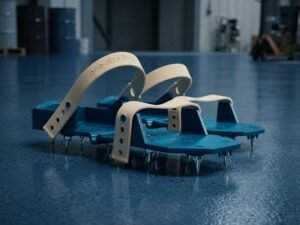
Strap-type spiked shoes use a separate PP outsole with adjustable straps that fasten over a work boot. Integrated spiked shoes are one-piece EVA units worn like a shoe cover, with no boot required underneath. The strap system adds adjustability and repairability; the integrated design adds a streamlined, lighter feel.
Structural Breakdown
Here's how I explain it to new OEM clients during initial sourcing calls:
| Feature | Strap-Type (PP) | Integrated (EVA) |
|---|---|---|
| Base material | Rigid, chemical-resistant PP[^1] | Lightweight, flexible EVA[^2] |
| Fit method | Straps over existing work boots | Worn directly, no boot needed |
| Repairability | Straps and spikes often replaceable | Typically replaced as a whole unit |
| Sizing flexibility | Fits a range of boot sizes | Fixed to shoe-size increments |
| Typical buyer | Contractor/industrial supply | Retail-facing, comfort-focused |
The strap system exists because contractors don't want to buy dedicated footwear — they want an accessory that clips onto boots they already own. That's a practical, cost-conscious mindset I hear again and again from industrial distributors.
The integrated design removes that complexity for the end-user. No adjusting straps, no boot compatibility questions. In our experience working with OEM clients selling on Amazon or Shopify, that simplicity is often the actual selling point — not necessarily superior performance.
Neither structure is "more advanced." They solve different friction points for different buyers.
When Do Integrated EVA Spiked Shoes Make Sense for Your Brand?
Brand owners frequently tell me they want the "premium-looking" option without asking who's actually wearing it. That's where I slow the conversation down.
Integrated EVA spiked shoes make sense when your target buyer values comfort, easy on/off use, and a clean retail presentation over heavy job-site durability. They fit well for occasional-use consumers, light DIY flooring projects, and e-commerce listings where unboxing experience and simplicity drive conversion.
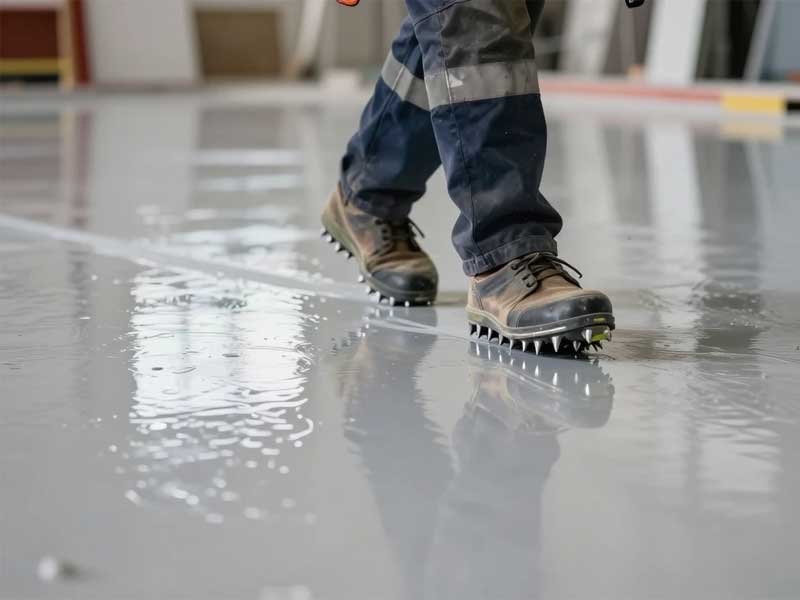
Where EVA Integrated Shoes Tend to Perform Well
- Light-frequency users — homeowners doing a single self-leveling floor project, not daily contractor use.
- Retail unboxing appeal — a clean, single SKU photographs well and reads as "finished product."
- E-commerce differentiation — Shopify and Amazon sellers often want a product that looks distinct from generic strap-based competitors.
- Comfort feedback — customers who ordered EVA integrated units have told our OEM partners they liked the lighter, more shoe-like feel. I want to be clear this is customer feedback, not a clinical comfort study.
Where I've Seen It Fall Short
I've also had brand clients come back after their first order asking about strap-type alternatives once return-rate patterns showed up. Common triggers:
- Heavy-load contractor use — daily wear on large commercial floors puts more repeated stress on the one-piece structure than occasional home use.
- Heat exposure — EVA can soften under prolonged sun or workshop heat[^3], which some contractor customers reported affecting fit over long shifts.
- No boot layering — some job sites require steel-toe or slip-resistant boots underneath spike protection[^4], which integrated designs don't accommodate.
None of this means EVA is a bad structure. It means it's matched to a specific buyer — usually retail-facing, comfort-first, lower-frequency use.
Which Job-Site Conditions Favor Strap-Type Spiked Shoes?
Contractors don't buy based on aesthetics. They buy based on whether a product survives their actual workday. That's the conversation I have most often with industrial distributors and building material wholesalers.
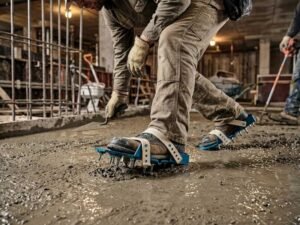
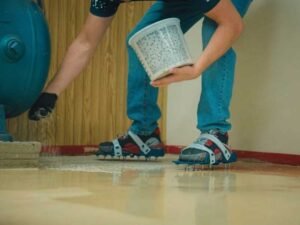
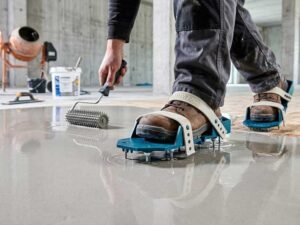
Strap-type spiked shoes tend to fit high-frequency, heavy-load job sites better — epoxy flooring contractors, self-leveling cement crews[^5], FRP/anti-corrosion applicators[^6], and lawn aeration services[^7]. The adjustable strap allows workers to wear their existing steel-toe or slip-resistant boots, and damaged straps or spikes can often be swapped instead of replacing the entire unit.
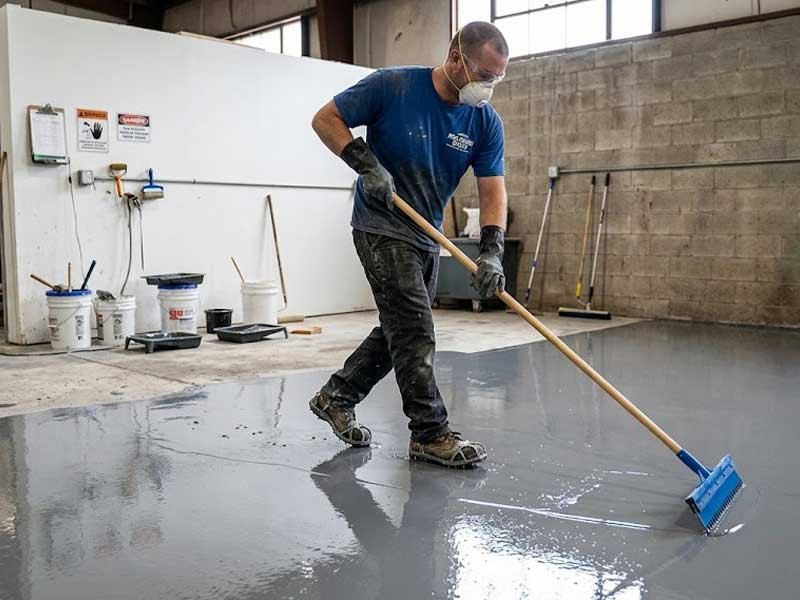
Why Contractors Default to Strap-Type in Practice
In our experience working with OEM clients supplying flooring contractors, a few patterns keep repeating:
- Boot compatibility matters more than shoe aesthetics. Contractors already own safety-compliant boots. They want spike attachments, not replacement footwear.
- Field repairability reduces downtime. A snapped strap or bent spike on a strap-type unit is often a quick fix on-site. A cracked integrated EVA shell usually means ordering a replacement.
- Chemical exposure is a real factor. Epoxy resin, solvents, and self-leveling cement compounds can be harsh on materials[^8]. PP is generally chosen in our production line for its chemical resistance in these environments[^9] — this is based on material selection knowledge, not third-party lab testing.
- Lawn aeration adds a different stress profile. Repeated soil penetration puts load directly through the spike-to-sole connection. Strap-type structures let us reinforce that connection point independently from the strap material.
A Quick Scenario Checklist
Ask these questions before assuming integrated EVA is the "upgrade":
- Will end-users wear safety boots underneath?
- Is the job site exposed to solvents, heat, or abrasive concrete dust daily?
- Do end-users need to repair or replace parts in the field without shipping delays?
If you answered "yes" to two or more, strap-type structure is worth serious consideration — regardless of price positioning.
Does Structure Affect Private-Label Positioning and Return Rates?
This is the question importers ask me most directly, usually after a batch of customer service emails. Structure isn't just an engineering detail — it shapes your brand's return rate and review profile.
Structure mismatch — not manufacturing defects — is one of the more common root causes behind return complaints[^10] we hear about secondhand from OEM clients. Selling integrated EVA shoes to heavy-duty contractor audiences, or strap-type PP shoes to casual home users expecting simplicity, tends to generate more dissatisfaction than the product's actual quality.
Matching Structure to Brand Positioning
- Amazon/Shopify comfort-focused brands — Integrated EVA generally aligns better with review expectations around ease-of-use and unboxing appeal.
- Industrial/contractor-facing brands — Strap-type PP generally aligns better with expectations around durability and repairability, even if the packaging looks less "finished."
- Hybrid catalogs — Some of our private-label partners carry both structures under one brand, marketing them explicitly for different use cases rather than positioning one as an upgrade.
I've noticed that brands who clearly communicate the intended use case — instead of implying "better" — tend to report fewer confused customer inquiries. That's not a scientific claim. It's a pattern from repeated conversations with OEM partners reviewing their own customer feedback.
[^1]: "Polypropylene", https://en.wikipedia.org/wiki/Polypropylene. Polypropylene is widely documented as having good to excellent resistance to a range of chemicals including acids, alkalis, and many organic solvents, which underpins its selection for industrial protective equipment and chemical-handling applications (see, e.g., polymer engineering references and material data sheets). Evidence role: mechanism; source type: encyclopedia. Supports: Polypropylene exhibits broad chemical resistance to acids, bases, and many organic solvents, making it a common choice for industrial applications involving chemical exposure.. Scope note: General PP chemical resistance data may not directly replicate the specific formulations, thicknesses, or spike-attachment geometries used in spiked shoe outsoles.
[^2]: "Ethylene-vinyl acetate", https://en.wikipedia.org/wiki/Ethylene-vinyl_acetate. Ethylene-vinyl acetate (EVA) is a copolymer of ethylene and vinyl acetate recognized for its flexibility, low density, and shock-absorbing properties, which have made it a standard material in footwear manufacturing and sports equipment. Evidence role: definition; source type: encyclopedia. Supports: EVA is a lightweight, flexible copolymer foam widely used in footwear midsoles and protective equipment due to its cushioning properties and low density.. Scope note: EVA properties vary significantly with vinyl acetate content and foaming process; general material descriptions may not precisely match the specific EVA formulation used in integrated spiked shoes.
[^3]: "The Thermal and Mechanical Properties of Poly(ethylene-co ...", https://pmc.ncbi.nlm.nih.gov/articles/PMC6631310/. Studies on EVA thermal properties indicate that the material's glass transition and softening behavior occur at temperatures that can be reached in direct sunlight or heated workshop environments, potentially leading to dimensional changes under prolonged exposure. Evidence role: mechanism; source type: research. Supports: EVA foam begins to soften at relatively moderate temperatures compared to rigid thermoplastics, which can affect dimensional stability under sustained heat exposure.. Scope note: Specific softening thresholds depend on the vinyl acetate content, crosslinking, and foaming density of the particular EVA formulation; general thermal data may not precisely predict behavior in a specific spiked shoe product.
[^4]: "1910.136 - Foot protection.", http://www.osha.gov/laws-regs/regulations/standardnumber/1910/1910.136. OSHA's construction safety standards (29 CFR 1926.96) require employers to ensure workers wear protective footwear when exposed to foot injury hazards, which on many job sites translates to mandatory steel-toe or safety-rated boots that any additional spike attachment must accommodate. Evidence role: general_support; source type: government. Supports: Occupational safety regulations in many jurisdictions require protective footwear (including steel-toe and slip-resistant boots) on construction and industrial job sites.. Scope note: OSHA standards address general protective footwear requirements but do not specifically address spiked shoe accessories or their compatibility with safety boots.
[^5]: "Why You Need Spike Shoes For Self Leveling Floor Compound ...", https://www.youtube.com/watch?v=ETNtVUPocO0. Industry flooring installation guides describe spiked shoes as essential accessories during self-leveling compound application, enabling workers to traverse freshly poured surfaces for deaeration and leveling without disrupting the finish. Evidence role: general_support; source type: other. Supports: Spiked shoes are a standard tool used during self-leveling cement application, allowing installers to walk across wet compound to deaerate and smooth the surface without leaving footprints.. Scope note: Most references are trade guides or manufacturer instructions rather than peer-reviewed research; practices may vary by region and specific compound type.
[^6]: "Walking on epoxy… on purpose Spike shoes allow installers ...", https://www.instagram.com/reel/DUGVTEbDXhU/?hl=en. FRP anti-corrosion lining application guides describe the use of spiked tools, including spiked shoes and rollers, to remove trapped air from wet resin-fiberglass laminates during installation, ensuring bond integrity and surface quality. Evidence role: general_support; source type: other. Supports: FRP anti-corrosion lining installation involves applying resin-saturated fiberglass layers to surfaces, during which spiked shoes or rollers are used to deaerate the laminate and ensure proper adhesion.. Scope note: References to spiked shoe use in FRP work are primarily found in trade and manufacturer literature rather than academic sources; specific tool requirements vary by project specification.
[^7]: "aerating lawn with shoes instead of machines?", https://www.facebook.com/groups/lifeinpocatello/posts/1853032398705082/. University turfgrass extension programs acknowledge spike aeration as a lawn care practice, noting that spike-type tools (including spiked shoes) penetrate soil to reduce surface compaction, though core aeration is generally considered more effective for heavily compacted soils. Evidence role: general_support; source type: education. Supports: Spiked shoes are marketed and used as a lawn aeration method, though their effectiveness compared to core aeration is debated in turfgrass management literature.. Scope note: Most university extension sources focus on aeration effectiveness rather than the mechanical stress on spiked shoe construction; the claim about stress profiles on the spike-to-sole connection remains unsupported by external research.
[^8]: "Testing of Selected Self-Leveling Compounds for Floors", https://nvlpubs.nist.gov/nistpubs/Legacy/IR/nistir5633.pdf. Material compatibility literature documents that epoxy resin systems and their cleaning solvents, as well as the highly alkaline environment of fresh cementitious compounds, can cause swelling, softening, or degradation in polymers lacking adequate chemical resistance. Evidence role: mechanism; source type: research. Supports: Epoxy resins, their associated solvents (such as acetone, MEK, and xylene), and cementitious self-leveling compounds create alkaline and solvent-rich environments that can degrade polymers with poor chemical resistance.. Scope note: Chemical degradation rates depend on specific polymer formulations, exposure duration, and concentration; general compatibility data may not precisely predict performance of a particular spiked shoe product.
[^9]: "Environmental hazard of polypropylene microplastics from ...", https://pmc.ncbi.nlm.nih.gov/articles/PMC8724753/. Engineering material references identify polypropylene as a preferred thermoplastic for chemical-contact applications, citing its resistance to a broad spectrum of acids, alkalis, and organic chemicals, which supports its selection for protective equipment used in resin and cement environments. Evidence role: mechanism; source type: encyclopedia. Supports: Polypropylene is widely selected for industrial applications involving chemical exposure due to its resistance to acids, bases, and many organic solvents.. Scope note: General PP chemical resistance data applies to the base polymer; actual performance in a spiked shoe application depends on specific PP grade, additives, wall thickness, and the particular chemicals encountered on site.
[^10]: "The most common ecommerce return reasons - Corso", https://www.corso.com/post-purchase-resource-center/the-most-common-ecommerce-return-reasons?srsltid=AU7gw4WZu-nma552Uk8zYeu-kGWpAYU91jIrLvQHz6h_yuE1zs33VP5X. Consumer research and e-commerce industry analyses consistently identify expectation mismatch (product not matching the buyer's intended use case or perceived description) as a primary driver of product returns, often outweighing returns due to manufacturing defects. Evidence role: general_support; source type: research. Supports: Research on e-commerce returns indicates that unmet customer expectations — often driven by product descriptions that do not match actual use conditions — are a leading cause of returns, frequently exceeding defect-related returns.. Scope note: General e-commerce return research covers broad product categories; no study specifically examines spiked shoe return patterns or the structure-mismatch hypothesis described in the article.