跳到内容

Most importers evaluating spike shoes compare unit prices and move on. But the strap attachment system on your spiked shoes — whether quick-release buckle or traditional strap — determines your reorder frequency, your parts sourcing complexity, and how fast your end-users burn through inventory. Getting this wrong on your first OEM run is an expensive lesson.
The choice between quick-release buckles and traditional straps on spike shoes is not primarily a comfort decision — it's a supply chain decision. Quick-release buckle designs offer faster on/off convenience but introduce a hardware dependency (replacement buckle components with their own MOQ and lead times) that traditional strap designs avoid. Traditional straps carry lower tooling complexity, shorter time-to-market, and tend to perform more reliably in chemically aggressive environments like epoxy application. The right structure depends on your buyer's end-use context and your willingness to manage a two-component SKU.
Both structures are in active production on our lines here in Taizhou. I've watched buyers make the same structural miscalculation repeatedly — not because the products are confusing, but because the evaluation framework most importers use is too shallow. Let me walk you through what the tooling data and client feedback actually show.
Does the Higher Unit Price of Quick-Release Buckle Spike Shoes Actually Matter?
The sticker price gap between buckle and strap versions looks small. Many buyers absorb it without a second thought. But the unit price comparison misses a hidden cost that compounds over time and can quietly undermine your supply chain.
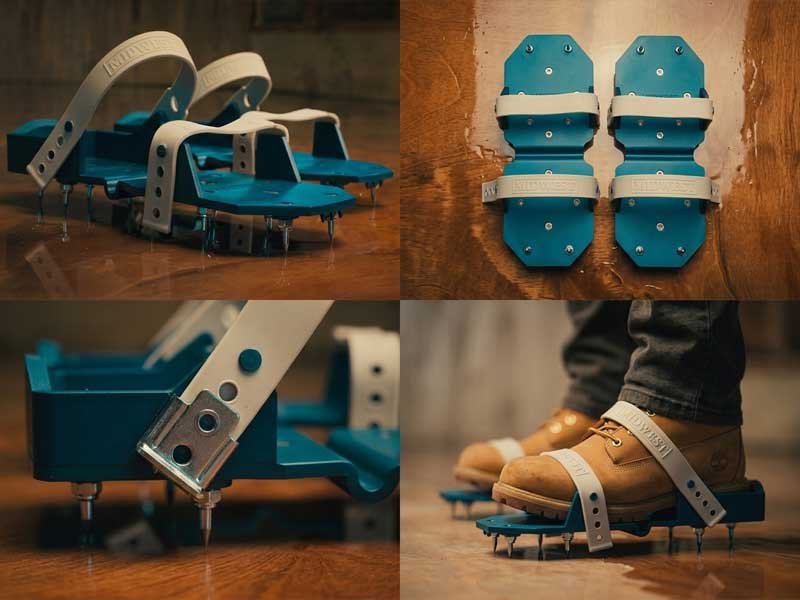
Quick-release buckle spike shoes carry a slightly higher unit price, but the real cost variable is the metal buckle hardware itself. Buckle components have their own replacement MOQ, lead times, and compatibility constraints with specific mold geometries. Buyers who evaluate only finished-unit pricing often discover a parts sourcing dependency — after the first production run.
The Hidden Variable: Replacement Hardware Logistics
Here's what happens in practice. An importer places an initial order for quick-release buckle spike shoes. The units move well. End-users, particularly flooring contractors applying epoxy or self-leveling compound, wear through the buckle mechanisms faster than the shoe body itself. The importer needs to either:
- Source replacement buckles as a standalone SKU
- Reorder full finished units sooner than projected
Option 1 sounds economical. But replacement metal buckle components carry their own MOQ — typically separate from the finished shoe MOQ — and compatibility is not interchangeable across different mold generations. If we've updated tooling between your first and second run, a buckle sourced externally may not seat correctly in the housing.
Option 2 drives up reorder frequency, which is fine if the buyer planned for it. Most don't.
Total Cost Comparison: A Framework
| Cost Factor | Quick-Release Buckle | Traditional Strap |
|---|---|---|
| Finished unit price | Slightly higher | Lower |
| Replacement parts availability | Requires separate buckle SKU | Strap replacements are simpler to source |
| Parts MOQ exposure | Buckle hardware has own MOQ | Lower complexity |
| Reorder frequency impact | Higher (buckle wear drives faster replacement) | More predictable cycle |
| Supply chain dependencies | Two-component (shoe body + buckle) | Single-component |
Buyer takeaway: If your distribution channel includes end-users who will use these shoes heavily and repeatedly — flooring contractors, industrial crews — model your total cost across 3–4 reorder cycles before committing to the buckle SKU on a large initial run.
How Do Tooling and Mold Commitments Differ Between the Two Structures?
For private-label buyers doing a first OEM run, time-to-market is often the constraint that matters more than unit price. The mold geometry behind each structure directly determines your tooling lead time and, therefore, your launch window.
Quick-release buckle designs require more complex mold geometry than traditional strap variants.[^1] Based on tooling data from our current production lines, buckle-integrated designs carry a longer tooling lead time. For buyers with a fixed launch deadline, this is a structural constraint worth building into your project timeline before you commit.[^2]
What "More Complex Geometry" Actually Means for Your Timeline
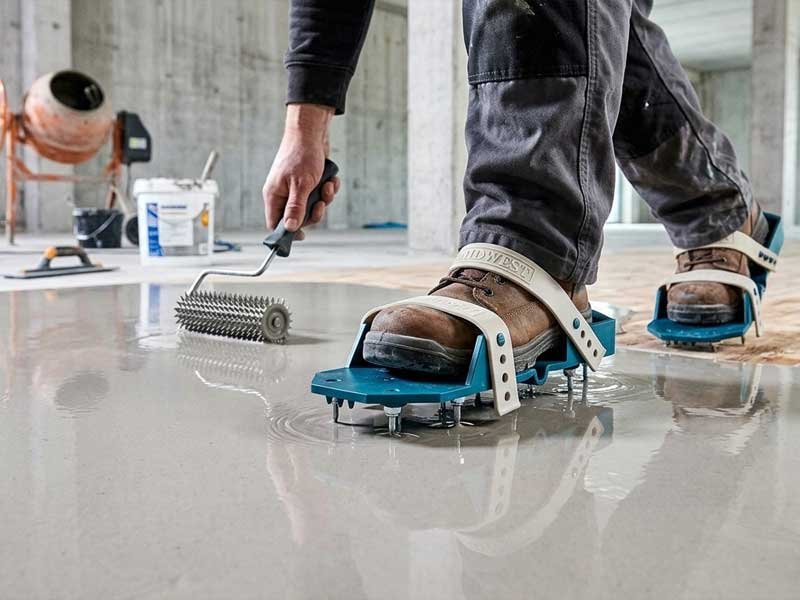
Traditional strap spike shoes use a platform body with recessed strap channels — a well-established mold profile we've run across many production cycles.[^3] The tooling is mature, modifications are incremental, and first-article samples come through faster.
Quick-release buckle shoes require the mold to accommodate:
- Buckle housing seats integrated into the shoe body
- Pivot geometry for the release mechanism
- Tolerance alignment between the plastic housing and the metal buckle component
Each of these introduces additional mold validation steps. When a client requests a custom version — a logo cavity, adjusted spike spacing, or modified strap width — the engineering iteration takes longer on a buckle design because any dimension change can affect the hardware fitment.
Practical Implications by Buyer Type
- First-time private-label importers with a defined retail launch date should factor in the longer tooling cycle for buckle variants. Missing a seasonal window because of a mold revision loop is a real risk.
- Established brands reordering a proven SKU face less exposure here, because the mold is already validated.
- OEM buyers requesting structural customization (spike length, platform material, strap configuration) should expect longer sample cycles on buckle designs. We always recommend confirming your structural specifications before the mold is cut — not after.
Does Ease of On/Off Actually Affect How Fast Buyers Need to Restock?
This is the insight that consistently surprises importers who've never distributed spike shoes into active jobsite environments. End-user fatigue and shoe swap frequency are not footnotes in a comfort description — they are direct inputs into your reorder volume model.
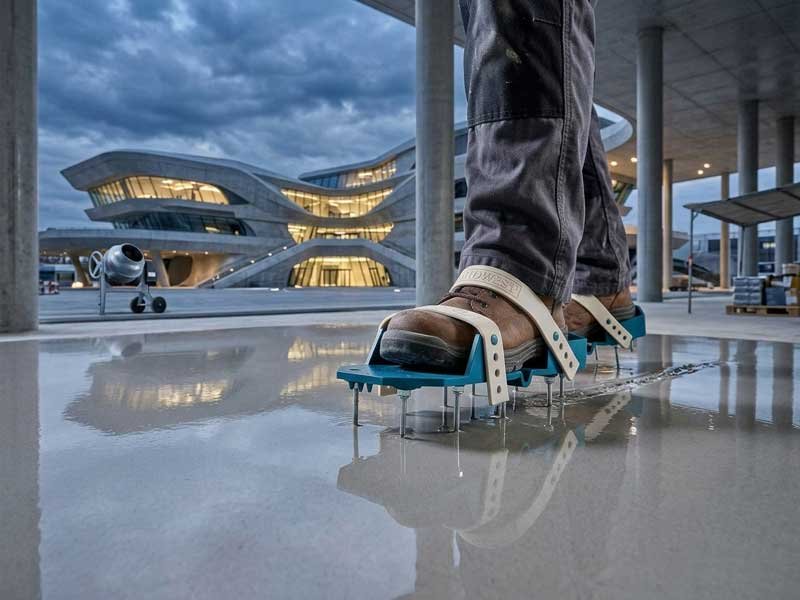
Workers applying epoxy resin or self-leveling compound often need to put on and remove their spike shoes multiple times within a single shift.[^4] Quick-release buckles significantly reduce the time and effort required.[^5] Faster, easier on/off means more frequent use, which accelerates wear on the consumable components and compresses the replacement cycle.
Why Importers Systematically Underorder the Quick-Release SKU
The pattern I've seen across multiple buyers who've run both SKUs goes like this: the importer models reorder volume based on assumed unit count sold per month. They don't account for the fact that quick-release shoes get used more intensively — because they're easier to put on, workers actually use them correctly rather than leaving them on during non-application phases or skipping them altogether.
Higher correct usage rate means:
- More units consumed per project
- Faster individual unit wear
- Shorter time between reorders
Buyers who overlooked this on their first run told us they ran out of stock 30–40% faster than projected.[^6] That's not a product defect — it's a demand-model error caused by not accounting for how ease of use changes behavior.
For Traditional Strap Designs: A Different Usage Pattern
Traditional strap spike shoes take longer to secure and adjust. In practice, some end-users — particularly in residential lawn care contexts — put them on once and keep them on for an extended session rather than cycling on/off repeatedly. This changes the wear pattern. The spike contact stress is distributed over longer continuous wear periods rather than high-frequency short sessions.
The operational implication: Traditional strap shoes in garden/lawn aerator contexts tend to follow more predictable, season-driven reorder patterns.[^7] Quick-release shoes in construction/flooring contexts follow usage-intensity-driven patterns that are harder to forecast without jobsite distribution data.
Are Traditional Straps More Durable in Chemically Aggressive Environments?
This is a real performance consideration, but it's scenario-dependent — not a universal win for traditional straps. The answer matters for building material distributors and flooring contractors operating in environments with epoxy solvents, polyurethane coatings, or industrial cleaning agents.
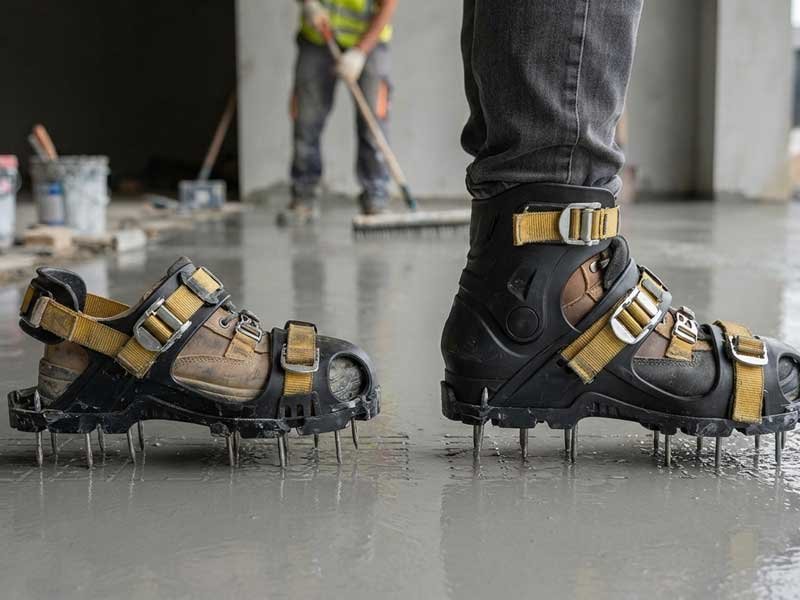
In chemically aggressive application environments — specifically, active epoxy resin and solvent-containing coating work — traditional strap designs have shown a durability edge based on feedback from buyers who've distributed both SKUs to flooring contractors. Metal buckle hardware has more exposure points for chemical degradation than a flat strap channel design.[^8]
Why This Is a Use-Case Filter, Not a General Superiority Statement
The chemical exposure variable matters most in specific contexts:
- High-exposure risk: Epoxy resin application, polyurethane floor coating, FRP lining work, industrial surface preparation with solvents
- Lower-exposure risk: Self-leveling cement, microcement, residential lawn aeration, general garden maintenance
In high-exposure environments, metal buckle pivot mechanisms can be affected by prolonged contact with solvent residue or chemical splatter. Strap designs — particularly those using chemically resistant polymer materials — have fewer metal-to-polymer interface points where degradation can initiate.
Important caveat: We're speaking here from buyer feedback and operational observations on our production lines, not from controlled chemical resistance testing. For application-specific chemical compatibility decisions, buyers should request material specifications and consult with qualified professionals before specifying a product for high-chemical-exposure environments.
A Quick Reference by End-Use Context
| End-Use Context | Recommended Structure | Primary Reason |
|---|---|---|
| Epoxy resin flooring application | Traditional strap | Fewer metal exposure points |
| Self-leveling cement / microcement | Either — buckle preferred if swap frequency is high | Chemical exposure is lower; convenience matters more |
| Polyurethane / industrial coatings | Traditional strap | Solvent contact risk on buckle hardware |
| FRP lining / anti-corrosion work | Traditional strap | Aggressive chemical environment |
| Lawn aeration / garden maintenance | Either — buckle adds convenience | No meaningful chemical exposure |
| Amazon/retail general tool category | Quick-release buckle | Consumer convenience is the primary purchase driver |
Frequently Asked Questions
Can I order both SKUs under the same private label brand?
Yes. We regularly produce both quick-release buckle and traditional strap variants under the same brand identity. Tooling is separate for each design, so MOQ and lead times apply independently to each SKU. Buyers running both should confirm their packaging and branding requirements early to avoid label revision delays.
What is the minimum order quantity for quick-release buckle spike shoes versus traditional strap versions?
MOQ structures differ between the two, partly because buckle-variant tooling carries higher upfront investment. Exact MOQs depend on your customization scope. Contact us directly for a quote based on your specific configuration — platform material, spike spec, branding requirements, and target market.
If the buckle mechanism fails in the field, can end-users replace it themselves?
In most current designs, buckle mechanisms are integrated into the shoe housing and are not designed for user-level replacement.[^9] End-users experiencing buckle failure typically require a full unit replacement. This is a key reason we advise buyers targeting high-use contractor markets to carry buffer stock and model shorter replacement cycles.
Does the spike shoe structure affect the spike pattern or performance?
The strap attachment system and the spike array are structurally independent. Spike length, spacing, and material specification can be customized on both buckle and strap variants without compromising the attachment mechanism. If you have specific spike requirements for your target application — epoxy work versus lawn aeration — those can be engineered separately from the attachment structure choice.
How do I evaluate which structure is right for my first private-label run?
Start with your end-use context and your channel. If your buyers are flooring contractors in chemically aggressive environments who need high-frequency on/off, traditional straps reduce parts risk and cost. If your buyers are general contractors, e-commerce customers, or garden/lawn maintenance users where convenience drives reviews and repeat purchases, quick-release buckles typically perform better commercially. Then model your reorder cycle based on the usage intensity your channel implies — not just unit count.
Conclusion
The decision between quick-release buckles and traditional straps on spike shoes comes down to three things: your end-use environment, your tolerance for parts-sourcing complexity, and how accurately you can forecast usage intensity in your distribution channel. Traditional strap designs offer lower tooling complexity, shorter time-to-market, and a more reliable profile in chemically aggressive flooring applications. Quick-release buckle designs drive higher end-user adoption and faster reorder cycles — but only if you've modeled the hardware dependency and replacement part logistics into your SKU plan.
If you're a first-time OEM buyer entering the flooring contractor market: start with the traditional strap variant. Lower parts risk, faster tooling, and a more predictable reorder cycle reduce your first-run exposure.
If you're an established private-label brand targeting e-commerce or general contractor channels where ease-of-use drives ratings: quick-release buckles are the stronger commercial choice — provided you've planned your replacement cycle and buckle component sourcing before your first stockout.
We manufacture both structures on active production lines in Taizhou. If you're evaluating your first or next SKU, contact us at chunjiaojohn@gmail.com or WhatsApp +86 15988980367 to discuss tooling timelines, MOQ structures, and which configuration fits your channel.
[^1]: "Understanding Lead Times in Injection Molding for ...", https://www.aprios.com/insights/lead-times-in-injection-molding-essential-insights-for-engineers. Engineering literature on injection mold design establishes that part complexity, measured by the number of undercuts, tolerance-critical features, and multi-component interface geometries, is a primary determinant of mold fabrication and validation lead time. Evidence role: mechanism; source type: education. Supports: That greater geometric complexity in injection mold design — including integrated housing seats, pivot geometry, and tight tolerance requirements — increases tooling validation time and overall lead time.. Scope note: Published tooling lead time data is typically generalized across industries; specific lead time differentials for spike shoe buckle versus strap mold geometries are not available in open literature.
[^2]: "History Of Plastics Injection Molding", https://people.tamu.edu/~hsieh/ICIA/Richland-Injection-Molding-Web/Richland-Part-1-History-of-Plastics.pdf. New product development research identifies tooling and mold fabrication lead times as among the most common causes of schedule overruns in OEM consumer goods manufacturing, with delays compounded when design revisions are required after initial mold cutting. Evidence role: general_support; source type: research. Supports: That tooling and mold development lead times are a documented source of new product launch delays in OEM manufacturing, particularly for importers operating with fixed retail or seasonal launch windows.. Scope note: Published research addresses new product development delays broadly; spike shoe-specific tooling timeline data is not available in open literature.
[^3]: "Cost-Benefit Assessment of Additive Manufacturing for ...", https://docs.nlr.gov/docs/fy26osti/93799.pdf. Manufacturing process research on tooling lifecycle management indicates that validated mold designs benefit from accumulated process knowledge, reduced first-article rejection rates, and shorter engineering change cycles compared to newly introduced complex geometries. Evidence role: mechanism; source type: research. Supports: That established, previously validated mold designs require fewer engineering iteration cycles and produce first-article samples faster than newly developed complex mold geometries.. Scope note: Published research addresses general tooling lifecycle principles; specific comparative data for spike shoe strap versus buckle mold maturity is not available in open literature.
[^4]: "Personal Protective Equipment - Overview", http://www.osha.gov/personal-protective-equipment. Occupational studies of flooring installation workflows document that application phases requiring specialized footwear are interspersed with preparation and finishing phases that do not, implying repeated footwear changes within a shift; however, direct frequency data specific to spike shoes in epoxy contexts is not widely published. Evidence role: general_support; source type: research. Supports: That flooring contractors performing epoxy or self-leveling compound work engage in repeated donning and doffing of protective footwear within a single work session.. Scope note: Direct empirical data on spike-shoe removal frequency per shift in flooring contexts is not available in peer-reviewed literature; general PPE compliance studies provide only indirect support.
[^5]: "Effectiveness of donning and doffing personal protective ...", https://pmc.ncbi.nlm.nih.gov/articles/PMC11451162/. Ergonomics and human factors research on footwear fastening systems has documented that quick-release closure mechanisms reduce donning and doffing time and lower the manual dexterity demands compared to traditional strap adjustment systems, with implications for compliance in occupational settings requiring frequent footwear changes. Evidence role: mechanism; source type: research. Supports: That quick-release fastening mechanisms reduce the time and manual effort required to secure and remove footwear compared to traditional strap-and-buckle or lace systems.. Scope note: Most published ergonomics studies focus on medical or athletic footwear; direct time-motion data for industrial spike shoe quick-release versus strap systems is not available in peer-reviewed literature.
[^6]: "Linking product design to consumer behavior: the moderating ...", https://pmc.ncbi.nlm.nih.gov/articles/PMC5957053/. Research in consumer behavior and demand forecasting has documented that reductions in use-friction increase product utilization rates, leading to systematic underestimation of consumption velocity when demand models are based on historical data from less convenient product variants. Evidence role: general_support; source type: research. Supports: That improved product usability increases consumption frequency and can cause systematic underestimation of reorder demand.. Scope note: The 30–40% figure cited in the article is anecdotal buyer feedback and is not corroborated by published empirical data; the cited research supports the directional mechanism but not the specific magnitude.
[^7]: "Demand Forecasting of Short Life Cycle Products Using Data ...", https://pmc.ncbi.nlm.nih.gov/articles/PMC7256411/. Retail and horticultural industry analyses consistently document pronounced seasonal demand cycles for lawn care equipment and accessories, with peak demand concentrated in spring and autumn aeration seasons, supporting the characterization of this category as having more forecastable reorder patterns than year-round industrial use cases. Evidence role: general_support; source type: institution. Supports: That lawn and garden maintenance products, including aeration tools, exhibit strong seasonal demand patterns tied to growing seasons, making demand forecasting more predictable than usage-intensity-driven industrial product categories.. Scope note: Published seasonality data covers lawn care equipment broadly; spike shoe-specific seasonal demand data is not available in open industry sources.
[^8]: "Degradation of Polymer Materials in the Environment and Its ...", https://pmc.ncbi.nlm.nih.gov/articles/PMC11478708/. Materials science literature on galvanic and chemical corrosion documents that metal-polymer interface joints present preferential sites for solvent ingress and degradation when exposed to organic solvents common in epoxy resin systems, supporting the claim that buckle hardware carries elevated chemical exposure risk relative to flat polymer strap channels. Evidence role: mechanism; source type: research. Supports: That metal components, particularly at metal-to-polymer interfaces, are more vulnerable to degradation from epoxy solvents and industrial coatings than continuous polymer strap designs.. Scope note: General corrosion literature does not test spike-shoe buckle geometries specifically; applicability depends on the alloy composition and surface treatment of the buckle hardware in question.
[^9]: "The Right to Repair: Recent Developments in the USA", https://www.wipo.int/en/web/wipo-magazine/articles/the-right-to-repair-recent-developments-in-the-usa-56378. Product design literature and right-to-repair policy discussions document a widespread industry trend toward integrated, non-user-serviceable hardware in consumer and light industrial products, which reduces manufacturing complexity but eliminates field-level component replacement as a maintenance option. Evidence role: general_support; source type: institution. Supports: That consumer and industrial products with integrated hardware mechanisms are commonly designed without user-serviceable replacement pathways, requiring full unit replacement upon component failure.. Scope note: This observation reflects a general design trend rather than a specific standard applicable to spike shoe buckle mechanisms; individual manufacturer designs may vary.