跳到内容

Sourcing spike shoes for your catalog sounds straightforward — until your first customer inquiry asks whether you carry "the open kind" or "the closed kind." If you don't know which variant fits which end-user, you risk stocking the wrong SKU, losing repeat orders, or building a private label that misses its target market entirely. Understanding the structural and commercial logic behind each design changes that.
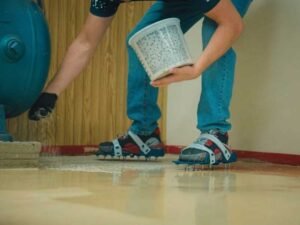
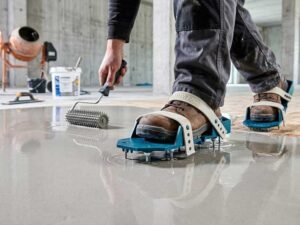
The honest answer is that neither open-toe nor closed-toe spike shoes is universally preferred. The right choice depends on the end-user's application environment, climate, and the market channel a brand is competing in. Open-toe variants consistently appear in warm-climate, light-to-medium duty epoxy floor work where ventilation and boot flexibility are priorities[^1]. Closed-toe designs align with industrial-grade, chemical-intensive, or full-shift applications where structural rigidity and foot protection matter more than airflow[^2].
The feature-level differences — sole geometry, strap configuration, toe coverage — are easy to describe. But those features only matter when you connect them to real use-case consequences. That's where this comparison gets commercially useful for brand owners and importers deciding which variant to carry, or whether to carry both.
What Actually Differs Between the Two Designs at the Manufacturing Level?
Buyers who compare spike shoes only by spike count or strap color miss the variables that drive real performance differences. The structural divergence between open-toe and closed-toe variants starts at the mold stage — and it compounds through every downstream use-case consequence.
From our production experience, the structural differences between the two variants go well beyond aesthetics. They affect mold tooling, strap stress distribution, and spike alignment tolerances in ways that directly translate to how each design performs under prolonged use.
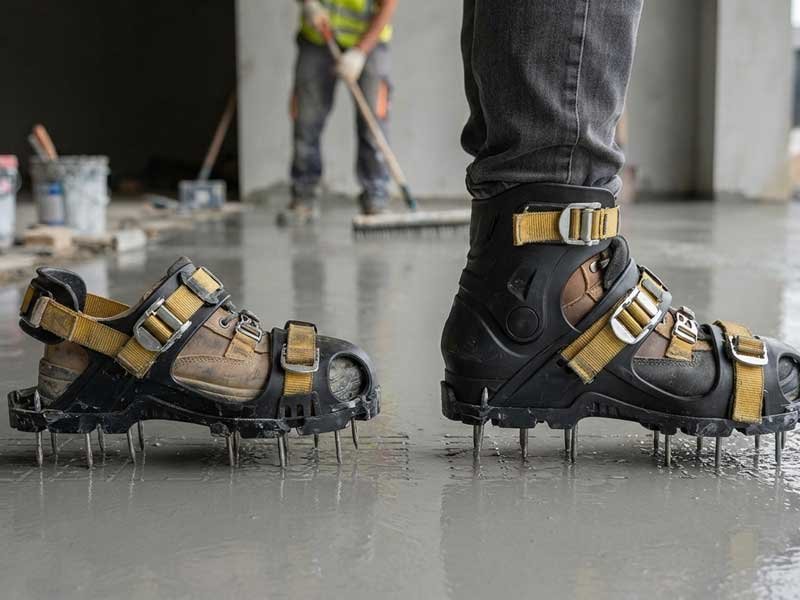
Here is what changes structurally when we produce each variant:
Sole and Frame Geometry
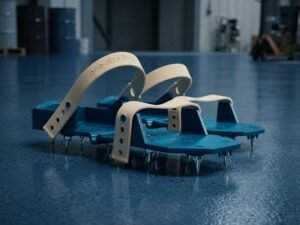
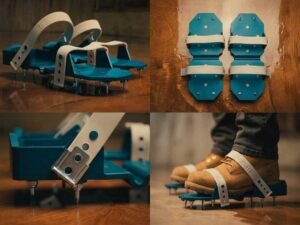
The open-toe design uses a shorter sole plate that terminates before the toe box of the wearer's boot. This reduces the total contact footprint, which affects lateral stability on uneven or partially cured surfaces. The closed-toe design extends the sole plate forward, distributing load across a longer base. On large commercial pours — where a contractor may walk several hundred meters in a single shift[^3] — that extended base reduces rocking and fatigue.
Strap Stress Points
Open-toe variants typically rely on two or three strap anchor points across the midfoot and heel. Because the toe is unsupported, the heel strap carries proportionally more retention load. Over extended use, this concentrates wear at the heel buckle or fastener. Closed-toe designs distribute retention across a wider strap network that includes the toe area, reducing the load on any single anchor point.
Spike Alignment Tolerances
Both designs use steel spikes, but the spike grid layout differs. Closed-toe models accommodate a forward spike row under the toe plate. This matters in applications where contractors need to avoid dragging their heel when backstepping — a common movement pattern when applying self-leveling compounds or polyurethane coatings[^4]. The forward spike row improves grip consistency in that specific motion.
Chemical Resistance at the Junction
One variable buyers rarely ask about is the strap-to-sole junction. In epoxy and polyurethane environments, uncured resins and solvents contact this junction repeatedly[^5]. The material at this point — and how it is bonded — determines how long the shoe remains functional in aggressive chemical environments. This is a manufacturing quality checkpoint, not a visible spec, and it varies significantly by supplier.
| Structural Variable | Open-Toe Design | Closed-Toe Design |
|---|---|---|
| Sole plate length | Shorter, terminates before toe | Full-length, covers toe box |
| Primary strap load | Concentrated at heel | Distributed across foot |
| Forward spike row | Absent | Present in most designs |
| Toe coverage | None | Full or partial |
| Typical sole material | PP (polypropylene) | PP or EVA depending on variant |
| Lateral stability | Moderate | Higher |
Which End-User Profile Does Each Variant Serve?
This is the question brand owners and importers need to answer before selecting a SKU — not "which is better," but "which customer type is buying this, and through what channel."
The end-user profile is the real decision variable. Open-toe and closed-toe spike shoes attract different contractor segments, in different application environments, at different price tiers.
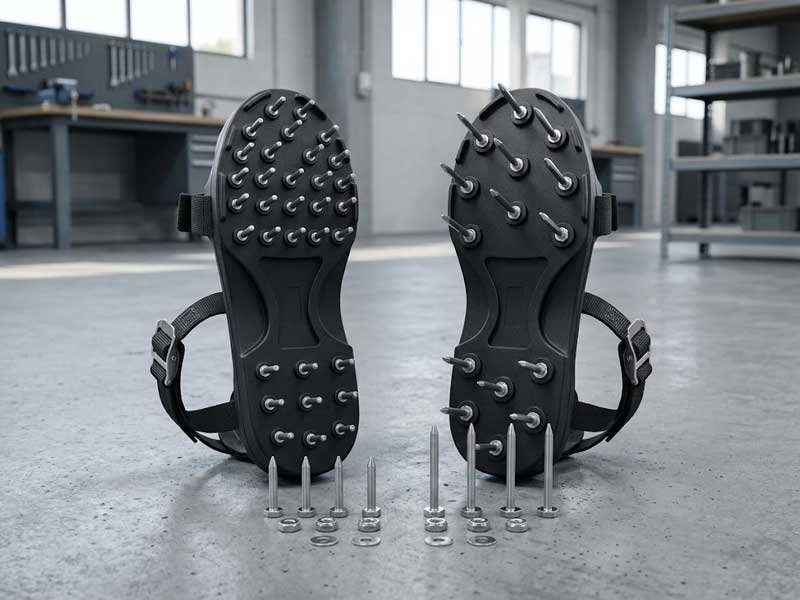
Open-Toe: The Light-to-Medium Duty Segment
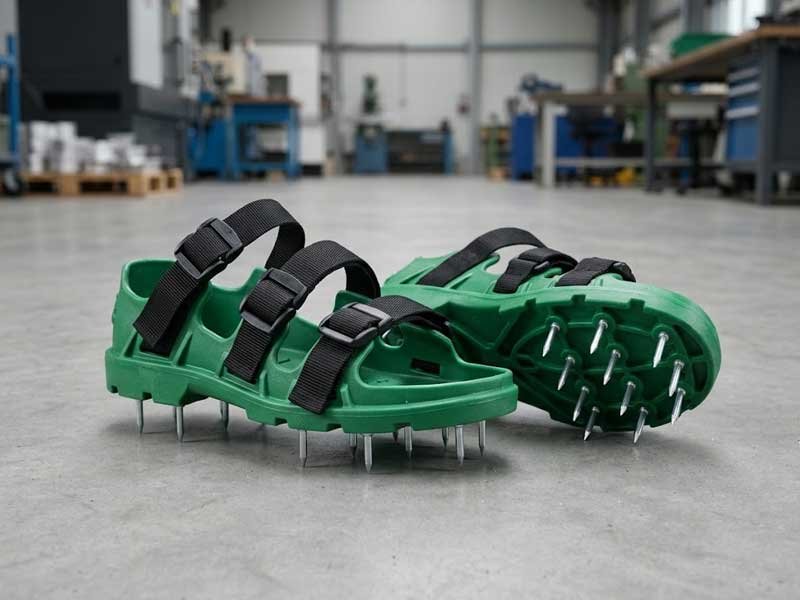
Open-toe spike shoes appear most frequently in:
- Residential and light commercial epoxy floor projects — smaller pours, shorter shift duration, less aggressive chemical exposure
- Warm-climate markets — Southeast Asia, the Middle East, parts of Southern Europe — where contractors work in high ambient temperatures and prioritize ventilation
- Self-leveling compound applications — where the compound is less chemically aggressive than solvent-based epoxies and shift durations are shorter
- DIY-adjacent product lines — including some Amazon and home improvement channel SKUs where the end-user is a skilled trades worker doing occasional floor work, not a daily-use industrial contractor
From the inquiries we receive, open-toe designs are frequently specified by coating distributors in warmer markets who bundle the shoes with self-leveling cement or decorative microcement products. The positioning is typically value-tier to mid-range, with the shoe functioning as an add-on bundling tool rather than a standalone professional product.
Closed-Toe: The Industrial and Heavy-Duty Segment
Closed-toe spike shoes align with:
- Industrial epoxy and polyurethane floor installations — full-day pours, solvent-rich environments, multi-coat applications
- FRP lining and chemical containment work[^6] — where foot protection from chemical splash is a practical safety consideration
- Commercial roofing waterproofing applications — PU and bitumen environments with irregular surfaces where toe protection and full-sole grip matter
- North American and Northern European industrial supply channels — where buyers and end-users tend to emphasize durability, safety adjacency, and full-shift performance over ventilation
From our customer inquiry patterns, importers sourcing for North American industrial distributors and safety-oriented hardware channels more frequently specify closed-toe configurations. Importers building mid-range Amazon SKUs in warm-climate markets lean toward open-toe or ask about both.
This is not a universal rule — it is a pattern we observe from sales conversations and inquiry specifications. Application-specific requirements should always be evaluated with knowledge of the end-user's actual working conditions.
Price Tier and Catalog Positioning
| Dimension | Open-Toe Variant | Closed-Toe Variant |
|---|---|---|
| Typical end-user | Light-duty / occasional-use contractor | Heavy-duty / daily-use industrial contractor |
| Climate fit | Warm to temperate | Temperate to cold, or climate-agnostic industrial |
| Channel fit | E-commerce, bundling SKUs, home improvement | Industrial distribution, safety supply, professional contractor supply |
| Price positioning | Value to mid-range | Mid-range to premium |
| Purchase driver | Price, convenience, ventilation | Durability, protection, full-shift reliability |
| Repeat purchase frequency | Moderate | Higher (professional consumable) |
How Should Brand Owners and Importers Approach the SKU Decision?
Choosing between variants — or deciding to carry both — is a catalog and positioning decision. Getting it right before your first production run is worth the analysis.
For brand owners and importers, the open-toe vs. closed-toe question is not a product quality debate. It is a SKU strategy question: which variant fits the customer you are building for, and does your catalog need one or both?
The Three-Variable Decision Framework
Based on the product development conversations we have with brand owners, three variables reliably determine which variant to specify:
1. End-user application environment
- Light-duty, warm-climate, shorter shifts → open-toe
- Industrial, chemical-intensive, full-shift, or toe-protection-relevant → closed-toe
- Mixed or unknown end-user base → consider stocking both with differentiated positioning
2. Sales channel and price tier
- E-commerce, bundling, home improvement retail → open-toe typically fits the value-to-mid price tier that moves in those channels
- Industrial distribution, professional contractor supply, safety supply → closed-toe justifies a higher unit price and fits the performance expectation of those buyers
3. Regional market norms
- This is the hardest variable to generalize, but it is real. Inquiries from certain markets consistently specify one variant over the other. If you are building a private label for a specific geography, the regional distribution norms for that market matter as much as the product specs. We recommend discussing regional inquiry patterns directly with your supplier before finalizing your SKU list.
Should You Carry Both?
For importers building a full product line, carrying both variants makes strategic sense — but only with differentiated positioning. Listing both at nearly identical price points with minimal description differentiation creates customer confusion and cannibalizes your own catalog.
The more effective approach is to position them as distinct SKUs for distinct segments:
- Open-toe as the accessible, ventilated option for lighter applications
- Closed-toe as the professional-grade, full-protection option for demanding environments
What to Verify With Your Supplier
Before committing to a production run, these are the manufacturing quality checkpoints worth raising — regardless of which variant you select:
- Strap-to-sole junction bonding method and material — this determines chemical resistance durability
- Spike retention under lateral load — spikes that rotate or loosen after the first shift are a return and complaint risk
- Strap buckle or fastener grade — particularly for closed-toe designs where the strap system is more complex
- Sole material certification — PP and EVA perform differently in solvent-rich environments[^8]; ask for material documentation rather than accepting verbal assurances
- Minimum order quantities and mold ownership terms — if you are commissioning a custom variant, clarify who owns the mold and what the re-order MOQ implies for your inventory cycle
Frequently Asked Questions
Can the same spiked shoe work for both epoxy and self-leveling compound applications?
Most spike shoe designs are used across both application types in practice. However, the chemical aggressiveness of solvent-based epoxies is higher than that of water-based self-leveling compounds. For frequent epoxy use, verify that the sole material and strap junction are rated for solvent exposure. For occasional mixed use, a standard PP sole design is generally adequate — but confirm this with your supplier's material specifications.
Is one variant easier to manufacture and therefore cheaper to source?
Open-toe designs typically involve a simpler mold and fewer strap components, which can translate to a lower unit cost at equivalent quality levels. However, cost differences narrow when both variants are produced on dedicated lines at scale. The more meaningful cost variable is often spike quality and strap hardware grade — not the toe design itself.
How do I know which variant my target market actually buys?
The most reliable signal is channel research: look at what established brands in your target channel are listing, at what price, and how they describe the product. If you have an existing supplier relationship, ask whether their inquiry or order history shows a regional or channel-specific pattern. We share general inquiry trend observations with customers evaluating SKU decisions — that kind of bounded, real-world data is more useful than generic market research.
Do open-toe and closed-toe variants require different spike lengths for different floor coatings?
Spike length selection is application-specific and depends on coating viscosity and depth[^9], not on whether the shoe is open or closed-toe. Contractors working with thicker polyurethane pours may require longer spikes than those applying thin self-leveling cements. Your supplier should offer multiple spike length options across both variants and be able to discuss which spike geometry suits which coating type.
What certifications should B2B buyers request when sourcing spike shoes?
At minimum, request material safety data for the sole polymer (PP or EVA grade), documentation of spike steel specification, and any applicable quality management system certification from the factory (ISO 9001 is the standard baseline[^10]). For markets with specific import requirements, confirm compliance documentation before placing a production order. Treat all certification claims as documents to verify independently, not as verbal assurances.
Conclusion
The open-toe vs. closed-toe spike shoe question does not have a universal answer — and any supplier who tells you otherwise is simplifying a decision that has real catalog consequences. The right variant depends on your end-user's application environment, the sales channel you are serving, and the regional market norms of your target geography. Open-toe designs serve the ventilation-priority, lighter-duty, and warm-climate segment well. Closed-toe designs serve the industrial, chemical-intensive, and full-shift performance segment. For brands with the catalog depth to carry both, differentiated positioning turns the comparison into a competitive advantage rather than a confusion risk.
At AeratorShoes.com, we manufacture both open-toe and closed-toe epoxy spike shoe variants and work directly with brand owners, tool importers, and private-label sellers on SKU selection, custom specifications, and production planning. If you are evaluating which variant fits your catalog — or whether to develop a custom design — contact us at chunjiaojohn@gmail.com or WhatsApp +86 15988980367 to discuss your specific market and application requirements.
[^1]: "How Temperature Affects Epoxy Flooring (And What We Do ...", https://www.youtube.com/watch?v=iq-UhQoAXDQ. Industry guidance on flooring contractor PPE selection notes that ambient temperature and shift duration influence preferences for ventilated versus enclosed foot accessories in coating applications. Evidence role: general_support; source type: research. Supports: That warm-climate flooring contractors prefer ventilated or open-design footwear accessories for epoxy floor applications. Scope note: Direct studies specifically comparing open-toe vs. closed-toe spike shoe adoption by climate zone are not widely published; support may be indirect from general PPE comfort research.
[^2]: "1910.136 - Foot protection.", http://www.osha.gov/laws-regs/regulations/standardnumber/1910/1910.136. OSHA's general industry standards (29 CFR 1910.136) require protective footwear in workplaces where chemical hazards or falling/rolling objects pose a risk to feet, supporting the rationale for closed-toe designs in chemical-intensive flooring applications. Evidence role: expert_consensus; source type: government. Supports: That occupational safety standards recommend toe coverage and foot protection in chemical-intensive industrial flooring environments. Scope note: OSHA standards address general protective footwear rather than spike shoe accessories specifically; the application to spike shoe design is inferential.
[^3]: "Exploring physical exposures and identifying high-risk work ...", https://pmc.ncbi.nlm.nih.gov/articles/PMC3999260/. Occupational ergonomics research on construction trades workers has documented that workers in finishing and coating roles may walk several kilometers per shift depending on project scale, consistent with the claim of several hundred meters on large commercial pours. Evidence role: statistic; source type: research. Supports: That construction and flooring workers cover significant walking distances during full work shifts. Scope note: Available studies typically measure general construction worker movement rather than epoxy flooring contractors specifically; the figure is plausible but not precisely documented for this trade.
[^4]: "How to Use Self Leveling Floor Compound (I Messed Up!)", https://www.youtube.com/watch?v=d1NN6YPCDog. Floor coating application guides consistently instruct installers to work toward an exit point using a backward-stepping pattern to avoid disturbing freshly applied self-leveling compounds or polyurethane coatings, confirming this as a standard installation technique. Evidence role: general_support; source type: other. Supports: That floor coating applicators use a backward-stepping technique to avoid walking on freshly applied material. Scope note: Application techniques vary by product type, project layout, and contractor preference; backstepping is standard practice but not the only movement approach used in all coating scenarios.
[^5]: "Ethylene-vinyl acetate", https://en.wikipedia.org/wiki/Ethylene-vinyl_acetate. Chemical compatibility references indicate that polypropylene generally resists degradation from epoxy resins and many common solvents, while EVA shows more variable resistance depending on solvent type and concentration, supporting the claim that material selection at the strap-to-sole junction affects durability in coating environments. Evidence role: mechanism; source type: research. Supports: That polypropylene and EVA exhibit varying degrees of chemical resistance when exposed to common epoxy solvents and uncured resins. Scope note: Chemical resistance data are typically derived from immersion testing under controlled conditions, which may not perfectly replicate intermittent splash exposure during field use.
[^6]: "Fiber Reinforced Polymer Reinforcing", https://www.fdot.gov/structures/innovation/frp.shtm. Industry guidance on FRP lining installation for chemical containment describes a wet layup process in which installers must traverse uncured resin surfaces, necessitating spiked footwear to avoid disturbing the coating while maintaining foot protection from chemical splash. Evidence role: general_support; source type: other. Supports: That FRP lining installation for chemical containment involves walking on uncured resin surfaces, creating a use case for spiked footwear with toe protection. Scope note: FRP installation practices vary by project specification and contractor preference; spike shoe use is common but not universally mandated across all FRP application methods.
[^7]: "The Power of Tiers: Upgrading Your Pricing Strategy – Wharton", https://executiveeducation.wharton.upenn.edu/thought-leadership/wharton-at-work/2025/04/the-power-of-tiers/. Marketing and product management literature describes tiered product line strategies, commonly termed 'good-better-best,' as a standard approach for industrial and tool brands to serve distinct customer segments within the same functional category at differentiated price and performance levels. Evidence role: general_support; source type: education. Supports: That tiered product line strategies (e.g., good-better-best) are a well-documented approach in industrial and tool brand portfolio management. Scope note: The general strategy is well-documented in business literature, but specific application to spike shoe product lines is an analogy rather than a directly studied case.
[^8]: "CHEMICAL COMPATIBILITY CHART", https://www.wisconsin.edu/ehs/download/Fisher-Scientific-Chemical-Compatibility-Chart.pdf. Polymer engineering references document that polypropylene exhibits broad resistance to organic solvents and acids, while EVA, due to its vinyl acetate content, shows greater susceptibility to swelling and degradation when exposed to aromatic and chlorinated solvents. Evidence role: mechanism; source type: encyclopedia. Supports: That polypropylene and ethylene-vinyl acetate (EVA) have distinct chemical resistance profiles, particularly regarding organic solvent exposure. Scope note: Performance in actual flooring environments depends on solvent concentration, exposure duration, and temperature, which may differ from standard laboratory resistance testing conditions.
[^9]: "How to Properly Use Epoxy Spike Shoes?", https://aeratorshoes.com/how-to-properly-use-epoxy-spike-shoes/. Coating application technical guides specify that spike or pin length for deaeration tools should exceed the wet film thickness of the applied coating to ensure effective air release without disturbing the substrate bond, with thicker or more viscous coatings requiring proportionally longer spikes. Evidence role: mechanism; source type: other. Supports: That spike or pin length in deaeration tools should be matched to the wet film thickness and viscosity of the coating being applied. Scope note: Most published guidance addresses spiked rollers rather than spiked shoes specifically; the principle of matching spike length to coating depth is transferable but not always explicitly stated for footwear accessories.
[^10]: "ISO 9000 family", https://en.wikipedia.org/wiki/ISO_9000_family. ISO 9001 is an international standard published by the International Organization for Standardization that specifies requirements for a quality management system, widely adopted across manufacturing sectors as a baseline indicator of process control and quality assurance capability. Evidence role: definition; source type: encyclopedia. Supports: That ISO 9001 is an internationally recognized quality management system standard applicable to manufacturing operations. Scope note: ISO 9001 certifies management processes rather than product-specific quality; holding the certification does not guarantee product performance for any particular application.