跳到内容

Choosing between OEM vs ODM for sourcing spiked shoes sounds like a simple branding question, but it's actually where most procurement mistakes begin. Buyers who pick the wrong model don't just lose money on tooling or packaging — they end up with a product that either fails to differentiate or costs far more than the margin justifies. The answer isn't "which is better." It's which model matches your order volume and the role this product plays in your catalog.
When sourcing spiked shoes directly from a factory, OEM means you own the design — including spike configuration, sole material, and strap system — while ODM means you select from existing, production-proven designs and apply your branding. The right choice depends on two factors: whether your MOQ and budget support custom tooling, and whether spiked shoes are a core brand differentiator or a supporting SKU in your product line.
Understanding this distinction before you sign a supplier agreement saves you from the two most common sourcing failures I see: overpaying for customization you don't need, or locking into a generic product when differentiation actually matters. Let me walk you through exactly how to think about this decision.
What's the Real Difference Between OEM and ODM Spiked Shoes?
Most buyers I talk to use "OEM" and "ODM" interchangeably, treating them both as shorthand for "put my logo on it." That confusion creates real procurement risk — because the cost structures, timelines, and competitive outcomes of each model are fundamentally different.
The real difference is design ownership. In an OEM arrangement, you bring the design (or co-develop it with the factory), and the factory manufactures it exclusively for you. In an ODM arrangement, the factory owns the existing design, and you license or purchase it with surface-level branding applied. This isn't just a semantic distinction — it determines what you can and cannot change about the spiked shoe's core parameters.
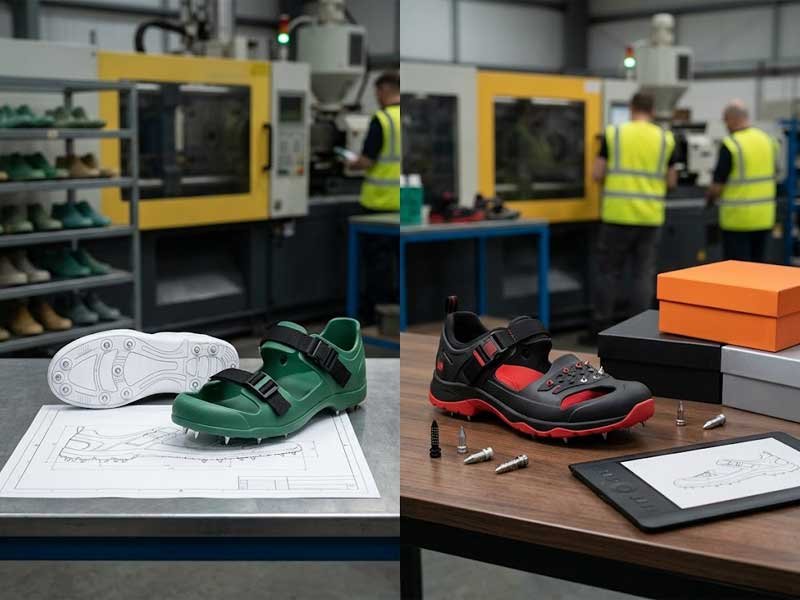
Design Ownership vs. Surface Branding
Here's where buyers trip up most often. When someone asks me for "ODM with custom spike length and a different strap material," what they're actually describing is OEM — because they want structural changes. ODM, by definition, means the factory's existing mold, existing spike configuration, existing sole structure. What you can customize in a true ODM model is limited to:
- Logo placement (laser engraving, embossing, printed tags)
- Strap color or surface embroidery
- Packaging design and retail-ready box art
- Woven labels and hang tags
What you typically cannot change in ODM without crossing into OEM territory:
- Spike length or diameter (these are mold-dependent)
- Sole material composition (PP vs. EVA requires different production lines[^1])
- Strap attachment mechanism (buckle vs. Velcro vs. ratchet[^2])
- Sole plate geometry or spike count
| Parameter | ODM (Factory Design) | OEM (Your Design) |
|---|---|---|
| [Spike length/count | Fixed to existing mold | Fully customizable](https://en.wikipedia.org/wiki/Injection_moulding)[^3] |
| Sole material (PP/EVA) | Fixed to existing SKU | Selectable per spec |
| Strap system | Cosmetic changes only | Full redesign possible |
| Logo/branding | Yes — surface level | Yes — integrated into design |
| Mold investment | None | Required (buyer-funded) |
| [Typical lead time | 2–4 weeks after order | 8–16 weeks (incl. mold dev)](https://importivity.com/blog/oem-vs-odm-manufacturing/)[^4] |
| Design exclusivity | None — shared design | Full or partial exclusivity |
This table isn't theoretical. It reflects the actual conversations I have weekly with hardware importers and e-commerce brand owners. The most expensive misunderstanding in spiked shoe sourcing happens when a buyer selects ODM expecting to "customize later" — then discovers the only thing they can change is the logo color.
Why the Textbook Definition Isn't Enough
Every article online will tell you "OEM = Original Equipment Manufacturer[^5]" and "ODM = Original Design Manufacturer." That's technically correct and practically useless for a sourcing decision. The relevant question isn't what the acronyms stand for. It's: what changes require new tooling, and can you afford that tooling at your current order volume? Every structural change to a spiked shoe — spike geometry, sole plate thickness, material grade — traces back to a mold. And molds cost money, take time, and only make economic sense above certain order quantities.
Why Do Buyers Confuse OEM and ODM When Sourcing Spiked Shoes?
The confusion isn't because buyers are careless. It's because many factories blur the line intentionally — marketing "full customization" when they really mean "we'll change the logo on our existing product." This creates false expectations that collapse during sampling.
In my experience, the confusion stems from three specific patterns: factories using "OEM/ODM" as a single marketing term, buyers assuming branding equals differentiation, and a general lack of transparency about what's structurally locked into existing molds. Recognizing these patterns early protects your procurement timeline and budget.
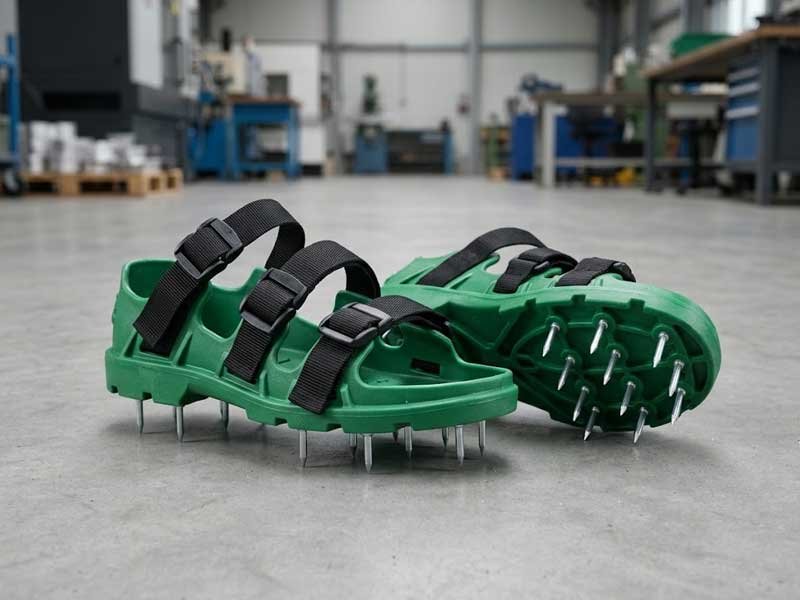
Pattern 1: "OEM/ODM" Used as One Term
Browse any B2B marketplace listing for spiked shoes, and you'll see "OEM/ODM Welcome" plastered on nearly every product page[^6]. This conflation trains buyers to treat the two models as a single service tier. In reality, they carry completely different cost implications. I've had buyers reach out asking for "OEM/ODM pricing" in the same sentence — which tells me they haven't yet decided whether they want structural customization or surface branding. That's not a criticism; it's a symptom of how the industry markets itself.
Pattern 2: Branding ≠ Differentiation
Here's a scenario I've seen play out multiple times. A Shopify or Amazon seller wants to launch a private-label epoxy spiked shoe. They choose ODM because it's faster and cheaper. They get their logo on the strap, custom packaging, nice photography. They launch. Within three months, they find two or three other sellers on the same marketplace with visually identical products — because those sellers sourced from the same factory, same mold, same design. The only differences are logo and listing copy.
This isn't a hypothetical. It's the single most common competitive failure mode for e-commerce sellers sourcing spiked shoes. The product works fine. The quality is acceptable. But there is zero structural differentiation, which means you're competing purely on price and listing optimization — a race to the bottom[^7].
Pattern 3: Lack of Mold Transparency
Some factories will accept "customization requests" on ODM orders without clarifying that those changes require new molds — then deliver a sample that doesn't match the buyer's spec because the existing mold couldn't accommodate the requested spike length or strap configuration. The buyer is now weeks into the process, has paid for samples, and faces a choice: accept the factory's standard design or restart with proper OEM mold development.
The takeaway: Before you request a quote, explicitly ask the factory which parameters are mold-dependent and which are surface-level. This single question saves more procurement time than any other I can think of.
When Does OEM Make Sense for Spiked Shoes Sourcing?
OEM sourcing sounds appealing — full design control, unique product, brand exclusivity. But it comes with real financial and timeline commitments that not every buyer's business model supports. Choosing OEM without the volume to justify it is the second most common failure mode I see.
OEM makes sense when spiked shoes are a core product in your catalog (not a bundled accessory), your annual order volume justifies mold development costs, and your brand strategy depends on structural differentiation that competitors cannot replicate by sourcing from the same factory.
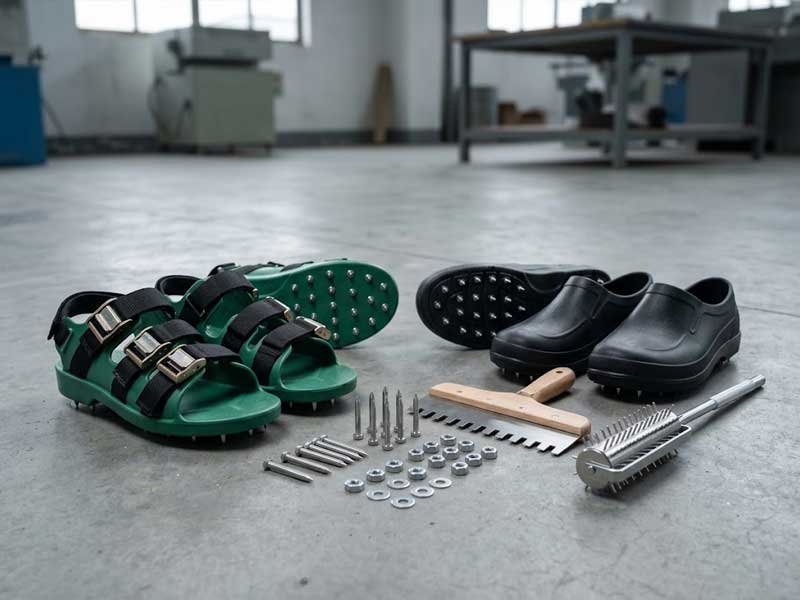
The Economics of Custom Tooling
Let's talk real numbers — not exact quotes, but the cost structure you should expect. Custom mold development for a spiked shoe sole plate typically involves[^8]:
- Mold design and CNC machining: This is a fixed upfront cost. Depending on complexity (spike count, material, sole geometry), it can range from several hundred to a few thousand dollars per mold.
- Sample iterations: Usually 1–3 rounds before production approval. Each round costs time (2–4 weeks) and money (sample fees, shipping).
- Minimum production run: Once the mold is approved, the factory needs a minimum order to justify setting up the production line. For spiked shoes, this is typically higher than ODM minimums.
Here's the critical math: divide your total mold and tooling investment by your first order quantity[^9]. That per-unit cost gets added to your COGS. If you're ordering 500 pairs, that tooling cost per unit is significant. If you're ordering 5,000 pairs, it becomes negligible.
Who Should Choose OEM?
Based on the buyer conversations I've had over the past decade, OEM spiked shoe sourcing works best for:
- Established hardware tool brands expanding their flooring tools line with a proprietary spiked shoe design that matches their existing product aesthetic and quality tier.
- Industrial coating distributors (think regional Sika or BASF distributors[^10]) who want to bundle a uniquely designed application tool with their coatings — creating a system, not just a product.
- High-volume e-commerce brands that have validated market demand through ODM first and are now ready to invest in a differentiated product to defend their market position.
Who Should Not Choose OEM?
- Buyers testing a new product category with uncertain demand.
- Sellers with annual volume below the threshold where tooling costs amortize reasonably.
- Brands where the spiked shoe is a supporting SKU — bundled with epoxy kits or listed as an accessory — rather than a hero product.
If spiked shoes represent 5% of your catalog revenue, spending months on custom mold development rarely makes strategic sense. That budget is better deployed on your core products.
When Is ODM the Right Choice for Spiked Shoes?
ODM gets dismissed as "generic" by buyers who equate customization with quality. But for a large segment of spiked shoe buyers, ODM is the strategically correct choice — not the lazy one. The risk isn't in choosing ODM; it's in choosing ODM while expecting OEM outcomes.
ODM is the right sourcing model when your priority is speed to market, your spiked shoe is a supporting or bundled product (not your brand's flagship), and your order volume or budget doesn't justify custom mold investment. Done correctly, ODM still allows meaningful brand presentation through packaging, labeling, and surface branding.
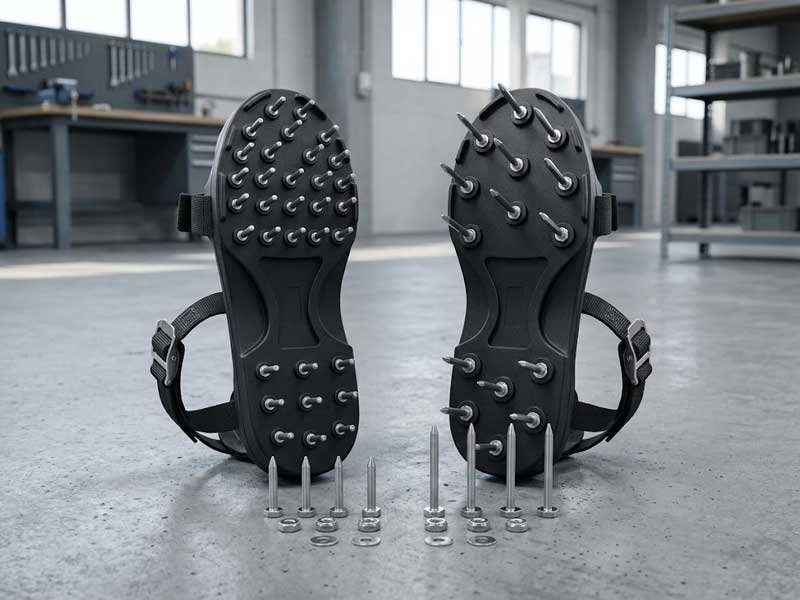
The Real Value of ODM
ODM's advantage isn't just cost savings — it's risk reduction. Consider what you gain:
- Proven mold and design: The factory's existing spiked shoe designs have already been through production validation. The spike length, sole plate thickness, and strap attachment points have been tested across multiple production runs. You're buying into a design with a known defect rate and known performance envelope[^11].
- Faster time to market: No mold development phase means you can go from purchase order to shipped goods in weeks, not months.
- Lower commitment: If the product doesn't perform in your market, your sunk cost is limited to inventory — not inventory plus tooling.
The Competitive Risk of ODM
Here's the honest trade-off. Because you're sourcing from an existing mold, other buyers can access the same core product. In practice, this means:
- On Amazon/Shopify: Multiple sellers may list products that are functionally and visually identical to yours. Differentiation shifts entirely to listing quality, pricing, reviews, and fulfillment speed.
- In wholesale/distribution: Your retail customers may find the same product from another importer at a lower price point if that importer secured better volume pricing.
- In industrial contracting: End users rarely care about brand aesthetics on a consumable tool — so ODM is often perfectly adequate for this channel.
Making ODM Work Harder
Even within the ODM model, there are ways to create meaningful differentiation without touching the mold:
- Premium packaging: A well-designed retail box or branded carrying case can elevate the perceived value significantly, especially for e-commerce.
- Bundling strategy: Pair the spiked shoes with complementary items — replacement spikes, cleaning brushes, instruction cards — to create a "kit" that competitors selling the bare product can't easily match.
- Quality-tier selection: Not all ODM products from the same factory are identical. Ask about material grade options within the existing design. Some factories offer standard and premium versions of the same mold — thicker sole plates, higher-tensile spikes, or upgraded strap hardware.
- Verification and documentation: Request quality inspection reports, material certificates, and testing data. Including these in your product listing or B2B sales pitch adds credibility even when the base product is shared.
How Do You Decide Between OEM and ODM for Your Spiked Shoes Order?
This is where most "OEM vs ODM" articles fail — they list pros and cons and end with "it depends on your needs." That's not helpful. I've found that the decision collapses into exactly two qualifying questions, and once you answer them honestly, the path forward is clear.
Ask yourself two questions: (1) Does my MOQ and budget realistically support custom mold development and extended lead times? (2) Is this spiked shoe a core brand differentiator, or is it a supporting/bundled tool item in my catalog? Your answers to these two questions determine your sourcing model with very little ambiguity.
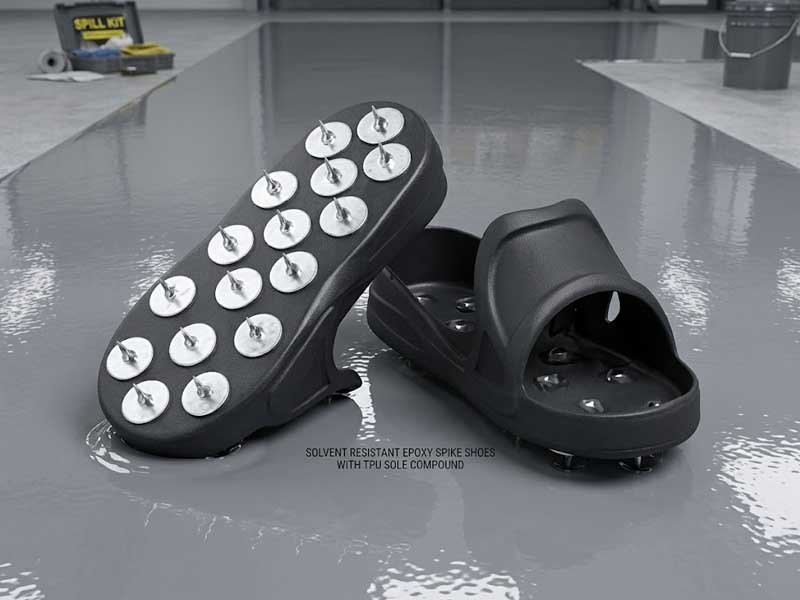
The Two-Question Decision Framework
Here's how the answers map to outcomes:
| Your MOQ/Budget | Product Role in Catalog | Recommended Model | Why |
|---|---|---|---|
| Supports tooling investment | Core differentiator | OEM | You have the volume to amortize mold costs, and your brand needs structural uniqueness |
| Supports tooling investment | Supporting/bundled SKU | ODM (premium tier) | You can afford OEM but don't need it — invest that budget in your core products instead |
| Does not support tooling | Core differentiator | ODM now → OEM later | Validate demand with ODM first, then invest in OEM once volume justifies it |
| Does not support tooling | Supporting/bundled SKU | ODM | Straightforward — keep costs low, focus branding effort on packaging and bundling |
This framework isn't something I invented in a conference room. It's the pattern that emerges from hundreds of sourcing conversations with hardware importers, tool brands, and e-commerce sellers. The buyers who get stuck are almost always the ones who haven't answered these two questions clearly before approaching a factory.
Question 1: MOQ and Budget Reality
Be honest about your numbers. Here are the questions to ask yourself — and your factory contact:
- What is my realistic first-order quantity?
- What is the mold development cost for the structural changes I want?
- What is the per-unit cost impact of amortizing that mold over my first order?
- Can I commit to repeat orders that further amortize the mold investment?
- What is my acceptable lead time from PO to delivery?
If your first order is small and you're testing a market, OEM mold costs will disproportionately inflate your per-unit cost. That's not a failure — it's just math. ODM lets you validate the market first.
Question 2: Product Role and Differentiation Need
This question requires strategic honesty. Ask yourself:
- If a competitor lists a nearly identical spiked shoe, does that threaten my brand positioning? If yes, you need structural differentiation (OEM). If no, ODM with strong branding is sufficient.
- Do my customers buy my spiked shoes specifically, or do they buy them as part of a larger system/bundle? If spiked shoes are the reason customers choose your brand, invest in OEM. If they're an accessory to your coatings, resins, or tool kits, ODM is strategically appropriate.
- Is my margin on spiked shoes large enough to absorb custom tooling costs? If your spiked shoes are a low-margin, high-volume consumable, the margin math may not support OEM regardless of your brand aspirations.
[^1]: "Prototyping of Injection EVA Foam Footwear Midsoles", https://dspace.mit.edu/bitstream/handle/1721.1/146701/galgali-amgalg-lgo-2022-thesis.pdf?sequence=1&isAllowed=y. Polypropylene is typically processed via injection molding at high temperatures and pressures, whereas EVA foams are produced through compression molding or injection foam molding at lower pressures, requiring distinct equipment and process parameters (Handbook of Thermoplastic Elastomers, 2nd ed., William Andrew Publishing, 2014). Evidence role: mechanism; source type: education. Supports: That PP (polypropylene) and EVA (ethylene-vinyl acetate) require fundamentally different molding processes — injection molding for PP and compression or foam molding for EVA — necessitating separate production equipment. Scope note: The specific production line configurations for spiked shoe soles may vary by factory and are not universally documented.
[^2]: "Lawn aerator spiked shoes assembly instructions", https://www.youtube.com/watch?v=4yXNBTHvrjc. Product surveys of spiked shoes marketed for epoxy and self-leveling flooring applications show that the three predominant strap closure types are buckle straps, hook-and-loop (Velcro) straps, and ratchet-style closures, each offering different trade-offs in adjustability and secure fit. Evidence role: general_support; source type: other. Supports: That commercially available spiked shoes for flooring applications commonly feature buckle, hook-and-loop (Velcro), or ratchet strap closure systems. Scope note: No formal industry standard or published classification of spiked shoe strap types exists; this observation is based on commercially available product specifications.
[^3]: "Injection moulding", https://en.wikipedia.org/wiki/Injection_moulding. In injection molding, the geometry of protruding features such as pins or spikes is defined by the mold cavity; altering their dimensions requires machining a new cavity or mold insert (Rosato, D.V. & Rosato, M.G., Injection Molding Handbook, 3rd ed., Springer, 2000). Evidence role: mechanism; source type: education. Supports: That protrusion geometry (such as spike length and count) in injection-molded sole plates is determined by the mold cavity and cannot be altered without creating a new mold. Scope note: This principle applies broadly to injection-molded components and is not specific to spiked shoe manufacturing.
[^4]: "OEM vs ODM Manufacturing: Key Differences Explained", https://importivity.com/blog/oem-vs-odm-manufacturing/. Industry sourcing guides indicate that ODM production using existing molds typically requires 2–5 weeks from order confirmation to shipment, while OEM projects involving custom tooling development commonly extend to 8–16 weeks or longer depending on mold complexity and iteration cycles (Sourcify, 'Manufacturing Lead Times Guide,' 2023). Evidence role: statistic; source type: research. Supports: That ODM orders with existing tooling typically ship in 2-4 weeks while OEM orders requiring new mold development take 8-16 weeks. Scope note: Lead times vary significantly by factory capacity, order size, and geographic location; these ranges represent general industry norms rather than spiked-shoe-specific data.
[^5]: "Original equipment manufacturer", https://en.wikipedia.org/wiki/Original_equipment_manufacturer. An Original Equipment Manufacturer (OEM) produces components or products to the buyer's specifications, while an Original Design Manufacturer (ODM) designs and manufactures products that the buyer then rebrands and sells (see 'Original design manufacturer,' Wikipedia; 'Original equipment manufacturer,' Wikipedia). Evidence role: definition; source type: encyclopedia. Supports: The standard definitions of OEM (Original Equipment Manufacturer) and ODM (Original Design Manufacturer) as distinct manufacturing and sourcing models.
[^6]: "Evaluating the drivers of B2B performance - PMC - NIH", https://pmc.ncbi.nlm.nih.gov/articles/PMC11244795/. Analyses of B2B e-commerce platforms such as Alibaba have noted that suppliers routinely advertise 'OEM/ODM' as a bundled capability without clearly delineating the scope and cost differences between the two models, contributing to buyer confusion (Luo, Y. et al., 'Cross-border e-commerce in China,' International Business Review, 2022). Evidence role: general_support; source type: research. Supports: That B2B platforms like Alibaba commonly feature suppliers listing 'OEM/ODM' as a single combined service offering, blurring the distinction between the two models. Scope note: Systematic quantitative studies of this specific listing practice are limited; the observation is widely acknowledged in trade sourcing communities but not rigorously measured.
[^7]: "Why Amazon's Private Labels Hurt Consumers More than ...", https://www.fuqua.duke.edu/duke-fuqua-insights/Amazon-private-labels-hurt-consumers. Economic analyses of e-commerce marketplaces have shown that product commoditization — where multiple sellers offer functionally identical goods — leads to intensified price competition and reduced seller margins, consistent with Bertrand competition models (Baye, M.R. et al., 'Information, Search, and Price Dispersion,' Handbook of Economics and Information Systems, 2006). Evidence role: general_support; source type: paper. Supports: That sellers of undifferentiated products on e-commerce marketplaces face intensified price competition, leading to margin erosion. Scope note: These findings apply to marketplace competition generally and are not derived from spiked shoe category data specifically.
[^8]: "CNC Machining vs Injection Molding: Cost, Lead Time, and ...", https://printform.com/cnc-machining-vs-injection-molding-cost-lead-time-and-volume-tradeoffs/. Industry analyses of injection mold tooling costs indicate that simple single-cavity molds for small plastic components typically range from several hundred to several thousand dollars, with lead times of 2–6 weeks per iteration depending on complexity and material (see, e.g., Bryce, D.M., Plastic Injection Molding: Manufacturing Process Fundamentals, SME, 1996). Evidence role: statistic; source type: research. Supports: Typical cost ranges and lead times for custom injection mold tooling in footwear or small plastic component manufacturing. Scope note: General injection molding cost data may not precisely reflect spiked shoe sole plate tooling, which involves specialized spike geometries and materials.
[^9]: "Amortization of Tool & Die Cost in Supply Chain ...", https://www.linkedin.com/posts/krishnarajan-r-b682481ab_today-i-want-to-share-a-basic-yet-important-activity-7403700854459138049-J4SC. Standard manufacturing cost accounting allocates fixed tooling and mold development costs across the total units produced, yielding a per-unit tooling cost that decreases with volume — a fundamental principle in make-or-buy and sourcing decisions (Horngren, C.T. et al., Cost Accounting: A Managerial Emphasis, 16th ed., Pearson, 2018). Evidence role: mechanism; source type: education. Supports: That amortizing fixed tooling costs over production volume is a standard manufacturing cost accounting practice for evaluating per-unit economics.
[^10]: "Flooring Systems", https://usa.sika.com/en/construction/floor-wall/flooring-systems.html. Major industrial coating manufacturers such as Sika and BASF publish technical data sheets and installation guides for their flooring systems that specify required application tools including spiked shoes, and their authorized distributors frequently offer these tools as bundled accessories (see, e.g., Sika Flooring Installation Guidelines; BASF Master Builders Solutions product catalogs). Evidence role: case_reference; source type: institution. Supports: That industrial coating manufacturers and their distributors commonly recommend or bundle specific application tools, including spiked shoes, as part of flooring system installation kits. Scope note: Whether distributors brand these tools as proprietary OEM products versus generic accessories varies by region and distributor.
[^11]: "Cost Estimating Using a New Learning Curve Theory for Non", https://scholar.afit.edu/cgi/viewcontent.cgi?article=2116&context=facpub. Manufacturing research demonstrates that defect rates in injection molding decrease with successive production runs as process parameters are optimized and mold wear patterns stabilize, a phenomenon consistent with manufacturing learning curve theory (Lapré, M.A. & Tsikriktsis, N., 'Organizational Learning Curves for Customer Dissatisfaction,' Management Science, 2006). Evidence role: mechanism; source type: paper. Supports: That molds and production processes that have undergone multiple production runs exhibit lower and more predictable defect rates due to process optimization and learning effects. Scope note: Learning curve research applies broadly to manufacturing processes; specific defect rate data for spiked shoe molds is not available in published literature.