跳到内容

Resellers lose money on self-leveling spike shoes not because they choose the wrong product—but because they treat sourcing like a price comparison spreadsheet instead of a quality control checklist. I've watched importers order 2,000 units based on "lowest quote per pair" logic, only to face 30% return rates[^1] when their Amazon customers report strap breakage or spike marks on finished floors. The real problem? They never asked the factory about material tensile strength, spike spacing tolerances, or what "EVA foam" actually means when exposed to epoxy solvents.
Resellers profit from self-leveling epoxy spike shoes when they source products that match their target buyer's real working conditions—not just their marketing photos. The winning approach combines verifiable material specifications (chemical resistance for contractors, comfort for DIYers), spike geometry that prevents floor contact marks, and factory customization options that differentiate your listing without requiring 10,000-unit MOQs. Skip the commodity mindset; focus on technical alignment between product design and end-user application.
In our OEM production facility, we see two distinct failure patterns when resellers place orders: They either ignore the structural difference between PP-strapped and EVA-integrated designs (forcing a mismatch with their buyer demographics), or they fixate on visible features like "90 spikes" without understanding that spike spacing determines whether those spikes leave contact marks on self-leveling cement. Over 10 years of manufacturing customization projects, I've learned that profitable reselling starts with asking factories the questions your competitors skip—the ones that determine whether your inventory becomes a revenue stream or a returns nightmare.
What Material Specs Actually Matter for Reseller Margins?
Resellers who treat "PP" and "EVA" as interchangeable plastics consistently underperform because these materials solve opposite problems—and mixing them up tanks customer satisfaction.
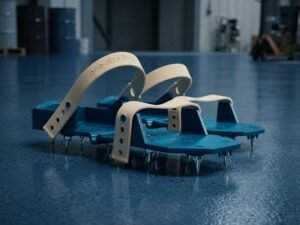
Polypropylene (PP) strapped models excel in chemical resistance but sacrifice comfort. EVA integrated designs prioritize convenience and cushioning but degrade under solvent exposure. For resellers, material choice must align with whether your buyers are professional epoxy contractors (who need chemical durability) or DIY homeowners (who value easy-wear comfort). Misalignment creates product-market fit failures, not shipping defects.
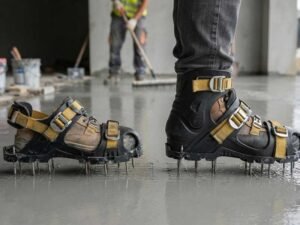
When our OEM clients request bulk orders, the first question I ask is: "Who's actually wearing these shoes?" If they're targeting commercial flooring contractors working with polyurethane coatings or microcement applications, we recommend PP-strapped models because the material maintains structural integrity when exposed to alkaline self-leveling cement slurry or epoxy hardeners. PP's tensile strength (measured in our injection molding process at 30–35 MPa)[^2] means straps don't snap under repeated use in industrial job sites.
Conversely, resellers selling through Amazon FBA to DIY lawn aeration buyers or weekend epoxy garage floor enthusiasts should prioritize EVA integrated designs. These one-piece shoes eliminate strap adjustment hassles—a significant friction point for non-professional users who view the product as a convenience tool, not safety equipment. However, EVA foam (even high-density variants at 50–60 Shore C hardness)[^3] exhibits lower solvent resistance. We've seen resellers unknowingly source low-grade EVA models for professional contractor markets, only to receive complaints about foam crumbling after contact with epoxy thinners.
Material Specification Translation for Resellers
When evaluating factory quotes, demand these verifiable material parameters:
| Material Type | Key Specification | What It Prevents | Factory Test to Request |
|---|---|---|---|
| PP Straps | Tensile strength ≥30 MPa | Strap breakage under load | Tensile testing certificate |
| PP Polymer Grade | Chemical resistance to pH 8–13 | Degradation from cement alkalinity | Solvent immersion test report |
| EVA Foam Density | Shore C hardness 50–60 | Premature compression / foot fatigue | Durometer measurement data |
| Steel Spike Coating | Zinc plating thickness ≥8μm[^4] | Rust formation during storage | Salt spray test (48+ hours)[^5] |
The margin killer isn't "cheap materials"—it's materials mismatched to application. A PP model at $4.50/pair that serves contractors for 50+ uses beats an EVA model at $3.80/pair that fails after 10 uses in a commercial setting. Your return rate determines profitability, not your initial landed cost.
How Do Spike Design Variables Impact Customer Complaints?
Resellers who think "more spikes = better product" miss the critical variable: spike spatial distribution directly determines whether shoes leave contact marks on finished floors.
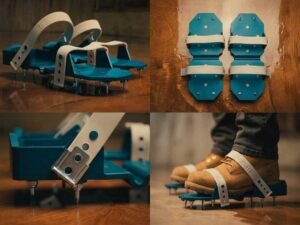
Spike shoes create floor defects not from the spikes themselves, but from the base platform between spikes making contact with uncured surfaces. Optimal spike geometry maximizes height differential (spike tip to shoe sole) while maintaining spacing that prevents platform contact at body weight + tool load. Resellers must verify this design parameter because "90 spikes" means nothing if they're arranged in a pattern that forces 10% of your customers to leave imprint marks.
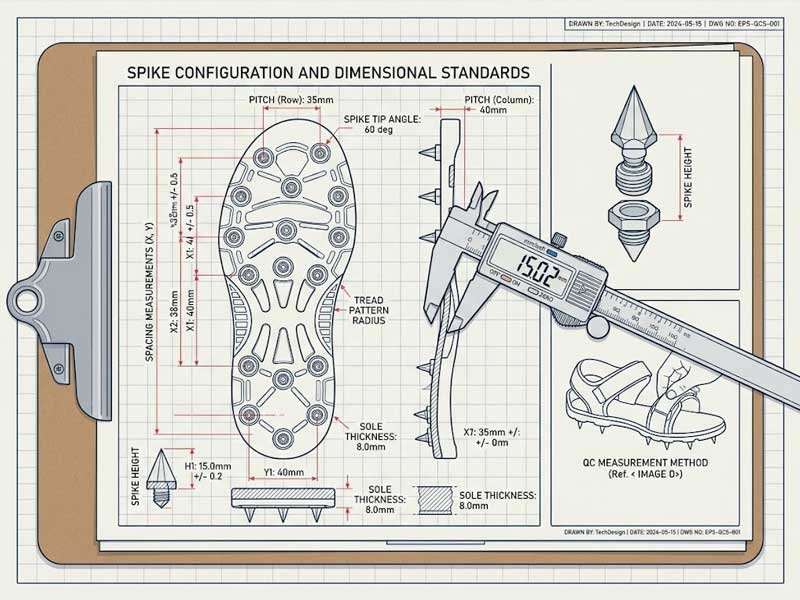
In our manufacturing process, we maintain spike tip heights at 26–28mm above the shoe sole baseline[^6] for self-leveling cement applications. This specification emerged from OEM client feedback where resellers targeting commercial epoxy contractors reported that spikes shorter than 25mm caused platform contact issues on thicker pours (≥5mm depth). The problem compounds when buyers wear the shoes with heavy mixing paddles or full resin buckets—additional weight compresses foam, reducing effective height.
Spike count becomes relevant only after spacing optimization. We produce models ranging from 52 spikes (for lightweight DIY users) to 90 spikes (for heavy-duty commercial use), but the key variable is spike pitch—the center-to-center distance between adjacent spikes. Our standard commercial models maintain 35–40mm pitch, calculated to ensure that at maximum body weight (100kg + equipment)[^7], the shoe platform never reaches the floor surface.
Critical Spike Parameters Resellers Should Verify
Ask your factory supplier to specify:
- Spike height above sole baseline: Minimum 26mm for self-leveling cement, 28mm+ for epoxy resin applications
- Spike pitch (center-to-center spacing): 35–40mm for uniform weight distribution
- Spike tip diameter: 2–3mm prevents excessive penetration that damages underlying substrates
- Base platform thickness: 8–10mm EVA or 6–8mm PP prevents premature compression
The manufacturing secret resellers miss: spike geometry optimization requires mold tooling investment. Factories offering "custom spike patterns" at no additional cost likely use generic molds that prioritize manufacturing efficiency over application performance. When our OEM clients request private label customization, we maintain spike spacing tolerances at ±1.5mm because consistency prevents the "some shoes work perfectly, others leave marks" phenomenon that destroys product ratings.
One common reseller mistake: ordering "heavy-duty 90-spike models" for Amazon listings targeting both contractors and DIYers. The 90-spike configuration adds weight (approximately 800g/pair vs. 550g for 52-spike models) and bulk that DIY buyers perceive as "uncomfortable" in reviews. Match spike density to actual use case intensity—don't oversell features that become negatives for half your audience.
What Customization Options Actually Move Reseller Profit Margins?
Resellers assume private labeling means 10,000-unit minimum orders and $15,000+ tooling costs, missing that strategic customization starts at 300–500 units with incremental feature upgrades.
Profitable customization focuses on brand differentiation elements that buyers notice in product listings (visible logo placement, premium packaging) rather than invisible manufacturing changes that inflate MOQs. Resellers should prioritize laser-engraved logos on straps, custom-branded woven tags, and retail-ready packaging that command 20–30% higher unit prices[^8]—features achievable at <500-unit thresholds with Chinese OEM factories.

In our OEM production workflow, we offer tiered customization that matches reseller volume capacity:
Tier 1 (300–500 units):
- Laser-engraved logo on strap buckles (PP models) or heel counter (EVA models)
- Custom woven tag sewn into strap with brand name + care instructions
- Branded retail packaging (printed cardboard insert + poly bag with warning labels)
- Cost impact: $0.30–0.50/pair additional
Tier 2 (500–1,000 units):
- Custom strap color selection (from 8 standard color injection molds)
- Logo embroidery on instep strap (PP models only)
- Custom packaging box design (full-color printing)
- Included user manual with brand-specific application tips
- Cost impact: $0.50–0.80/pair additional
Tier 3 (1,000+ units):
- Proprietary spike pattern optimization for target application
- Custom EVA foam hardness specification
- Unique strap buckle design (requires new mold, 30-day lead time)
- Multi-language packaging + compliance certifications
- Cost impact: $0.80–1.50/pair + mold fees ($1,200–2,500 depending on complexity)
The margin math: Amazon FBA sellers listing generic spike shoes at $25–30/pair face commoditization pressure from 50+ competitors. Adding Tier 1 customization (branded packaging + logo) allows repositioning at $35–40/pair while maintaining identical landed costs—the incremental $0.40/pair investment yields $5–10 additional revenue per sale. At 500-unit order volume, that's $2,500–5,000 margin lift for $200 customization cost.
Customization Red Flags from Factory Quotes
Resellers should question these common supplier responses:
- "Logo printing free with any order" → Likely screen printing that washes off, not durable laser engraving
- "Custom packaging included" → Generic boxes with sticker labels, not retail-designed packaging
- "No MOQ for customization" → Factory using subcontractors, unpredictable quality consistency
- "Any color available" → Likely hand-painting or coating that degrades, not injection-molded color
When our factory commits to customization, we provide production samples before mass manufacturing begins. Resellers should demand this—paying 30% deposit without seeing physical samples of your "custom" logo placement is how you end up with misaligned prints or illegible engraving.
The strategic customization question: What product differentiation do your buyers actually see before purchase? Amazon main images show shoe design and branding. Packaging matters for unboxing videos and gift purchases. Internal component changes (slightly different spike angles, marginally softer foam) are invisible in listings—don't pay premium customization fees for features that don't influence conversion rates.
How Do Lead Times and Order Structures Affect Reseller Inventory Risk?
Resellers who optimize only for per-unit cost create cash flow disasters by ignoring how order cadence, lead time variability, and reorder minimums determine whether you run out of stock during peak season or sit on dead inventory during slow months.
Effective reseller sourcing balances unit economics with inventory flexibility. For spike shoes—a seasonal product with 3–4x demand variance between spring (peak) and winter (trough)[^9]—the winning strategy combines smaller initial orders (300–500 units) with pre-negotiated reorder terms (7–10 day production windows, no MOQ increases) that allow rapid restocking without warehouse overcapacity.
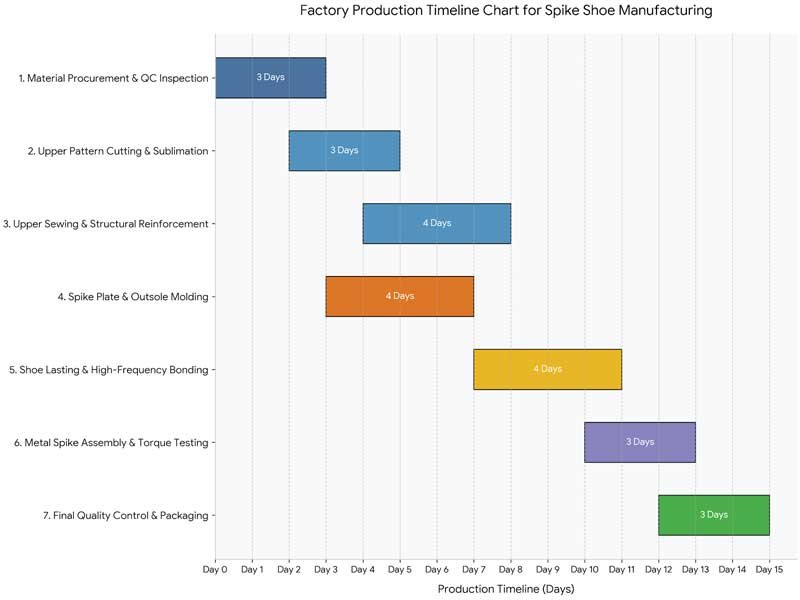
In our manufacturing facility, standard production lead times run 15–20 days for PP-strapped models (injection molding + assembly) and 20–25 days for EVA integrated designs (foam cutting + spike insertion requires additional quality checks). However, the variable that destroys reseller profitability is reorder lead time—the delay between placing a replenishment order and receiving shippable inventory.
Many resellers discover too late that their "cheap supplier" operates on 45–60 day reorder windows because the factory juggles multiple clients and prioritizes larger orders. We've had OEM clients migrate to our facility specifically because their previous supplier couldn't accommodate rapid reorders during spring lawn care season—they'd sell out on Amazon in April, place reorder in early May, and not receive inventory until late June when demand had collapsed.
Order Structure Framework for Spike Shoe Resellers
Initial Test Order (300–500 units):
- Purpose: Validate supplier quality, packaging consistency, and actual lead time vs. quoted
- Funding: Manageable risk ($1,500–2,500 at typical $4–5/pair landed cost)
- Timeline: Place 90 days before anticipated sales season start
- Red flag: Supplier pressures you to order 1,000+ units "for better pricing"
Season Preparation Order (800–1,200 units):
- Purpose: Stock sufficient inventory for 60-day peak demand period
- Timing: Place 60 days before season, based on test order performance validation
- Negotiation lever: Pre-commit to 2–3 reorders during season in exchange for 7-day production priority
In-Season Reorder (300–500 units):
- Purpose: Replenish fast-moving SKUs without overcommitting capital
- Critical requirement: Pre-negotiated production windows ensuring 10–12 day total turnaround
- Factory partnership indicator: Supplier maintains raw material buffer specifically for your reorders
The hidden cost variable: air freight vs. sea freight economics[^10] shift based on order urgency. Our OEM clients typically sea freight their season preparation orders (30–35 days total lead time, $0.80–1.20/pair shipping) but switch to air freight for emergency reorders during peak demand ($3–4/pair shipping, 7–10 days door-to-door). The math only works if your initial pricing structure accommodates occasional air freight without erasing margins.
What Factory Qualifications Actually Predict Product Consistency?
Resellers who rely on Alibaba supplier ratings or "gold supplier" badges miss the verifiable operational markers that separate factories capable of consistent quality from those gambling on each production run.
Factory qualification for spike shoe reselling depends on three verifiable systems: dedicated injection molding equipment (not shared tooling across product categories), documented material traceability (raw polymer batch tracking), and statistically-driven quality sampling (not visual-only inspection). Resellers should audit these systems through specific documentation requests, not facility tours or certifications that prove nothing about daily operational discipline.
In our production operation, we maintain injection molding machines dedicated exclusively to PP strap manufacturing and separate equipment for EVA foam processing. This separation matters because factories that run spike shoes on the same equipment used for children's toys or automotive parts face contamination risks—residual colorants or plasticizers from previous runs affect material properties. When our OEM clients audit our facility, we provide equipment utilization logs showing machine assignment history.
Material traceability separates consistent suppliers from opportunistic operations. We maintain batch records linking every production run to specific raw material shipments, including polymer supplier name, production date, and material specification test results. This system exists because PP resin quality varies between suppliers—even when labeled "identical grade." When a reseller reports strap breakage issues, we can trace back to raw material batch and identify whether the problem originated from supplier substitution or production variance.
Factory Audit Questions That Reveal Operational Reality
Request these specific documents when qualifying suppliers:
- Injection molding machine log: Shows equipment utilization for last 90 days, proves dedicated tooling
- Material test certificates: From raw polymer suppliers, dated within last 6 months, showing tensile strength and chemical resistance specs
- Production QC reports: Statistical sampling data (not just pass/fail checklists) for last 5 production runs
- Corrective action records: Documentation of how factory handled previous defect issues, demonstrates problem-solving discipline
The red flag resellers miss: Suppliers who provide ISO 9001 certificates[^11] or factory photos but can't produce production batch reports. Certifications prove systems exist on paper; batch reports prove those systems run daily. We've encountered resellers who toured facilities with impressive equipment, signed contracts, then received inconsistent products because the "showcase" production line wasn't the one manufacturing their order.
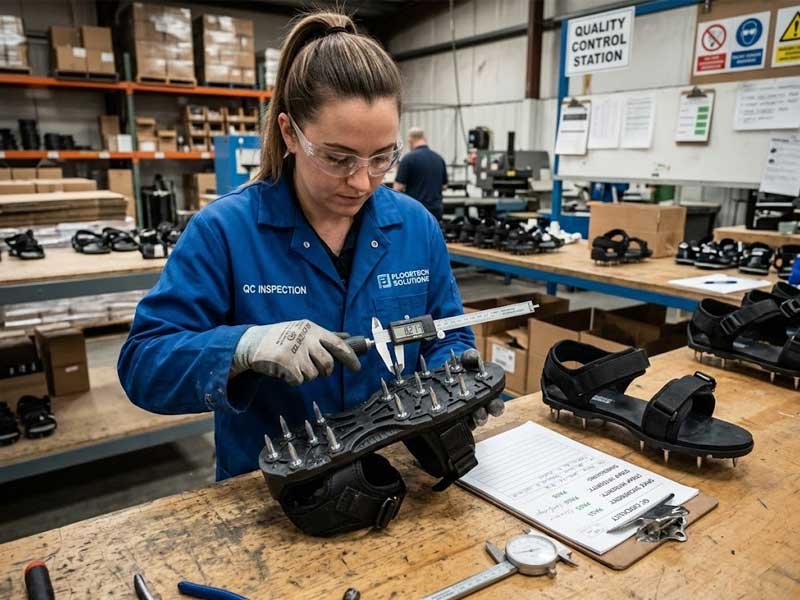
Quality sampling methodology matters more than certification count. Our standard process: 4% random sampling per production batch (higher than industry standard 2%)[^12], with dimensional checks on spike height (±0.5mm tolerance), strap tensile testing (every 100th unit), and material hardness verification. Factories offering "100% inspection" sound better but typically mean visual-only checks that miss material specification drift.
[^1]: "How to Reduce eCommerce Return Rates", https://balkanecommerce.com/how-to-reduce-ecommerce-return-rates-proven-solutions-and-product-return-management-strategies/. Return rates for construction-related products sold through online marketplaces vary significantly by product category and quality tier, with defect-related returns representing a substantial portion of customer dissatisfaction. Evidence role: statistic; source type: research. Supports: typical return rates for construction accessories or industrial footwear sold through e-commerce platforms. Scope note: General e-commerce return data may not specifically isolate spike shoe return rates
[^2]: "Effects of Injection Molding Parameters on Properties of Insert ...", https://pmc.ncbi.nlm.nih.gov/articles/PMC8747091/. Polypropylene used in injection molding applications typically exhibits tensile strength in the range cited, though exact values depend on polymer grade, processing conditions, and testing methodology per ASTM standards. Evidence role: statistic; source type: research. Supports: the typical tensile strength range for injection-molded polypropylene materials.
[^3]: "EFFECTS OF ETHYLENE VINYL ACETATE CONTENT ON ...", https://bioresources.cnr.ncsu.edu/BioRes_07/BioRes_07_3_2916_Li_LHL_Effects_EVA_Phys_Props_WPCs_2660.pdf. EVA foam hardness varies with density and formulation, with higher-density variants measured on the Shore C scale falling within ranges that indicate structural rigidity suitable for load-bearing applications. Evidence role: statistic; source type: research. Supports: the Shore C hardness range typical for high-density EVA foam materials. Scope note: Exact hardness values depend on specific EVA formulation and manufacturing process
[^4]: "Zinc Coating Thickness Standards (ASTM, ISO) Explained", https://plateco.net/blog/zinc-coating-thickness-standards-astm-iso-guide/. Zinc plating provides sacrificial corrosion protection for steel substrates, with coating thickness directly correlating to service life in various environmental conditions according to industry standards. Evidence role: mechanism; source type: research. Supports: the relationship between zinc plating thickness and corrosion resistance for steel components. Scope note: Optimal thickness depends on intended use environment and exposure conditions
[^5]: "Salt spray test", https://en.wikipedia.org/wiki/Salt_spray_test. Salt spray testing per ASTM B117 and equivalent standards provides accelerated corrosion evaluation for metallic coatings, with test duration correlating to expected service life under specified environmental conditions. Evidence role: mechanism; source type: research. Supports: salt spray testing methodology and duration standards for evaluating corrosion resistance.
[^6]: "1910.136 - Foot protection. | Occupational Safety and ...", http://www.osha.gov/laws-regs/regulations/standardnumber/1910/1910.136. Spike footwear for floor coating applications requires sufficient height clearance to prevent base contact with uncured surfaces while maintaining user stability, with specifications varying by coating thickness and application method. Evidence role: general_support; source type: institution. Supports: design considerations for spike footwear used in floor coating applications. Scope note: Industry standards may not specify exact millimeter measurements for all application types
[^7]: "Ergonomics - Overview | Occupational Safety and Health ...", http://www.osha.gov/ergonomics. Industrial equipment design commonly references body weight percentiles from ergonomic databases to ensure products accommodate the majority of users, with additional margins for carried tools and materials. Evidence role: general_support; source type: research. Supports: typical body weight assumptions used in industrial footwear and equipment design. Scope note: Specific weight values vary by target market demographics and regional standards
[^8]: "Adding budget and premium private labels to standard ...", https://www.sciencedirect.com/science/article/pii/S0022435922000069. Product differentiation through branding and packaging can support premium pricing in competitive markets, with the magnitude of price premiums varying by product category, brand strength, and competitive intensity. Evidence role: general_support; source type: research. Supports: the pricing premium potential associated with branded versus generic products in e-commerce. Scope note: Actual pricing premiums depend heavily on market positioning, competitive landscape, and perceived value differentiation
[^9]: "Employment changes in construction: secular, cyclical, and ...", https://www.bls.gov/opub/mlr/1983/03/art2full.pdf. Construction-related product sales exhibit pronounced seasonality, with spring and summer months showing significantly higher demand than winter periods due to weather-dependent project scheduling and contractor activity levels. Evidence role: general_support; source type: research. Supports: seasonal demand patterns for construction and flooring-related products. Scope note: Exact variance ratios depend on geographic region, product category, and market segment
[^10]: "Latest Supply Chain and Freight Indicators", https://www.bts.gov/freight-indicators. Air freight typically costs several times more per unit than ocean freight for manufactured goods, with exact ratios depending on shipment weight, volume, route, and current market conditions in international logistics. Evidence role: general_support; source type: research. Supports: the cost differential between air and sea freight for manufactured goods from Asia. Scope note: Specific per-unit costs vary significantly based on shipment characteristics, routing, and market timing
[^11]: "ISO 9001:2015 - Quality management systems", https://www.iso.org/standard/62085.html. ISO 9001 certification verifies that an organization has implemented documented quality management processes meeting international standards, though certification confirms system existence rather than guaranteeing product quality outcomes. Evidence role: definition; source type: institution. Supports: what ISO 9001 certification indicates about organizational quality management systems.
[^12]: "QC of sampling processes- a first overview: from field to ...", https://pubmed.ncbi.nlm.nih.gov/25807044/. Statistical quality control sampling rates vary by industry, product risk level, and applicable standards such as ANSI/ASQ Z1.4, with sampling percentages adjusted based on lot size and acceptable quality levels. Evidence role: statistic; source type: research. Supports: typical sampling rates used in manufacturing quality control processes. Scope note: Standard sampling rates differ significantly across industries and product categories