跳到内容
跳到内容 
Spike material is one of those specification decisions that looks minor until a buyer gets it wrong. Procurement managers sourcing spiked shoes for epoxy flooring contractors or lawn care distributors often default to zinc-plated hardware because it carries an "outdoor rated" reputation — and then field corrosion complaints within a single season. Choosing the wrong spike material is not a price mistake. It is a corrosion mechanism mistake.
The core answer: zinc-plated spikes and stainless steel spikes fail in fundamentally different ways, and those failure modes map directly to two different environments. For soil aeration at low-to-moderate frequency, zinc plating is a viable and cost-appropriate specification. For any epoxy flooring application, stainless steel is the correct default — not because zinc is cheap, but because epoxy solvents chemically attack zinc plating in ways that soil simply does not. Specifying zinc-plated spikes for epoxy work will produce premature corrosion and potentially contaminate the coating surface mid-application.
Understanding why these two materials behave differently in each environment is what turns this from a vague preference into a defensible specification decision. The sections below break down the failure mechanics, the test data we have collected in-house, and the procurement logic that follows from both.
What Actually Happens to Zinc-Plated Spikes in Soil?
Most buyers know zinc rusts eventually. What they underestimate is the mechanism — and whether it matters for their specific use case.
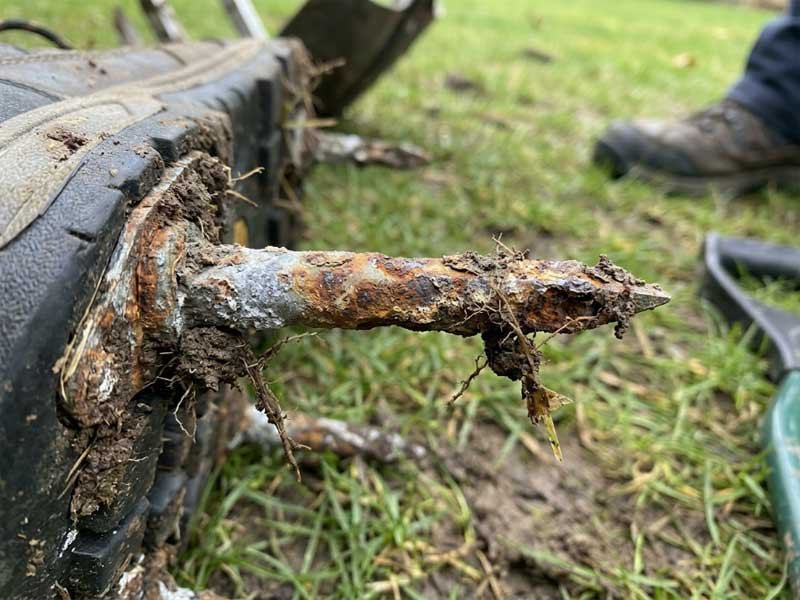
Zinc-plated spikes degrade in soil through electrochemical corrosion[^1]. Moisture, oxygen, and dissolved salts in the soil create a galvanic environment where zinc acts as a sacrificial layer, corroding slowly in place of the underlying steel. This process is gradual, relatively predictable, and — for low-to-medium frequency residential lawn use — often acceptable over a typical product life cycle.
The Electrochemical Corrosion Process in Plain Terms
When a zinc-plated spike penetrates moist soil, it enters a complex electrochemical environment. Here is what happens at each stage:
- Initial contact: The zinc coating is intact and acts as a physical barrier plus a sacrificial anode. Early corrosion is surface-level and slow.
- Moisture penetration: As the coating weathers through repeated use, micro-abrasions from soil particles allow moisture to reach the zinc layer more directly.
- Red rust appearance: Once the zinc layer is sufficiently depleted, the underlying steel is exposed. Red iron oxide (rust) begins forming. In our accelerated salt spray testing, this threshold appeared between 48 and 96 hours of continuous exposure.
- Structural weakening: At this stage, spike integrity begins declining. For lawn aerator shoes used seasonally and stored dry, real-world degradation is much slower than accelerated test conditions suggest — which is why zinc-plated remains a reasonable option for that context.
Where Zinc Performs Adequately — and Where It Does Not
| Use Case | Frequency | Climate | Zinc-Plated Verdict |
|---|---|---|---|
| Residential lawn aeration | Seasonal / low | Temperate, moderate humidity | Acceptable — cost-appropriate |
| Commercial lawn aeration | High frequency, weekly use | Variable / humid | Marginal — corrosion accumulates faster |
| Coastal or high-salt environments | Any | Saltwater proximity | Not recommended — accelerated galvanic attack |
| Epoxy flooring application | Any | Any (indoor) | Not suitable — see below |
The key procurement insight here: soil is a physical and electrochemical environment. That means corrosion is a function of time, exposure frequency, and local soil chemistry. It is manageable. You can engineer around it with use-frequency guidance, proper storage instructions, and reasonable replacement cycles. Epoxy is a different problem entirely.
Why Do Epoxy Environments Destroy Zinc Plating Faster?
This is the most important section in this article for buyers supplying epoxy flooring contractors. The failure mechanism in epoxy environments is chemical, not electrochemical — and that distinction changes everything about the specification.
Epoxy floor coatings involve a two-component system: a resin and a hardener (typically an amine-based curing agent)[^2]. During the open-time window when contractors walk the wet surface wearing spiked shoes, these compounds are chemically active. They do not simply wet the spike surface the way water wets it — they react with it.
Zinc plating is chemically vulnerable to both the resin component and, especially, to amine-based hardeners[^3]. The result is accelerated coating delamination on the spike surface, followed by rapid oxidation of the now-exposed steel beneath.
What Failed Spikes from Epoxy Job Sites Actually Show
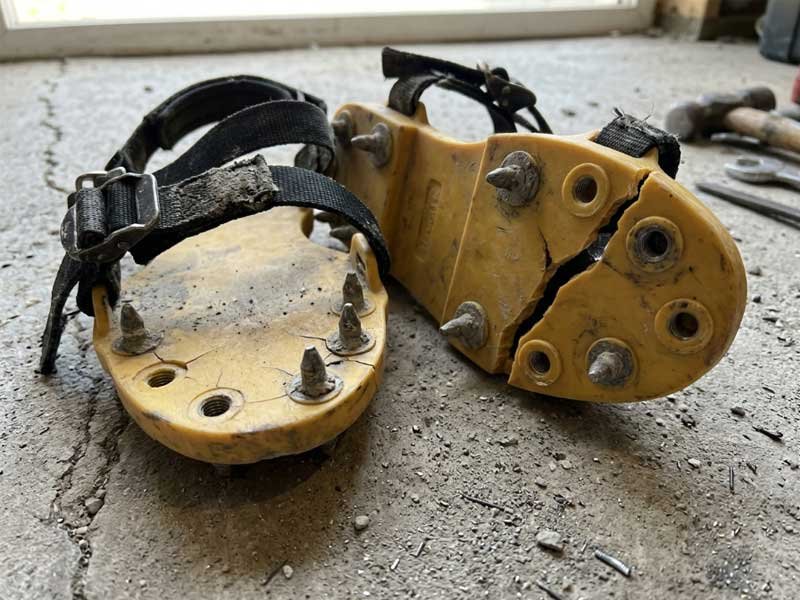
We have collected physical spike samples returned from epoxy flooring job sites over years of production experience. The pattern is consistent and instructive:
- Zinc-plated spikes returned from epoxy applications show patchy coating delamination concentrated at the spike tip — the area with the highest chemical contact — and orange-brown oxidation spreading from those delamination points. This damage occurs within a small number of uses, not after months of wear.
- Stainless steel spikes from the same environments show mechanical wear (tip blunting, minor surface marring from concrete sub-base contact) but no significant corrosion or chemical attack on the spike body.
The visual difference between a zinc-plated spike and a stainless steel spike after equivalent epoxy exposure is not subtle. Buyers who have seen both side by side rarely need further convincing.
The Specific Chemical Attack Mechanism
The amine compounds in epoxy hardeners are alkaline in nature[^4]. Zinc, while resistant to mild acids and neutral moisture, reacts readily with strongly alkaline solutions — a process called dezincification. In a wet epoxy environment:
- The hardener contacts the zinc-plated spike surface during application.
- The alkaline chemistry begins dissolving the zinc coating, initially as a white powdery deposit (zinc hydroxide[^5]), then progressing to bare steel exposure.
- Once steel is exposed in a chemically active environment, iron oxide forms rapidly[^6] — faster than it would in open soil, because the chemical environment is more aggressive than a galvanic soil circuit.
- The corroded spike tip can transfer iron oxide particles onto the wet epoxy surface, creating contamination risk in the coating itself.
That last point is the one epoxy flooring contractors care about most. A corroded spike tip can leave rust transfer marks on a fresh epoxy pour. For contractors working on high-end commercial floors — polished concrete, decorative epoxy, self-leveling screeds — this is a defect that requires remediation. It is a job-site failure, not just a tool-life inconvenience.
In-House Salt Spray Test Results
Our accelerated corrosion testing runs both zinc-plated and stainless steel spike samples under continuous salt spray conditions to generate comparable data. The results:
| Spike Material | Red Rust Onset (Salt Spray) | Condition at 500 Hours |
|---|---|---|
| Zinc-plated steel | 48–96 hours | Significant rust, coating delamination visible |
| Stainless steel (304-grade equivalent)[^7] | No significant onset | No notable corrosion observed |
These are our in-house findings under accelerated conditions — not a formal laboratory certification. Salt spray testing compresses real-world exposure into hours[^8], so direct translation to calendar time requires application-specific judgment. What the data establishes clearly is the order-of-magnitude difference in corrosion resistance between the two materials. This is not a marginal gap buyers can close with maintenance protocols or storage practices.
[^1]: "Corrosion of Galvanized Steel in Soils", https://nvlpubs.nist.gov/nistpubs/jres/049/5/v49.n05.a02.pdf. Electrochemical corrosion of zinc-plated steel in soil occurs through galvanic action where moisture and dissolved salts create conditions for zinc to act as a sacrificial anode, with corrosion rate dependent on soil chemistry, moisture content, and oxygen availability. Evidence role: mechanism; source type: research. Supports: the electrochemical corrosion process of zinc coatings in soil environments. Scope note: specific corrosion rates vary with soil type and environmental conditions
[^2]: "Epoxy", https://en.wikipedia.org/wiki/Epoxy. Two-component epoxy flooring systems commonly employ amine-based curing agents (including aliphatic and cycloaliphatic amines) that react with epoxy resins to form cross-linked polymer networks, with amines being among the most widely used hardener classes for construction applications. Evidence role: general_support; source type: research. Supports: the use of amine-based hardeners in two-component epoxy flooring systems.
[^3]: "ZN CORROSION IN ALKALINE AQUEOUS ELECTROLYTES", https://etd.ohiolink.edu/acprod/odb_etd/ws/send_file/send?accession=case1618400150411797&disposition=inline. Zinc exhibits poor resistance to strongly alkaline environments (pH > 12.5), where alkaline solutions including amines can cause dezincification through dissolution of zinc oxide protective layers, leading to accelerated corrosion of the underlying coating and substrate. Evidence role: mechanism; source type: research. Supports: the chemical reactivity of zinc with alkaline amine compounds. Scope note: reaction rate depends on specific amine type, concentration, and exposure duration
[^4]: "WATER BORNE 2K EPOXY AMINE SYSTEMS FOR CONCRETE ...", https://allnex.com/getmedia/edfad230-c8b1-4ce7-a801-00abdcc078bb/waterborne-2K-epoxy-amine-resins-for-concrete-coatings-Nov-2021.pdf. Amine-based epoxy hardeners are alkaline compounds that typically exhibit pH values between 11 and 14 in concentrated form, as amines function as Lewis bases that accept protons in aqueous environments, creating hydroxide ions. Evidence role: mechanism; source type: research. Supports: the alkaline pH characteristics of amine-based epoxy hardeners.
[^5]: "Reasons for the appearance of white rust on the surface of zinc ...", https://www.electroplatingmachines.com/news/reasons-for-the-appearance-of-white-rust-on-the-surface-of-zinc-electroplated-workpieces.html. In alkaline conditions, zinc corrosion initially produces zinc hydroxide (Zn(OH)₂) as a white precipitate, which can further dissolve at very high pH levels (>13) to form soluble zincate ions, preventing formation of a stable protective layer. Evidence role: mechanism; source type: research. Supports: the formation of zinc hydroxide as a corrosion product in alkaline environments.
[^6]: "Mechanochemical Activation Effect on Technogenic Iron Oxide Reduction ...", https://pmc.ncbi.nlm.nih.gov/articles/PMC8746031/. Steel corrosion in alkaline environments (pH 11-13) can proceed at accelerated rates when protective passive layers are disrupted, as hydroxyl ions facilitate electron transfer in the oxidation reaction, with corrosion rates dependent on oxygen availability, temperature, and specific solution chemistry. Evidence role: mechanism; source type: research. Supports: the mechanism and rate of iron oxidation in alkaline chemical environments. Scope note: actual corrosion rate in epoxy systems depends on hardener chemistry, cure state, and oxygen access
[^7]: "SAE 304 stainless steel", https://en.wikipedia.org/wiki/SAE_304_stainless_steel. AISI 304 stainless steel, an austenitic chromium-nickel alloy containing approximately 18% chromium and 8% nickel, demonstrates good corrosion resistance in moderate atmospheric and chemical environments due to formation of a passive chromium oxide surface layer, though it remains vulnerable to chloride-induced pitting in harsh conditions. Evidence role: general_support; source type: research. Supports: the corrosion resistance properties of 304-grade stainless steel. Scope note: performance varies with specific chemical exposure and may not be optimal for all aggressive environments
[^8]: "Accelerated Test Method for Corrosion Protective Coatings Project", https://ntrs.nasa.gov/api/citations/20150016076/downloads/20150016076.pdf. Salt spray testing (ASTM B117) is an accelerated laboratory corrosion test that exposes specimens to continuous 5% sodium chloride fog at 35°C, creating conditions significantly more aggressive than most natural environments, though direct correlation to real-world service life remains challenging due to differences in exposure patterns, temperature cycling, and environmental complexity. Evidence role: general_support; source type: research. Supports: the accelerated nature of salt spray testing relative to natural exposure. Scope note: correlation factors between salt spray hours and outdoor exposure time vary widely by material, coating, and actual service environment
[^9]: "Development of Alkaline-Activated Self-Leveling Hybrid Mortar Ash ...", https://pmc.ncbi.nlm.nih.gov/articles/PMC6213578/. Cement-based flooring systems including self-leveling compounds and microcements typically exhibit high alkalinity (pH 12-13) due to calcium hydroxide formation during hydration, while polyurethane flooring systems vary in pH depending on formulation but can contain alkaline catalysts or additives. Evidence role: general_support; source type: research. Supports: the alkaline chemical properties of common flooring materials. Scope note: specific pH and reactivity depend on product formulation and cure state