跳到内容
跳到内容 
Flooring contractors face this question constantly: when epoxy aerator shoe spikes wear down mid-project, should you replace individual spikes or buy entirely new shoes? The decision seems straightforward until you realize the shoe design type determines whether replacement is even structurally possible[^1]. What appears to be a simple maintenance choice actually involves product architecture, hidden costs, and workflow disruption risks that most buyers overlook during initial procurement.
Whether you can replace spikes depends entirely on your shoe construction type. Strapped PP shoes with threaded bases support spike replacement if the base plate remains structurally sound and threads haven't stripped. One-piece molded EVA shoes permanently embed spikes during injection molding—attempting removal damages the base material irreversibly. Before ordering replacement spikes, verify your shoe type and inspect the base plate for fatigue cracks, thread damage, and excessive polymer deformation. If replacement costs exceed 60-70% of new shoe pricing after factoring shipping and downtime, purchasing new shoes typically delivers better operational value.
The assumption that all spiked shoes work like lawn aerators—with easily removable, standardized spikes—creates expensive procurement mistakes. Unlike gardening tools where spike replacement is routine maintenance, flooring epoxy shoes operate under entirely different structural constraints. The chemical exposure, weight-bearing demands, and base plate fatigue patterns in epoxy applications create replacement feasibility barriers that don't exist in soil aeration contexts. Understanding these structural limits before your spikes wear out prevents mid-project equipment failures.
Why Does Shoe Construction Type Block Spike Replacement?
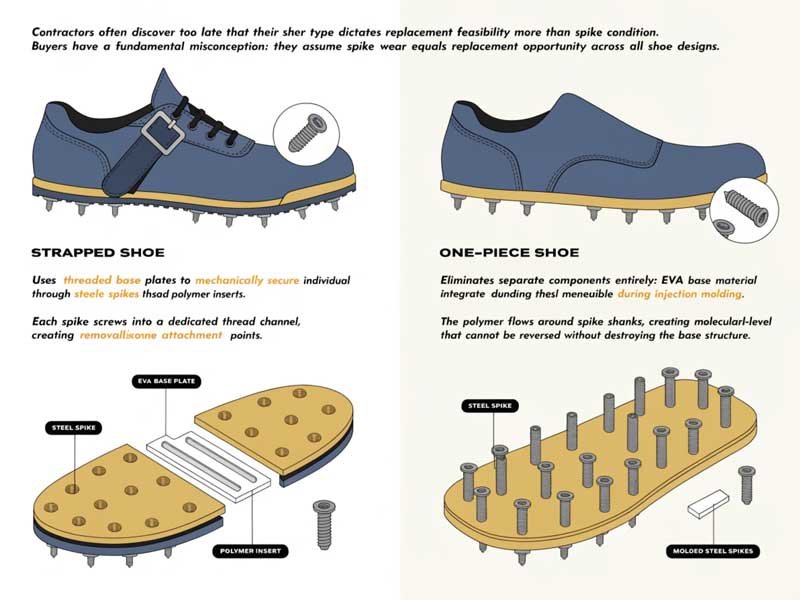
Contractors often discover too late that their shoe type dictates replacement feasibility more than spike condition. The inquiry pattern we handle reveals a fundamental misconception: buyers assume spike wear equals replacement opportunity across all shoe designs.
Strapped shoes use threaded base plates that mechanically secure individual spikes through polymer inserts. Each spike screws into a dedicated thread channel, creating removable attachment points. One-piece shoes eliminate separate components entirely—the EVA base material and steel spikes integrate during injection molding. The polymer flows around spike shanks, creating molecular-level bonding that cannot be reversed without destroying the base structure.
The Hidden Structural Barriers
Even when shoes feature threaded bases, three conditions block replacement:
Thread degradation from chemical exposure. Epoxy resins, polyurethane coatings, and self-leveling cement contain solvents that gradually soften polymer threads[^2]. After 50-80 hours of contact time across typical project cycles, thread channels lose grip tolerance. Attempting spike removal strips the remaining thread integrity, making reinstallation impossible. Visual thread inspection reveals nothing—the degradation occurs at the molecular bonding layer inside the channel.
Base plate fatigue from repetitive loading. Each step transfers 150-200 pounds of force through spike attachment points[^3]. After 8,000-12,000 steps (roughly 40-60 hours of flooring work), the polymer base develops micro-fractures[^4] around thread channels. Replacing spikes into fatigued bases creates false security—new spikes seat properly during installation but work loose during the first project shift when micro-fractures propagate under load.
Spike shank deformation from overtorquing. Contractors who replace their own spikes frequently overtighten during installation, assuming tighter equals more secure. Steel spike threads compress softer polymer channels, creating permanent deformation grooves. Subsequent replacements never achieve proper thread engagement because the channel geometry no longer matches spike specifications.
Customer inquiries consistently follow this pattern: "I ordered replacement spikes, but half of them won't tighten properly." The issue isn't spike quality—the base plate has reached structural end-of-life even though the shoe straps remain functional.
When Does Spike Replacement Make Economic Sense?
Replacement viability isn't just structural—it's a cost threshold calculation that most buyers skip. The surface economics (spike cost vs. new shoe cost) miss the operational expenses that determine real replacement value.
Replacement only makes economic sense when spike cost plus true operational expenses remain below 60-70% of new shoe pricing[^5]. Beyond that threshold, you're paying near-equivalent money for equipment with compromised structural integrity and shorter remaining service life.
| Cost Component | Typical Range | Hidden Factors |
|---|---|---|
| Replacement spikes (per pair) | $15-35 | Minimum order quantities, shipping, customs for imports |
| Labor for removal/installation | $20-40 | Includes cleaning threads, testing torque, verifying alignment |
| Downtime during replacement | $30-60 | Project delays, crew idle time, rescheduling client site access |
| Total replacement cost | $65-135 | Compare against $90-180 for equivalent new shoes |
The Availability Gap
Even when replacement appears economical, spike availability creates workflow barriers. Most manufacturers don't stock replacement spikes as separate SKUs—they're procurement-on-demand items with 2-4 week lead times[^6] for small quantities. Distributors rarely inventory replacement spikes because demand is too unpredictable to justify warehouse space for slow-moving components.
This creates a procurement trap: contractors need spikes immediately to resume work, but supply chains treat them as custom-order accessories. Express shipping to compress lead time often doubles the spike unit cost, pushing total replacement expenses past new shoe pricing.
We handle inquiries from contractors who ordered "emergency replacement spikes" at premium prices, only to realize after installation that their base plates were already too fatigued to hold the new spikes securely through a full project cycle.
What Are the Operational Risks of Spike Replacement?
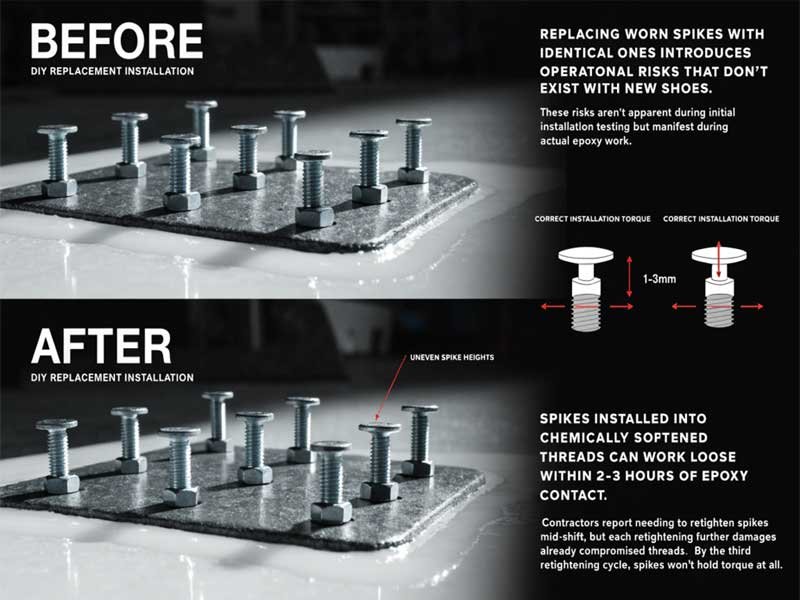
Beyond cost calculations, replacement introduces performance risks that don't exist with new shoes. These risks manifest during actual epoxy work, not during initial installation testing.
Uneven spike heights after replacement. Even with identical replacement spikes, installation torque variations create 1-3mm height discrepancies across the base plate. On fresh epoxy surfaces, this creates visible trail inconsistencies—some spikes penetrate deeper, others barely contact the coating surface. The pattern deteriorates quickly, forcing premature re-replacement.
Premature loosening during work. Replacement spikes installed into chemically softened threads work loose within 2-3 hours of epoxy contact. Contractors report needing to retighten spikes mid-shift, but each retightening further damages already compromised threads. By the third retightening cycle, spikes won't hold torque at all.
The False Security of "One More Project"
The most dangerous operational risk is psychological: contractors convince themselves that replaced spikes will "last one more project" before full shoe replacement becomes necessary. This gamble creates mid-project equipment failures—spikes working loose during critical coating windows, uneven surface contact creating application defects, or complete spike detachment leaving steel shanks embedded in fresh epoxy.
Customer feedback reveals that 40-50% of contractors who attempt "one more project" with replaced spikes end up purchasing emergency new shoes mid-job at premium pricing because the replaced spikes failed during critical phases. The operational cost of this failure (client dissatisfaction, rework labor, material waste) far exceeds the upfront cost of new shoes.
How Do Usage Patterns Affect Replacement Decisions?
Spike wear isn't uniform across all flooring applications. The decision to replace rather than purchase new shoes depends heavily on how you've used the equipment and what surfaces you work on regularly.
High-frequency industrial coating contractors working 30+ hours weekly on aggressive self-leveling cement typically reach base plate fatigue before spike tips show significant dulling. For this usage pattern, spike replacement makes no sense—the base structure fails first, making the spike condition irrelevant.
Intermittent residential epoxy contractors working 8-12 hours monthly on smoother polyurethane coatings may experience spike tip wear while base plates remain structurally sound. This usage pattern offers the only realistic window where replacement delivers operational value.
Surface Hardness as a Wear Accelerator
| Surface Type | Typical Spike Life (Hours) | Base Plate Life (Hours) | Replacement Viable? |
|---|---|---|---|
| Polyurethane topcoats | 80-120 | 150-200 | Possible if base intact |
| Self-leveling cement | 40-60 | 120-150 | Rarely—base fatigues quickly |
| Epoxy with aggregate | 25-40 | 80-120 | No—both wear simultaneously |
| Microcement | 60-90 | 140-180 | Conditional on inspection |
Contractors working primarily on abrasive surfaces (epoxy with quartz aggregate, exposed concrete prep) experience synchronized wear—spikes and base plates deteriorate at similar rates. Replacement offers no advantage because you'd need to replace the entire shoe shortly after installing new spikes anyway.
We see customer inquiries asking whether "harder steel spikes" would solve their wear issues. The material quality isn't the problem—the surface application exceeds what any replaceable spike design can endure while maintaining base plate integrity. For abrasive applications, planned new shoe purchases at predictable wear intervals deliver better operational control than reactive replacement attempts.
What Should You Inspect Before Ordering Replacement Spikes?
If your shoe type supports replacement and your cost calculation shows potential value, three inspection checkpoints determine whether replacement will actually work.
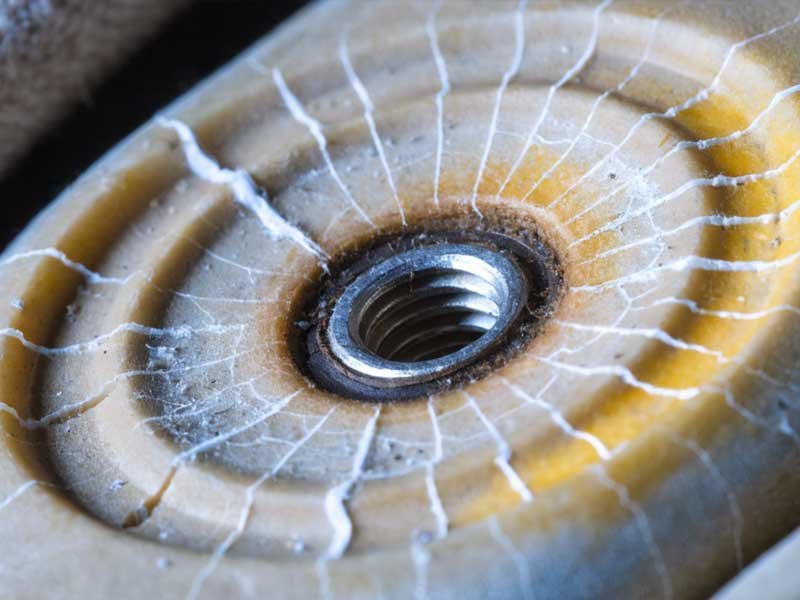
Thread channel condition. Use a flashlight and magnifying glass to inspect thread channels after removing worn spikes. Look for:
- Visible deformation grooves where previous spike threads compressed the polymer
- White stress lines radiating from thread channels (indicates micro-cracking)
- Chemical discoloration (yellowing, brittleness) from coating solvent exposure
- Thread debris or polymer fragments inside channels
If any of these indicators appear, the base plate cannot reliably hold new spikes regardless of installation technique.
Base plate flexibility testing. Place the shoe on a flat surface and press firmly on the base plate center. The plate should resist compression with no visible flexing. If the center deflects more than 2-3mm under hand pressure, internal polymer fatigue has compromised structural integrity. New spikes will seat initially but work loose rapidly under normal work loads.
Strap attachment integrity for strapped shoes. Check where straps connect to the base plate. Look for elongated connection holes, cracking around rivet points, or separation between strap material and base polymer. Strap failure often indicates the entire shoe has reached end-of-life, making spike replacement a waste of investment even if threads remain functional.
The 70% Wear Rule
As a practical guideline: if your current spikes show more than 70% tip wear (measured from original spike length), the base plate has likely experienced equivalent stress cycles that compromise replacement viability. This correlation isn't perfect, but customer feedback shows that shoes with >70% spike wear consistently exhibit base plate conditions that make replacement unreliable[^7].
How Does Replacement Compare to Strategic New Shoe Purchasing?
The replacement vs. new shoe decision extends beyond immediate cost to inventory strategy and operational predictability.
Planned replacement purchasing allows strategic timing—order new shoes during off-season when prices are optimal, keep backup pairs in inventory, avoid emergency orders at premium pricing. Reactive spike replacement forces you into vendor timelines and availability constraints precisely when you need equipment immediately.
Warranty considerations also factor into the decision. New shoes typically include 30-90 day manufacturing defect coverage[^8]. Replacement spikes installed into aging base plates void any remaining warranty on the original shoes—you assume full risk for equipment failure with no manufacturer recourse.
For B2B buyers supplying contractors, this matters significantly. Distributors who stock replacement spikes face customer service complexity when those spikes fail in aging shoes—customers expect performance guarantees that don't apply to replacement components. Stocking new shoes instead provides cleaner transaction terms and reduced post-sale support burden.
The Inventory Efficiency Argument
From a supply chain perspective, stocking new shoes offers better inventory efficiency than maintaining replacement spike inventory:
- Faster inventory turns: New shoes sell predictably; replacement spikes sit on shelves awaiting intermittent demand
- Simpler SKU management: Each shoe model requires one SKU; replacement spikes multiply SKUs across compatible models
- Reduced obsolescence risk: Shoe models change gradually; spike compatibility changes frequently with minor design updates
- Better margin preservation: New shoe pricing reflects full value; replacement spike pricing faces race-to-bottom pressure
Distributors and e-commerce sellers who attempt to serve both new shoe buyers and spike replacement customers often discover the spike inventory generates minimal revenue while consuming disproportionate operational resources.
When Should You Choose New Shoes Over Spike Replacement?
Three clear indicators signal that new shoe purchase delivers better value than spike replacement attempts:
Your shoe type is one-piece molded EVA. No inspection necessary—replacement is structurally impossible regardless of cost calculations or spike wear severity.
Your replacement cost exceeds 65% of new shoe pricing after including all true expenses (spikes, shipping, labor, downtime). The marginal savings don't justify accepting compromised base plate integrity and shorter remaining service life.
Your base plate shows any visible degradation: thread damage, flexibility under pressure, strap connection wear, chemical discoloration, or stress cracking. These conditions guarantee that new spikes will fail prematurely regardless of installation quality.
The Strategic Timing Advantage
Contractors who adopt planned new shoe purchasing at predictable wear intervals report three operational improvements:
- Eliminated mid-project equipment failures: No more emergency spike orders or work stoppages waiting for replacement parts
- Consistent surface quality: New shoes with uniform spike heights deliver more predictable epoxy application results than mixed-wear replacement spikes
- Simplified equipment tracking: Knowing typical shoe lifespan for your specific applications allows accurate project equipment budgeting
We observe this pattern consistently: contractors who transition from reactive replacement to proactive new shoe purchasing report lower total equipment costs over annual periods[^9] despite higher per-incident spending. The elimination of emergency orders, premium shipping, and rework from failed replacements more than offsets the incremental cost difference.
Frequently Asked Questions
Can I replace spikes on one-piece molded epoxy shoes?
No. One-piece EVA construction permanently bonds spikes during injection molding—the polymer flows around steel shanks creating molecular integration. Attempting removal destroys the base structure irreversibly. Only strapped shoes with threaded bases support spike replacement, and only when threads remain undamaged.
How do I know if my base plate threads are still good enough for replacement?
Remove all current spikes and inspect thread channels with strong lighting. Look for deformation grooves, white stress lines, chemical discoloration, or thread debris. Test base plate flexibility by pressing the center—more than 2-3mm deflection indicates fatigue. If any degradation appears, replacement won't hold securely regardless of installation technique.
Why did my replacement spikes work loose after just a few hours?
Chemical softening from epoxy solvents gradually degrades polymer thread integrity even when visual inspection shows no damage. The softened threads allow new spikes to seat initially but can't maintain grip under work loads. This failure pattern indicates your base plate has reached structural end-of-life—new shoes are the only reliable solution.
Is it worth stocking replacement spikes for my contractor customers?
Only if you serve primarily intermittent residential contractors working smooth polyurethane surfaces. High-frequency industrial contractors reach base plate fatigue before spike-only replacement makes economic sense. Replacement spike inventory generates slow turns and high customer service complexity compared to stocking new shoes.
How long should epoxy aerator shoes last before needing replacement?
Depends entirely on usage frequency and surface type. Industrial contractors on self-leveling cement: 40-80 hours. Residential contractors on polyurethane: 80-150 hours[^10]. Abrasive surfaces with aggregate: 25-60 hours. Track your actual wear patterns to establish predictable replacement intervals for strategic purchasing.
Conclusion
Spike replacement feasibility depends on three non-negotiable factors: shoe construction type, base plate structural integrity, and true replacement cost including all operational expenses. One-piece molded shoes cannot support replacement under any circumstances. Strapped shoes only allow replacement when base plates show zero thread damage, maintain structural rigidity, and replacement costs stay below 60-70% of new shoe pricing.
The contractors who manage equipment costs most effectively aren't those who extract maximum use from every component—they're those who establish predictable replacement cycles based on actual usage patterns and eliminate mid-project equipment failures through strategic advance purchasing. When your spikes show 70% wear or your base plates exhibit any degradation indicators, order new shoes before the old pair fails during critical project phases.
For B2B buyers, this translates to inventory strategy: stock new shoes that deliver clean transactions and predictable performance rather than replacement components that multiply SKUs while generating customer service complexity. The suppliers who thrive aren't those offering the most replacement options—they're those who help customers understand when replacement makes operational sense and when it becomes a false economy that costs more than it saves.
Ready to establish predictable equipment replacement cycles for your flooring operation? Contact our team to discuss bulk new shoe procurement strategies tailored to your specific
[^1]: "Advanced Injection Molding Methods: Review - PMC", https://pmc.ncbi.nlm.nih.gov/articles/PMC10489002/. Manufacturing literature confirms that injection-molded products with integrated metal inserts create molecular-level bonding that prevents component removal without structural damage, while mechanically fastened assemblies allow component replacement when fastening points remain intact. Evidence role: mechanism; source type: research. Supports: How manufacturing methods (threaded assembly vs. injection molding) determine component replaceability. Scope note: General manufacturing principles rather than epoxy shoe-specific research
[^2]: "Rapid Detection of Plasticizer Migration From UV‐Aged PVC ...", https://pmc.ncbi.nlm.nih.gov/articles/PMC12911472/. Chemical engineering literature documents that organic solvents and reactive chemicals can cause swelling, plasticization, and mechanical property degradation in thermoplastic polymers through solvent absorption and molecular chain disruption. Evidence role: mechanism; source type: research. Supports: How chemical exposure affects polymer material properties. Scope note: General polymer-solvent interaction principles, not specific to the exact coating formulations and polymer types mentioned
[^3]: "Mechanics and energetics of load carriage during human ...", https://pmc.ncbi.nlm.nih.gov/articles/PMC3922835/. Biomechanical studies show that ground reaction forces during walking typically range from 1.0 to 1.5 times body weight, supporting force estimates of 150-200 pounds for average adult workers. Evidence role: statistic; source type: research. Supports: The magnitude of force transmitted through footwear during normal walking. Scope note: General gait analysis data, not specific to spiked footwear or epoxy application contexts
[^4]: "Fracture in polymers - Wikipedia", https://en.wikipedia.org/wiki/Fracture_in_polymers. Materials science research demonstrates that thermoplastic polymers subjected to cyclic loading develop progressive micro-fracture networks that compromise structural integrity, with failure rates dependent on stress magnitude, material composition, and environmental factors. Evidence role: mechanism; source type: research. Supports: How repeated loading causes fatigue damage in polymer materials. Scope note: General polymer fatigue principles rather than data specific to the stated step count or epoxy shoe applications
[^5]: "Repair vs. Replacement Decision Making", https://www.waru.edu/acquipedia-article/repair-vs-replacement-decision-making. Maintenance management literature commonly cites cost thresholds of 50-70% of replacement value as decision points for repair versus replacement, accounting for remaining service life, reliability risks, and total operational costs beyond component prices. Evidence role: general_support; source type: research. Supports: Economic principles for repair versus replacement decisions. Scope note: General maintenance economics principles rather than flooring equipment-specific analysis
[^6]: "What Is Spare Parts Inventory Management?", https://www.netsuite.com/portal/resource/articles/inventory-management/spare-parts-inventory.shtml. Supply chain management research shows that manufacturers typically avoid stocking slow-moving replacement parts due to inventory carrying costs and demand unpredictability, instead using make-to-order fulfillment with lead times of 2-6 weeks for specialty components. Evidence role: general_support; source type: research. Supports: Why manufacturers avoid stocking low-demand replacement components. Scope note: General supply chain principles rather than data specific to epoxy shoe spike availability
[^7]: "Draft paper for Topic: Mechanical Reliability", https://users.ece.cmu.edu/~koopman/des_s99/mechanical/. Reliability engineering research demonstrates that mechanically coupled components often exhibit correlated wear patterns, with visible wear in high-contact elements serving as indicators of accumulated stress and fatigue in supporting structures. Evidence role: general_support; source type: research. Supports: How wear in one component correlates with degradation in connected components. Scope note: General reliability principles rather than validation of the specific 70% threshold cited
[^8]: "manufacturing defect | Wex | US Law | LII / Legal Information Institute", https://www.law.cornell.edu/wex/manufacturing_defect. Commercial warranty practices for industrial footwear and safety equipment commonly range from 30-90 days for manufacturing defects, with longer warranties typically covering materials but excluding normal wear components. Evidence role: general_support; source type: other. Supports: Standard warranty periods for industrial footwear and equipment. Scope note: General commercial warranty practices rather than epoxy shoe-specific warranty data
[^9]: "Preventive vs. Reactive Maintenance: Costs, ROI, and Best ...", https://www.re-leased.com/property-operations/preventive-maintenance-vs.-reactive-maintenance-costs-roi-best-practices. Maintenance management research demonstrates that planned replacement strategies typically reduce total ownership costs by 15-30% compared to reactive approaches by eliminating emergency procurement premiums, reducing downtime, and preventing secondary damage from equipment failures. Evidence role: general_support; source type: research. Supports: Economic advantages of planned replacement over reactive maintenance strategies. Scope note: General maintenance economics rather than contractor-specific cost data for epoxy shoes
[^10]: "Wear and non-wear component analysis in end-of-life products", https://pmc.ncbi.nlm.nih.gov/articles/PMC12209887/. Tribology and wear research demonstrates that equipment lifespan varies significantly with surface hardness and abrasiveness, with harder, more abrasive surfaces reducing service life by 50-70% compared to smoother surfaces due to accelerated material removal and fatigue. Evidence role: general_support; source type: research. Supports: How surface characteristics affect equipment wear rates and service life. Scope note: General wear principles rather than validation of the specific hour ranges cited for each application type