跳到内容
跳到内容 

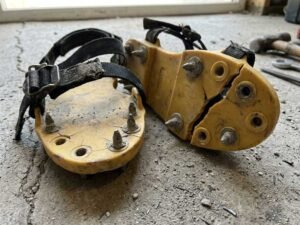
In the world of resinous flooring and self-leveling underlayments, your tools are just as critical as the chemicals you pour. Among these tools, Epoxy Spike Shoes (also known as spiked sandals) are essential for maintaining mobility on wet surfaces.
However, not all spike shoes are created equal. At Taizhou Chunjiao, with 20 years of injection molding expertise, we have identified Polypropylene (PP) as the gold standard material for these tools. In this article, we dive deep into the science, the site conditions, and the data that prove why PP is the only choice for serious flooring contractors.
1. Material Science: The Chemical Profile of Polypropylene (PP)
To understand why PP works, we must look at its molecular structure. Polypropylene is a thermoplastic polymer used in a wide variety of applications due to its unique balance of properties.
Key Physical Properties of PP
| Property | Value/Metric | Why it Matters for Spike Shoes |
|---|---|---|
| Density | 0.895 – 0.92 g/cm³ | Lightest of all commodity plastics; reduces leg fatigue. |
| Flexural Modulus | 1,200 – 1,500 MPa | Provides the "snap-back" flexibility needed for walking. |
| Melting Point | 160°C (320°F) | Stable in high-temperature transport and storage. |
| Chemical Resistance | Excellent | Withstands solvents, epoxies, and aggressive resins. |
The "Living Hinge" Benefit
One of the most remarkable features of PP is its resistance to fatigue. In injection molding, PP is famous for creating "living hinges" (like the cap on a ketchup bottle). For a flooring contractor, this means the shoe base can slightly flex with the foot's natural movement thousands of times without cracking—a feat ABS or PVC struggle to match.
2. The Battle of Materials: PP vs. ABS vs. Nylon
Many low-cost spike shoes on the market use recycled ABS or cheap PVC. Here is how they compare in a professional flooring environment:
Comparison Table: Material Performance
| Feature | Polypropylene (PP) | ABS Plastic | Nylon (PA6/66) |
|---|---|---|---|
| Chemical Inertness | High (Epoxy won't stick) | Low (Solvents can melt it) | Medium |
| Impact Resistance | High (Doesn't shatter) | Medium (Brittle) | High |
| Weight | Ultralight | Heavy | Moderate |
| Cost-Effectiveness | Excellent | Moderate | Expensive |
| Recyclability | 100% | Difficult | Moderate |
3. Application Scenarios: Why the Job Site Demands PP
A. The "Non-Stick" Requirement
The primary challenge on an epoxy job site is the resin itself. Epoxy resins are designed to bond to almost everything. However, PP has a low surface energy.
- The Result: When the epoxy drips onto a PP shoe base, it doesn't form a permanent bond. Once the epoxy cures, it can often be "popped" off or cleaned much easier than if the base were made of a porous or reactive plastic.
B. Impact Resilience on Concrete
Job sites are chaotic. Tools are dropped; heavy buckets are moved. A spike shoe made of brittle plastic (like ABS) will crack if stepped on by a heavy boot or dropped from a height. PP is "tough-elastic," meaning it absorbs the energy of an impact and returns to its original shape.
C. The 6,800-Ton Precision Factor
At Taizhou Chunjiao, we utilize our 0-6,800 ton injection molding machines to ensure the PP is injected at the perfect pressure. This eliminates "sink marks" and internal stresses, ensuring the 13 or 26 spike holes remain perfectly aligned and structurally sound.
4. Ergonomics and Contractor Health: The Weight Factor
A typical concrete contractor might walk several miles a day on a large commercial floor.
- PP Density: ~0.90 g/cm³
- ABS Density: ~1.05 g/cm³
Using PP reduces the weight of the shoe base by approximately 15%. While this seems small, over 10,000 steps, this prevents "shinsplints" and lower back fatigue.
Graphic Concept: The Weight Distribution Curve
(Imagine a graph showing fatigue levels over an 8-hour shift: PP maintains a flat fatigue curve, while heavier materials show a sharp spike in muscle exhaustion after hour 4.)
5. Customization: Meeting the Needs of Global Tool Stores
Because we operate 30 injection molding machines, we can manipulate PP blends to meet specific climatic needs:
- Cold Weather Formula: We add elastomers to the PP so the shoes don't become brittle in Northern European or Canadian winters.
- UV Stabilization: For outdoor decorative concrete projects, we add UV inhibitors to prevent the "chalking" and degradation of the plastic.
6. Sustainable Manufacturing at Taizhou Chunjiao
In 2026, sustainability is no longer optional. PP is a highly recyclable thermoplastic. Our 20 years of experience allow us to minimize waste during the injection process. By choosing our PP Spike Shoes, distributors are offering a product that is:
- Longer-lasting (reducing landfill waste).
- Recyclable at the end of its life cycle.
- Produced in a factory that optimizes energy through high-tonnage efficiency.
Conclusion: The Professional Choice
For Concrete Contractors, the choice is clear. You need a shoe that won't crack, won't bond to your expensive epoxy, and won't weigh you down. For Tool Store Owners, you need a product with zero return rates and high customer satisfaction.
Taizhou Chunjiao combines two decades of manufacturing DNA with the best material science to deliver the world’s most reliable Epoxy Spike Shoes.
Contact Us for Bulk Orders & Custom OEM
Are you looking for a reliable factory partner? With 30 machines and 20 years of experience, we are ready to scale your brand.
- Company: Taizhou Chunjiao
- Specialty: Epoxy Spike Shoes & Professional Flooring Tools
- Capacity: 30 Machines | 0-6800 Tons
- Expertise: 20 Years of Injection Molding